Comparison of the Effectiveness of Functional Communication-Based Intervention Training and Theory of Mind Training on the Sense of Competence in Children with Autism Spectrum Disorder
Keywords:
functional communication-based intervention training, Theory of Mind training, sense of competence, children with autism spectrum disorderAbstract
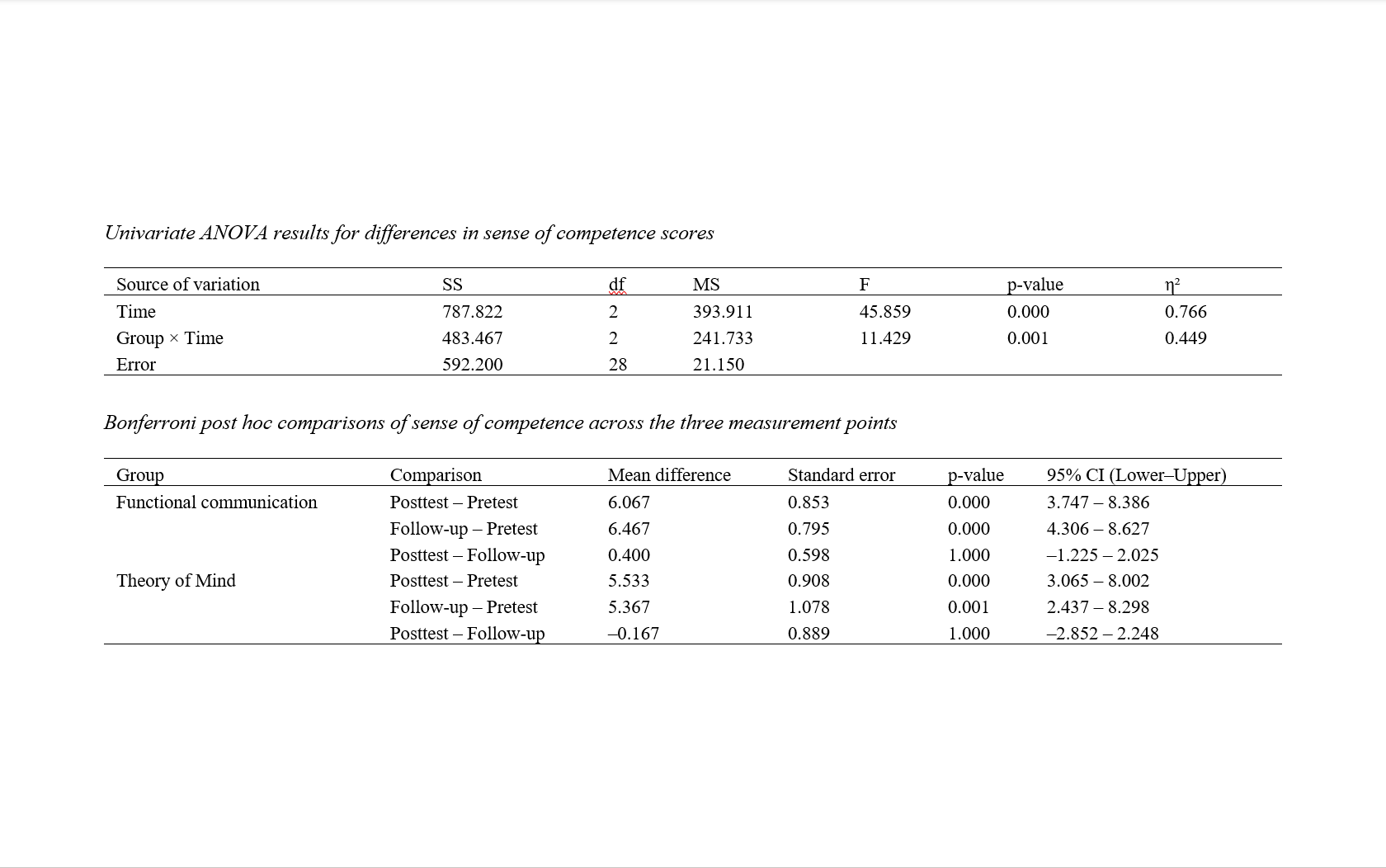
The primary aim of the present study was to compare the effectiveness of functional communication-based intervention training and Theory of Mind training on the sense of competence in children with Autism Spectrum Disorder (ASD). This study was applied in purpose and employed a quasi-experimental design with a pretest–posttest and follow-up measurement across three groups (two experimental groups and one control group). The statistical population consisted of children with ASD and their mothers in Shahin Shahr, Isfahan, in 2024. A total of 45 participants were selected using a non-random sampling method. Data were collected using the Harter Perceived Competence Scale (1985), which includes 27 items. The face and content validity of the instrument were confirmed by experts, and its reliability was calculated using Cronbach’s alpha coefficient (α = .93). Data were analyzed using repeated measures analysis of variance (ANOVA). The results indicated that functional communication-based intervention training and Theory of Mind training were 76.6% successful in distinguishing pretest, posttest, and follow-up scores for the sense of competence in children with ASD in Shahin Shahr, Isfahan. Therefore, the effectiveness of functional communication-based intervention training and Theory of Mind training on the sense of competence in children with ASD differed between the intervention types.
Downloads
References
Abd Ellatif Elsayed, H., & Aleriani, F. (2024). The Relationship Between Distress Tolerance and Life Satisfaction Among Young Adults in Saudi Arabia. Frontiers in psychology, 15, 1447466. https://doi.org/10.3389/fpsyg.2024.1447466
Aghababaei, S. (2017). The Impact of Theory of Mind-Based Training on Theory of Mind and Executive Functions in Preschool Children. Sixth Congress of the Iranian Psychological Association.
Bidar, S., Hashemi Rezini, H., & Abdollahi, M. H. (2023). The Effectiveness of Functional Communication Training in Reducing Challenging, Stereotypical, and Self-Harming Behaviors in Children with Autism Spectrum Disorder. Journal of Psychology and Educational Sciences Studies, 5(50), 196-180. https://www.noormags.ir/view/fa/keyword/%DA%A9%D9%88%D8%AF%DA%A9%D8%A7%D9%86_%D8%B7%DB%8C%D9%81_%D8%A7%D9%88%D8%AA%DB%8C%D8%B3%D9%85
Choupani, H. (2022). Determining the Predictive Role of Parenting Style and Sense of Competence in Behavioral Disorders in Adolescents Aged 14 to 18 Years. A New Approach in Educational Sciences Journal, 4(3), 75-66. https://journal.iocv.ir/article_149204.html
Ferris, E. L., Howard, A. R., Baker, E., Craig, A. R., Roane, H. S., & Sullivan, W. E. (2025). Chaining Differential Reinforcement of Compliance and Functional Communication Training to Treat Challenging Behavior Maintained by Negative Reinforcement. Behavioral Sciences, 15(7), 891. https://doi.org/10.3390/bs15070891
Ghadiri Soormaan Abadi, F., & Soleimani, I. (2021). Designing an Executive Function Training Program and Examining Its Effectiveness on Enhancing Empathy in High-Functioning Children with Autism Spectrum Disorder. Applied Psychological Research, 12(1), 245-227.
Kermpour, M., Hashemi Rezini, H., Gholamali Lavasani, M., & Vakili, S. (2021). The Effectiveness of an Intervention Program Based on Functional Communication Training on Stereotypical, Challenging, and Self-Harming Behaviors in Children with Autism Spectrum Disorder. Quarterly Journal of Child Mental Health, 8(3), 57-47. https://doi.org/10.52547/jcmh.8.3.5
Khoda Bakshi, M., Malekpour, M., & Abadi, A. (2015). The Impact of Theory of Mind-Based Training on Mindreading and Executive Functions in Children with Autism Spectrum Disorders. Iranian Journal of Psychiatry and Clinical Psychology, 21(2), 166-155. https://ijpcp.iums.ac.ir/article-1-2468-fa.html
Lecce, S., Ronchi, L., & Devine, R. T. (2024). The Effect of Peers' Theory of Mind on Children's Own Theory of Mind Development: A Longitudinal Study in Middle Childhood and Early Adolescence. Developmental Psychology. https://doi.org/10.1037/dev0001758
Neely, L., Carnett, A., Cantrell, K., Stegemann, S., & Svoboda, M. (2022). Functional Communication Training for Toddlers At-Risk for Autism with Early Problem Behavior. Advances in Neurodevelopmental Disorders, 6, 537-548. https://doi.org/10.1007/s41252-022-00306-1
Peng, Q., Dong, Y., Jin, J., Ao, H., Zhang, C., & Ma, Y. (2025). The Effectiveness of Mindfulness-Based Interventions for Children with Autism and Their Parents: A Systematic Review and Meta-Analysis. Frontiers in psychology, 16, 1526001. https://doi.org/10.3389/fpsyg.2025.1526001
Rezaei, S., Eftakhari Saadi, Z., Hafezi, F., & Heydari, A. (2019). Developing a Timely Intervention Program Based on Executive Functions and Examining Its Effectiveness on Improving the Neurocognitive Performance of Educable Mentally Disabled Children. Journal of the Faculty of Medicine, Mashhad University of Medical Sciences, 62(1), 212-199. https://mjms.mums.ac.ir/article_14315.html
Talantseva, O. I., Romanova, R. S., Shurdova, E. M., Dolgorukova, T. A., Sologub, P. S., Titova, O. S., Kleeva, D. F., & Grigorenko, E. L. (2023). The Global Prevalence of Autism Spectrum Disorder: A Three-Level Meta-Analysis. Frontiers in Psychiatry, 14, 1071181. https://doi.org/10.3389/fpsyt.2023.1071181
Tayebli, M., Alizadeh, H., Rezaei, S., Dastjordi Kazemi, M., & Asgari, M. (2024). Designing Educational Games Based on Theory of Mind and Examining Their Effectiveness on Enhancing Social Competence and Self-Esteem in Children with Mild Intellectual Disabilities. Journal of Cognitive Psychology and Psychiatry, 11(4), 170-185. http://shenakht.muk.ac.ir/article-1-2024-fa.html
Wu, Y., Liu, X., & Zhang, S. (2024). Training Deaf College Students to Improve Their Theory of Mind: Based on a Two-Component Model. Frontiers in psychology, 15, 1361878. https://doi.org/10.3389/fpsyg.2024.1361878
Zhu, Y., Zhou, X., Yin, X., Qiu, L., Sun, N., An, R., & Gong, Y. (2022). Parenting Sense of Competence and Its Predictors Among Primiparous Women: A Longitudinal Study in China. BMC Pregnancy and Childbirth, 22(1), 548. https://doi.org/10.1186/s12884-022-04881-y

Downloads
Additional Files
Published
Submitted
Revised
Accepted
Issue
Section
License
Copyright (c) 2025 Rezvan Beigi (Author); Mohammad Kazem Fakhri (Corresponding Author); Shaban Haydari (Author)

This work is licensed under a Creative Commons Attribution-NonCommercial 4.0 International License.