The Effectiveness of Executive Function Training on the Dimensions of Metacognition in Students with Learning Disabilities
DOI:
https://doi.org/10.61838/kman.prien.3.3.7Keywords:
Executive function training, Metacognition, Learning disabilities, Cognitive regulation, Self-awarenessAbstract
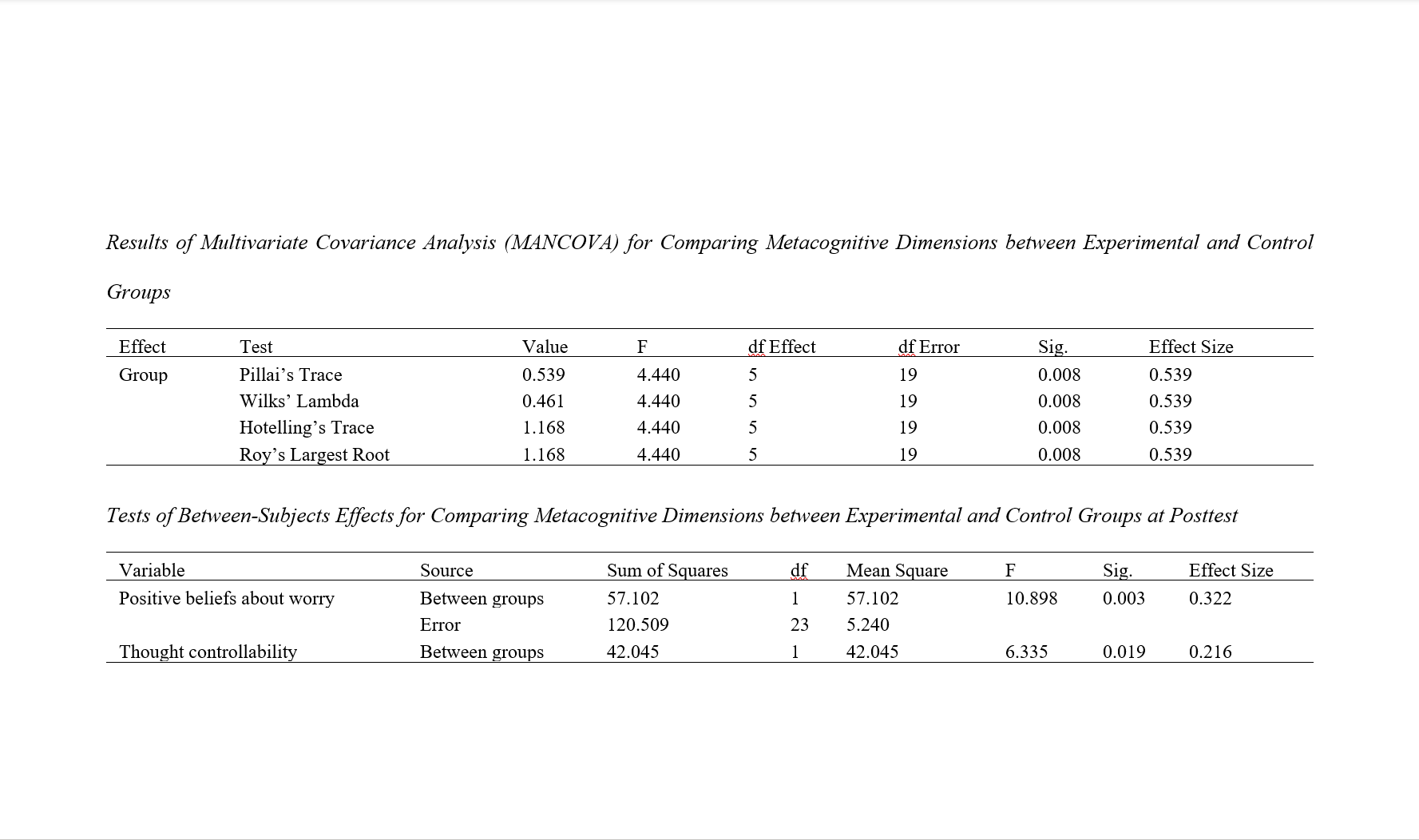
This study aimed to investigate the effectiveness of executive function training on improving the dimensions of metacognition—positive beliefs about worry, thought controllability, cognitive uncertainty, need to control thoughts, and cognitive self-consciousness—among elementary students with specific learning disabilities in Bandar Abbas. This quantitative study employed a semi-experimental pretest–posttest design with a control group and a two-month follow-up. The statistical population included all elementary school students with learning disabilities in Bandar Abbas during the 2024–2025 academic year. Thirty students from the fifth and sixth grades were purposefully selected and randomly assigned to experimental and control groups (15 students each). The experimental group received ten sessions of executive function training, focusing on planning, self-monitoring, reflection, and cognitive flexibility, while the control group received no intervention. Data were collected using the Wells Metacognition Questionnaire (MCQ-30) and analyzed using descriptive statistics and multivariate covariance analysis (MANCOVA) with SPSS version 22. The results of MANCOVA showed a significant multivariate effect of the group on the combined metacognitive variables (Wilks’ Lambda = 0.461, F = 4.440, p = 0.008, η² = 0.539). Univariate analyses indicated significant group differences in all metacognitive subscales at the posttest stage: positive beliefs about worry (F = 10.898, p = 0.003, η² = 0.322), thought controllability (F = 6.335, p = 0.019, η² = 0.216), cognitive uncertainty (F = 4.987, p = 0.036, η² = 0.178), need to control thoughts (F = 9.688, p = 0.005, η² = 0.296), and cognitive self-consciousness (F = 5.892, p = 0.023, η² = 0.204). Executive function training significantly enhanced metacognitive abilities in students with learning disabilities, improving their self-regulation, cognitive control, and reflective awareness. Integrating such interventions into educational programs may promote cognitive flexibility and academic adaptation in children with learning challenges.
Downloads
References
Babaei, F., Abdollahi, M., Amini Gilvani, M., & Masoomifard, M. (2024). The Mediating Role of Theory of Mind in the Relationship Between Executive Functions and Marital Burnout Using Structural Equation Modeling and Artificial Neural Networks (SEM-ANN). International Journal of Education and Cognitive Sciences, 5(4), 62-73. https://doi.org/10.61838/kman.ijecs.5.4.7
Baniasadi, T. (2024). Comparison of Executive Function and Working Memory among Children with High and Low Levels of Physical Activity. International Journal of Education and Cognitive Sciences, 5(3), 9-15. https://doi.org/10.61838/kman.ijeas.5.3.2
Barua, N., Singh, S., Agarwal, V., Arya, A., & Barua, N. (2020). Executive Functions, Metacognitive Beliefs, and Thought Control Strategies in Adolescents with Obsessive-Compulsive Disorder. IJRAR, 7, 672-680. https://www.ijrar.org/papers/IJRAR2001512.pdf
Cécillon, F. X., Mermillod, M., Leys, C., Lachaux, J. P., Le Vigouroux, S., & Shankland, R. (2024). Trait Anxiety, Emotion Regulation, and Metacognitive Beliefs: An Observational Study Incorporating Separate Network and Correlation Analyses to Examine Associations with Executive Functions and Academic Achievement. Children, 11(1), 123. https://doi.org/10.3390/children11010123
Davoodi, M., Malihi Alzakerini, S., Nikpajouh, A., & Sabet, M. (2023). Comparing the Effectiveness of Metacognitive Skills Training with Executive Function Skills Training on Biological Markers in Patients with Coronary Artery Disease. Journal of Assessment and Research in Applied Counseling (JARAC), 5(5), 45-52. https://doi.org/10.61838/kman.jarac.5.5.6
Drigas, A., & Karyotaki, M. (2019). Executive Functioning and Problem Solving: A Bidirectional Relation. International Journal of Engineering Pedagogy (Ijep), 9(3), pp. 76-98. https://doi.org/10.3991/ijep.v9i3.10186
Esmaeilian Anvar, S., Ghorban Jahromi, R., Rafieipour, A., & Sabet, M. (2024). The effectiveness of a lateral dominance enhancement training package on executive functions and visual perception in children with specific learning disorder. Psychology of Exceptional Individuals, 14(53), 43-75. https://jpe.atu.ac.ir/article_15574.html?lang=en
Fernandez-Duque, D., Baird, J. A., & Posner, M. I. (2000). Executive Attention and Metacognitive Regulation. Consciousness and Cognition, 9(2), 288-307. https://doi.org/10.1006/ccog.2000.0447
Haugen, I., Ueland, T., Stubberud, J., Brunborg, C., Wykes, T., Øie, M. G., & Haug, E. (2023). Moderators of metacognitive strategy training for executive functioning in early schizophrenia and psychosis risk. Schizophrenia Research: Cognition, 31, 100275. https://www.sciencedirect.com/science/article/pii/S2215001322000403
Khan, K., & Lal, P. S. (2023). Executive Dysfunctions in Different Learning Disabilities: A Review. Journal of Indian Association for Child and Adolescent Mental Health, 19(2), 126-142. https://doi.org/10.1177/09731342231179614
Kokabi Rahman, E., Taghvaei, D., & Pirani, Z. (2023). The Effectiveness of Cognitive and Metacognitive Strategies Teaching on Academic Motivation, Academic Engagement and Quality of Life in School of Students with Specific Learning Disorder in Hamadan City. Sociology of Education, 8(2), 257-266. https://doi.org/10.22034/ijes.2023.707262
Kraft, B., Jonassen, R., Stiles, T. C., & Landrø, N. I. (2017). Dysfunctional metacognitive beliefs are associated with decreased executive control. Frontiers in psychology, 8(593). https://doi.org/10.3389/fpsyg.2017.00593
Lievore, R. (2024). Let’s Face It! The Role of Social Anxiety and Executive Functions in Recognizing Others’ Emotions From Faces: Evidence From Autism and Specific Learning Disorders. Development and Psychopathology, 1-13. https://doi.org/10.1017/s0954579424000038
Roebers, C. M. (2017). Executive function and metacognition: Towards a unifying framework of cognitive self-regulation. Developmental Review, 45, 31-51. https://doi.org/10.1016/j.dr.2017.04.001
Saleh Al Rasheed, L., & Hanafy, A. A. M. (2023). Effects of brain-based instruction on executive function and habits of mind among young children at-risk for learning disabilities. Applied Neuropsychology, 2, 1-8. https://doi.org/10.1080/21622965.2022.2161904
Tamm, L., Nakonezny, P. A., & Hughes, C. W. (2012). An Open Trial of a Metacognitive Executive Function Training for Young Children With ADHD. Journal of Attention Disorders, 18(6), 551-559. https://doi.org/10.1177/1087054712445782
Zhou, M., Lam, K. K. L., & Zhang, Y. (2022). Metacognition and Academic Procrastination: A Meta-Analytical Examination. Journal of Rational-Emotive & Cognitive-Behavior Therapy, 40(2), 334-368. https://doi.org/10.1007/s10942-021-00415-1
Downloads
Additional Files
Publication Timeline
- Submitted
- Revised
- Accepted