Attachment Patterns in Children with Fetal Alcohol Spectrum Disorders
DOI:
https://doi.org/10.61838/kman.prien.2.3.2Keywords:
Fetal Alcohol, Spectrum Disorders (FASD), attachment patterns, caregiving, child-caregiver relationship, therapeutic interventions, neurodevelopmental impairmentsAbstract
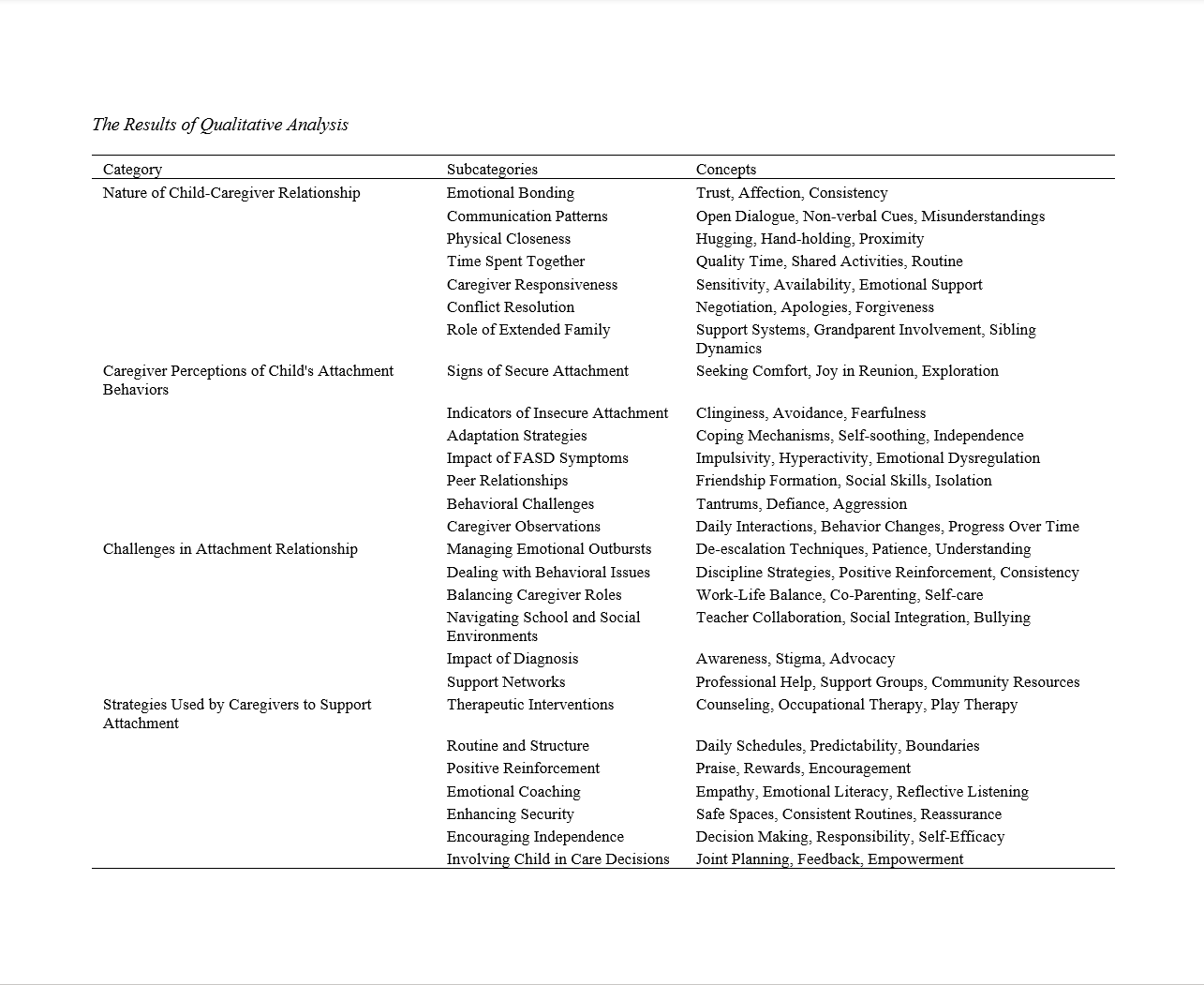
This study aimed to explore the attachment patterns in children diagnosed with Fetal Alcohol Spectrum Disorders (FASD) by examining the experiences and perceptions of their primary caregivers. A qualitative research design was employed, utilizing semi-structured interviews with 14 primary caregivers of children diagnosed with FASD. Participants were recruited from specialized clinics and support groups. Data were collected through in-depth interviews, focusing on topics such as the nature of the child-caregiver relationship, caregiver perceptions of the child's attachment behaviors, challenges in the attachment relationship, and strategies used to support attachment. The interviews were transcribed and analyzed thematically, with theoretical saturation achieved when no new themes emerged. Four main themes emerged from the analysis: the nature of the child-caregiver relationship, caregiver perceptions of the child's attachment behaviors, challenges in the attachment relationship, and strategies used by caregivers to support attachment. Caregivers emphasized the importance of emotional bonding, effective communication, physical closeness, and consistent caregiving in fostering secure attachment. They reported a range of attachment behaviors, including both secure and insecure patterns, influenced by the neurodevelopmental impairments associated with FASD. Key challenges included managing emotional outbursts, behavioral issues, and balancing caregiving roles. Caregivers employed various strategies such as therapeutic interventions, establishing routines, positive reinforcement, and emotional coaching to support attachment. The study provides a comprehensive understanding of the attachment patterns in children with FASD, highlighting the critical role of responsive caregiving and the adaptive strategies used by caregivers. The findings underscore the need for targeted interventions and comprehensive support systems to enhance attachment and promote the developmental well-being of children with FASD. Further research is needed to explore the long-term impact of these attachment patterns and the effectiveness of specific interventions.
Downloads
References
Almeida-Toledano, L., Andreu-Férnández, V., Aras-López, R., Garcı́a-Algar, Ó., Martínez, L., & Gómez-Roig, M. D. (2021).Epigallocatechin Gallate Ameliorates the Effects of Prenatal Alcohol Exposure in a Fetal Alcohol Spectrum Disorder-Like Mouse Model. International Journal of Molecular Sciences, 22(2), 715.https://doi.org/10.3390/ijms22020715
Altounian, M., Bellon, A., & Mann, F. (2023). Neuronal miR-17-5p Contributes to Interhemispheric Cortical Connectivity Defects Induced by Prenatal Alcohol Exposure.https://doi.org/10.1101/2022.12.30.522325
Arendt, R., & Farkas, K. J. (2007). Maternal Alcohol Abuse and Fetal Alcohol Spectrum Disorder. Alcoholism Treatment Quarterly, 25(3), 3-20.https://doi.org/10.1300/j020v25n03_02
Arevalo, E., Shanmugasundararaj, S., Wilkemeyer, M. F., Dou, X., Chen, S., Charness, M. E., & Miller, K. W. (2008). An Alcohol Binding Site on the Neural Cell Adhesion Molecule L1. Proceedings of the National Academy of Sciences, 105(1),371-375.https://doi.org/10.1073/pnas.0707815105
Avery, M., Droste, N., Giorgi, C., Ferguson, A., Martino, F., & Coomber, K. (2016). Mechanisms of Influence: Alcohol Industry Submissions to the Inquiry Into Fetal Alcohol Spectrum Disorders. Drug and Alcohol Review, 35(6), 665-672.https://doi.org/10.1111/dar.12399
Berrigan, P., Andrew, G., Reynolds, J. N., & Zwicker, J. (2019). The Cost-Effectiveness of Screening Tools Used in the Diagnosis of Fetal Alcohol Spectrum Disorder: A Modeled Analysis.https://doi.org/10.21203/rs.2.11956/v1
Brown, J., Rodger, S., George, N., Arnault, D. S., & Sintzel, J. (2008). Rewards of Parenting a Child With a Fetal Alcohol Spectrum Disorder. The Open Family Studies Journal, 1(1),23-30.https://doi.org/10.2174/1874922400801010023
Candelaria‐Cook, F. T., Flynn, L., Hill, D. E., & Stephen, J. M. (2020). Altered Resting‐State Neural Oscillations and Spectral Power in Children With Fetal Alcohol Spectrum Disorder. Alcoholism Clinical and Experimental Research, 45(1), 117-130.https://doi.org/10.1111/acer.14502
Carito, V., Parlapiano, G., Rasio, D., Paparella, R., Paolucci, V., Ferraguti, G., Greco, A., Ralli, M., Pichini, S., Fiore, M., Coriale, G., Ceccanti, M., & Tarani, L. (2018). Fetal Alcohol Spectrum Disorders in Pediatrics. FASD and the Pediatrician. Biomedical Reviews, 29(0), 27.https://doi.org/10.14748/bmr.v29.5847
Colom, J., Segura-Garcia, L., Bastons-Compta, A., Astals, M., Andreu-Fernández, V., Barcons, N., Vidal, R., Ibar, A. I.,Fumado, V., Gómez, N., Russiñol, A., & Garcia-Algar, O. (2021). Prevalence of Fetal Alcohol Spectrum Disorders (FASD) Among Children Adopted From Eastern European Countries: Russia and Ukraine. International journal of environmental research and public health, 18(4), 1388.https://doi.org/10.3390/ijerph18041388
Darbinian, N., & Selzer, M. E. (2022). Oligodendrocyte Pathology in Fetal Alcohol Spectrum Disorders. Neural Regeneration Research, 17(3), 497. https://doi.org/10.4103/1673-5374.314294
Floyd, R. L., O'Connor, M. J., Sokol, R. J., Bertrand, J., & Cordero, J. F. (2005). Recognition and Prevention of Fetal Alcohol Syndrome. Obstetrics and Gynecology, 106(5, Part 1), 1059-1064.https://doi.org/10.1097/01.aog.0000181822.91205.6f
Hanson, J. D., Winberg, A., & Elliott, A. J. (2011). Development of a Media Campaign on Fetal Alcohol Spectrum Disorders for Northern Plains American Indian Communities. Health Promotion Practice, 13(6), 842-847.https://doi.org/10.1177/1524839911404232
Leruste, S. (2024). Obstacles and Facilitators to Preventing Fetal Alcohol Spectrum Disorder: A Qualitative Study With General Practitioners. Frontiers in Medicine, 11.https://doi.org/10.3389/fmed.2024.1280349
Mandal, C. h., Park, K. S., Jung, K. H., & Chai, Y. G. (2015). Ethanol-Related Alterations in Gene Expression Patterns in the Developing Murine Hippocampus. Acta Biochimica Et Biophysica Sinica, 47(8), 581-587.https://doi.org/10.1093/abbs/gmv050
Manriquez, M., Starer, J., Parisi, V., Tracy, E. E., McFadden, T., & Penney, L. (2019). Fetal Alcohol Spectrum Disorder Prevention Program: SBIRT's Role in Averting Fetal Alcohol Spectrum Disorders. Birth Defects Research, 111(12), 829-834.https://doi.org/10.1002/bdr2.1516
Montag, A. C., Jones, K. L., Campo, M. d., Akshoomoff, N., Coles, C. D., Kable, J. A., Hernandez, J. G., & Chambers, C. D.(2022). Fetal Alcohol Spectrum Disorders and Access to Regional Center Services in San Diego County. Alcoholism Clinical and Experimental Research, 46(10), 1857-1864.https://doi.org/10.1111/acer.14934
Mukherjee, R., Cook, P. A., Fleming, K. M., & Norgate, S. (2016). What Can Be Done to Lessen Morbidity Associated With Fetal Alcohol Spectrum Disorders? Archives of Disease in Childhood, 102(5), 463-467.https://doi.org/10.1136/archdischild-2016-310822
Patel, T., Narula, S., Naderzad, E., Early, D., & Nandhagopal, T. (2022). Fetal Alcohol Spectrum Disorder in a Newborn. Cureus.https://doi.org/10.7759/cureus.28836
Phillips, N. L., Zimmet, M., Phu, A., Rattan, M., Zurynski, Y., & Elliott, E. J. (2022). Impact of Fetal Alcohol Spectrum Disorder on Families. Archives of Disease in Childhood, 107(8), 755-757.https://doi.org/10.1136/archdischild-2021-322703
Reid, N. (2023). Renewed Call to Improve Approaches for Developing Fetal Alcohol Spectrum Disorder Diagnostic Criteria: Commentary on “Comparison of Three Systems for the Diagnosis of Fetal Alcohol Spectrum Disorders in a Community Sample”. Alcohol: Clinical and Experimental Research, 47(5), 840-842.https://doi.org/10.1111/acer.15050
Riley, E. P., Infante, M. A., & Warren, K. S. (2011). Fetal Alcohol Spectrum Disorders: An Overview. Neuropsychology Review,21(2), 73-80.https://doi.org/10.1007/s11065-011-9166-x
Rutman, D., & Bibber, M. V. (2010). Parenting With Fetal Alcohol Spectrum Disorder. International journal of mental health and addiction, 8(2), 351-361. https://doi.org/10.1007/s11469-009-9264-7
Downloads
Additional Files
Publication Timeline
Issue
Section
License

This work is licensed under a Creative Commons Attribution-NonCommercial 4.0 International License.