The Mediating Role of Self-Efficacy and Social Support in the Effect of Psychological Hardiness on the Quality of Life of Physically Disabled People
DOI:
https://doi.org/10.61838/kman.prien.5360Keywords:
Self-Efficacy, Social Support, Psychological Hardiness, Quality of Life, Physically DisabledAbstract
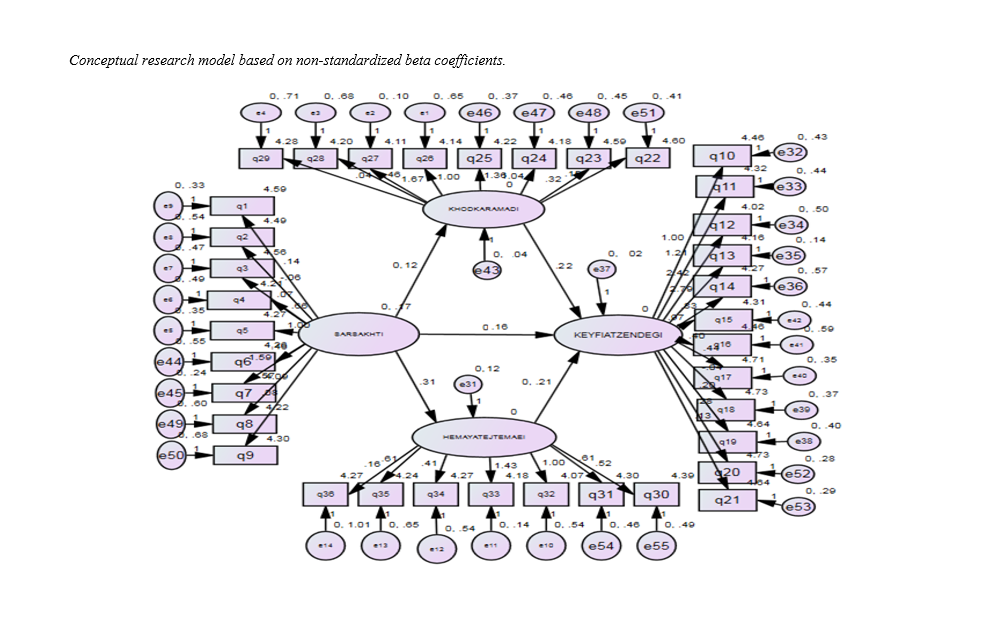
The present study aimed to investigate the structural relationship between psychological hardiness and quality of life in physically and motor disabled individuals, with the mediating roles of self-efficacy and perceived social support. This applied, cross-sectional, correlational study was conducted using structural equation modeling among physically and motor disabled individuals in Mazandaran Province, Iran. The statistical population consisted of approximately 26,000 individuals registered in the provincial Welfare Organization, from whom 424 participants aged 14–40 years (277 males and 147 females) were selected through two-stage cluster sampling from Sari, Amol, Behshahr, and Chalus cities. Data were collected using the Ahvaz Psychological Hardiness Questionnaire, the SF-36 Quality of Life Questionnaire, Sherer’s Self-Efficacy Scale, and the Sherbourne and Stewart Social Support Scale. The instruments demonstrated acceptable reliability coefficients ranging from 0.86 to 0.91. Descriptive statistics, Pearson correlation coefficients, Sobel tests, and structural equation modeling were performed using SPSS-22, AMOS, and SmartPLS software at a 95% confidence level. The results demonstrated significant positive relationships among all study variables. Psychological hardiness had significant direct effects on self-efficacy (β=0.10, T=2.09, P<0.01), perceived social support (β=0.27, T=2.53, P<0.01), and quality of life (β=0.10, T=2.94, P<0.01). Self-efficacy also showed a significant direct effect on quality of life (β=0.11, T=2.55, P<0.01), while perceived social support significantly predicted quality of life (β=0.18, T=2.71, P<0.01). Pearson correlation analysis revealed the strongest correlation between psychological hardiness and quality of life (r=0.853, P<0.01). Sobel test findings confirmed the mediating role of self-efficacy (β=0.04, Z=2.57, P=0.01) and perceived social support (β=0.03, Z=2.74, P=0.001) in the relationship between psychological hardiness and quality of life. The proposed model explained 18% of the variance in self-efficacy, 14% in social support, and 11% in quality of life. The findings indicate that psychological hardiness contributes significantly to improving the quality of life of physically disabled individuals both directly and indirectly through enhancing self-efficacy and perceived social support. Strengthening resilience-related psychological characteristics, promoting self-efficacy beliefs, and expanding supportive social networks may improve mental health and overall life satisfaction among individuals with physical and motor disabilities. Therefore, psychological interventions and rehabilitation programs focused on resilience enhancement and social support development are recommended for improving the well-being and quality of life of this population.
Downloads
References
Albakova, Z. A. M., Ezhov, K. S., Umerkaeva, S. S., Antonova, M. A., Kidinov, A. V., Aigumova, Z. I., & Klepach, Y. V. (2020). Social and Psychological Features of Hardiness in Personality of Students of Higher Education Institutions. Journal of Educational Psychology - Propositos y Representaciones, 8. https://doi.org/10.20511/pyr2020.v8nSPE2.660
Awick, E. A., Ehlers, D. K., Aguinaga, S., Daugherty, A. M., Kramer, A. F., & McAuley, E. (2017). Effects of a randomized exercise trial on physical activity, psychological distress and quality of life in older adults. General Hospital Psychiatry, 49, 44-50. https://doi.org/10.1016/j.genhosppsych.2017.06.005
Azadi, R., Ahadi, H., & Hatami, H. R. (2020). The Relationship of Psychological Wellbeing and Psychological Hardiness With the Mediating Role of Social Support in Women With Breast Cancer. Internal Medicine Today, 27(1), 18-33. https://doi.org/10.32598/hms.27.1.3093.2
Bahrami, M., Mohamadirizi, S., & Mohamadirizi, S. (2018). Hardiness and optimism in women with breast cancer. Iranian Journal of Nursing and Midwifery Research, 23(2), 105. https://doi.org/10.4103/ijnmr.IJNMR_200_16
Bellin, M. H., Osteen, P., Kub, J., Bollinger, M. E., Tsoukleris, M., Chaikind, L., & Butz, A. M. (2015). Stress and quality of life in urban caregivers of children with poorly controlled asthma: A longitudinal analysis. Journal of Pediatric Health Care, 29(6), 536-546. https://doi.org/10.1016/j.pedhc.2015.04.018
Boyraz, G., & Sayger, T. V. (2011). Psychological well-being among fathers of children with and without disabilities: The role of family cohesion, adaptability, and paternal self-efficacy. American Journal of Men's Health, 5(4), 286-296. https://doi.org/10.1177/1557988310372538
Cattik, M., & Aksoy, V. (2018). An examination of the relations among social support, self-efficacy, and life satisfaction in parents of children with developmental disabilities. Education and Science, 43(195), 65-77. https://doi.org/10.15390/EB.2018.7246
Davarmnesh, A., & Barati Sade, F. (2007). Introduction to Rehabilitation of the Disabled. Growth.
Dermani, H. R. K., Haghighatian, M., & Khalili, E. R. (2019). Explaining the Mediating Role of Social Happiness and Quality of Life in the Impact of Social Support on the Social Health of Physically Disabled People in Tehran. Journal of Social Work, 9(4), 33-40.
Dube, M. O., Roos, M., Desmeules, F., & Roy, J. S. (2023). Reliability, validity, and responsiveness of a Canadian French adaptation of the Pain Self-Efficacy Questionnaire (PSEQ). Disability and Rehabilitation, 45(16), 2675-2682. https://doi.org/10.1080/09638288.2022.2102254
Farahbakhsh Beh, S., Mehrinejad, A., & Moazedian, A. (2019). Structural Model of Quality of Life in Patients with Breast Cancer: The Role of Psychological Hardiness, Religious Orientation, Perceived Social Protection and Self-Efficacy with Mediation of Resilience and Death Anxiety. Shefaye Khatam, 8(1), 86-98. https://doi.org/10.29252/shefa.8.1.86
Farahmand, M., Jiriai, R., & Salehzadeh, M. (2019). The role of perceived social support and quality of life in predicting the body image of physical disabilities in Yazd. Quarterly Journal of Social Work, 8(3), 41-48.
Gelkop, N., & Engel-Yeger, B. (2025). Participation, environment, and quality of life in children with cerebral palsy and physical disabilities. Developmental Medicine & Child Neurology. https://doi.org/10.1111/dmcn.70079
Ghafari, G., Karimi, A., & Nozari, H. (2013). Trend study of quality of life in Iran. Quarterly of Social Studies and Research in Iran, 1(3), 107-134.
Gholami Jam, F., Takaffoli, M., Kamali, M., Eslamian, A., Alavi, Z., & Ali Nia, V. (2018). Systematic Review on Social Support of Parent/Parents of Disabled Children. Archives of Rehabilitation, 19(2), 126-141. https://doi.org/10.32598/rj.19.2.126
Haugland, T. (2013). Stress, social support, general self-efficacy and health related quality of life in patients with neuroendocrine tumors: A cross-sectional and pilot study
Honey, A., Emerson, E., Llewellyn, G., & Kariuki, M. (2010). Mental health and disability. In International Encyclopedia of Rehabilitation (pp. 20-25).
Hosseini, Z., Pourjalil, F., & Homayuni, A. (2024). Investigating the correlation between health-promoting lifestyle and health hardiness with quality of life. BMC psychology, 12(1), 511. https://doi.org/10.1186/s40359-024-02012-0
Iravani, M., Riahi, L., Abdi, K., & Tabibi, S. J. (2021). A comparative study of the rehabilitation services systems for people with disabilities. Archives of Rehabilitation, 21(4), 544-563. https://doi.org/10.32598/RJ.21.4.3225.1
Kiamarci, A. (1998). Creating and validating a scale for assessing psychological hardiness. Journal of Psychology, 2(3), 271-284.
Kim, Y. J., Lee, H. M., & Lee, S. Y. (2016). The Relationship between Stress, Psychological Hardiness, Social Support and Quality of Life in Insomniacs. Korean Journal of Stress Research, 24(3), 137-150. https://doi.org/10.17547/kjsr.2016.24.3.137
Kuprieieva, O., Traverse, T., Serdiuk, L., Chykhantsova, O., & Shamych, O. (2020). Fundamental assumptions as predictors of psychological hardiness of students with disabilities. Social welfare: interdisciplinary approach, 1(10), 96-105. https://doi.org/10.21277/sw.v1i10.566
Li, J., Lin, Y., Li, X., Cui, Y., Wang, Q., Ouyang, A., & Hua, Y. (2025). Mediating effects of health literacy between self-efficacy and quality of life in patients with type 2 diabetes mellitus. Diabetes, Metabolic Syndrome and Obesity, 3625-3637. https://doi.org/10.2147/DMSO.S546698
Martinez-Marti, M. L., & Ruch, W. (2017). Character strengths predict resilience over and above positive affect, self-efficacy, optimism, social support, self-esteem, and life satisfaction. The Journal of Positive Psychology, 12(2), 110-119. https://doi.org/10.1080/17439760.2016.1163403
Mehrabi, A. (2017). Statistical Yearbook.
Miller, M. J., Cook, P. F., Magnusson, D. M., Morris, M. A., Blatchford, P. J., Schenkman, M. L., & Christiansen, C. L. (2021). Self-Efficacy and Social Support are Associated with Disability for Ambulatory Prosthesis Users After Lower-Limb Amputation. Pm&r, 13(5), 453-460. https://doi.org/10.1002/pmrj.12464
Mirghazanfari, B., & Khosh Akhlagh, H. (2021). The mediating role of social support in the relationship between psychological well-being and quality of life of female-headed households in Isfahan province. Journal of Women Interdisciplinary Researches, 3(2), e725874.
Moshavvegh, S., Goodarzi, N., Emamipour, S., & Sepah Mansour, M. (2021). Development of a Health Model in Patients with Type 2 Diabetes Based on Psychological Hardiness, Health Literacy, Self-Efficacy and Health Beliefs Mediated by Self-Management Behaviors and Social Support. RBS, 19(1), 24-34. https://doi.org/10.52547/rbs.19.1.24
Pourakbari, F., Khajevand Khoshli, A., & Asadi, J. (2014). Relationship of psychological hardiness and quality of life with death anxiety in nurses. Journal of Research Development in Nursing and Midwifery, 11(2), 53-59.
Russo, R. N., Goodwin, E. J., Miller, M. D., Haan, E. A., Connell, T. M., & Crotty, M. (2008). Self-esteem, self-concept, and quality of life in children with hemiplegic cerebral palsy. The Journal of Pediatrics, 153(4), 473-477. https://doi.org/10.1016/j.jpeds.2008.05.040
Sabzmanesh Jafari, S., Amraei, K., & Hasanzadeh, N. (2021). The Effectiveness of Family Resilience Training on Psychological Hardiness of Mothers of Children with Disability. ijrn, 7(4), 29-37. http://ijrn.ir/article-1-635-fa.html
Sadeghi, A., & Einaky, S. (2020). Relationship between Psychological Hardiness and Resilience with Mental Health in Athlete Students in the Guilan Unit of University of Applied Science and Technology. Sociology Mind, 11(1), 10. https://doi.org/10.4236/sm.2021.111002
Sattari, B., Omidvar, K., & Yaghoubi, V. (2005). Measurement of attitude of rural families with handicapped member(s) towards handicapped people in fields where Community Based Rehabilitation (CBR) has been executed compared with those where it has not. Archives of Rehabilitation, 6(3), 25-32.
Schel, S. H. H., Bouman, Y. H. A., & Bulten, B. H. (2015). Quality of life in long-term forensic psychiatric care: Comparison of self-report and proxy assessments. Archives of Psychiatric Nursing, 29(3), 162-167. https://doi.org/10.1016/j.apnu.2015.01.004
Sharifi Fardshad, M., Bahrami Hidaji, M., Sodagar, S., Hassani Abharian, P., & Malihialzackerini, S. (2021). Causal model of the anticipation of quality of life based on activity of daily living and social capital in the elderly: The mediating role of self-care. Aging Psychology, 7(3), 301-315.
Shirazi, M., Chari, M., Jafari Kahkha, S., & Marashi, F. (2018). The role of hope for the future and psychological hardiness in quality of life among dialysis patients. Jentashapir Journal of Health Research, 9(3). https://doi.org/10.5812/jjhr.67827
Shokrpoor, S., Khalatbari, J., & Ghorbanshiroudi, S. (2022). Predicting quality of life based on resilience, psychological hardiness and social support with the mediating role of assertiveness in working women in Tehran. npwjm, 10(34), 3. http://npwjm.ajaums.ac.ir/article-1-883-fa.html
Strubbe, S., Roy, S., Sidorenko, I., & Lampe, R. (2025). Motor-sensory learning in children with disabilities: Does piano practice help? Children, 12(3), 335. https://doi.org/10.3390/children12030335
Van Timmeren, E. A., Van der Schans, C. P., Van der Putten, A. A. J., Krijnen, W. P., Steenbergen, H. A., van Schrojenstein Lantman-de Valk, H. M. J., & Waninge, A. (2017). Physical health issues in adults with severe or profound intellectual and motor disabilities: A systematic review of cross-sectional studies. Journal of Intellectual Disability Research, 61(1), 30-49. https://doi.org/10.1111/jir.12296
Yilmaz, T., & Bozo, O. (2019). Psychometric qualities of Medical Outcomes Study Social Support Survey (MOS-SSS) in Turkish culture. International Eurasian Journal of Social Sciences. https://doi.org/10.35826/ijoess.2516
Zeer, E. F., Yugova, E. A., Karpova, N. P., & Trubetskaya, O. V. (2016). Psychological Predictors of Human Hardiness Formation. International journal of environmental and science education, 11(14), 7035-7044.
Downloads
Additional Files
Publication Timeline
- Submitted
- Revised
- Accepted