Comparison of the Effectiveness of Transcranial Electrical Brain Stimulation and Cognitive Rehabilitation on Working Memory in Students Aged 7–13 Years with Specific Reading Learning Disorder
DOI:
https://doi.org/10.61838/kman.prien.5384Keywords:
Transcranial electrical brain stimulation, cognitive rehabilitation, working memory, students, reading learning disorderAbstract
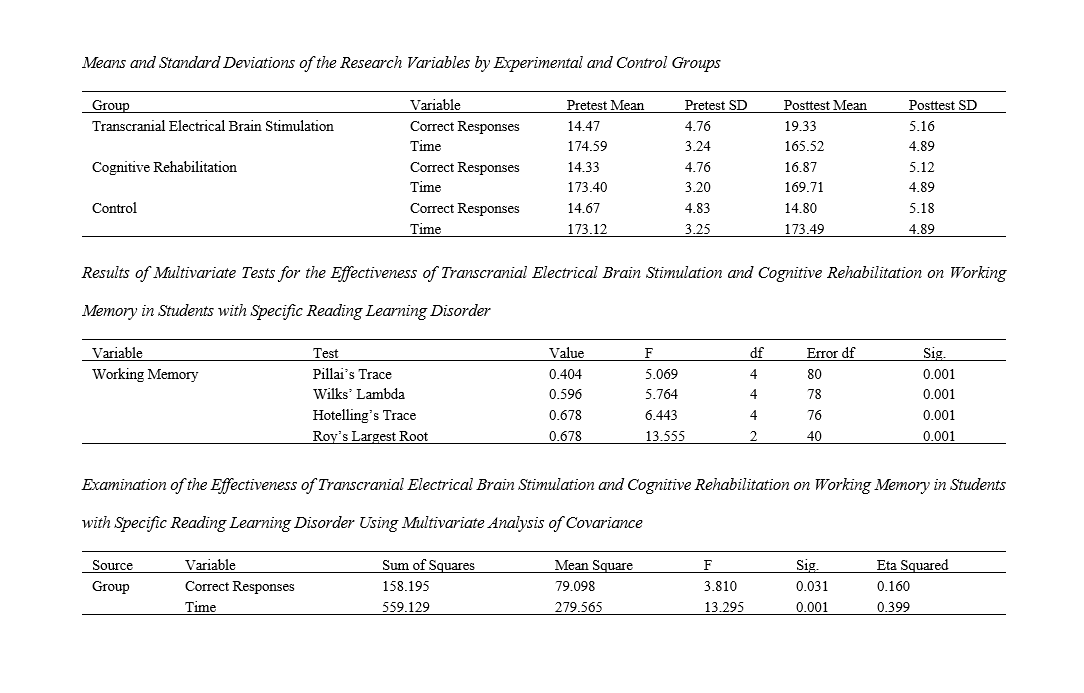
The overall objective of the present study was to compare the effectiveness of transcranial electrical brain stimulation and cognitive rehabilitation on the working memory of students aged 7–13 years with specific reading learning disorder. In terms of purpose, the present study was applied research, and in terms of methodology, it was a quasi-experimental study with a pretest–posttest design and a control group. The statistical population consisted of all 7–13-year-old students with reading learning disabilities in Districts 7 and 10 of Tehran, totaling 1,500 individuals. A total of 45 participants (15 in the experimental group receiving transcranial electrical brain stimulation, 15 in the experimental group receiving cognitive rehabilitation, and 15 in the control group) were selected as the sample using simple random sampling. Data were collected using the N-back test to assess working memory. Multivariate analysis of covariance and the LSD post hoc test were used for data analysis. Transcranial electrical brain stimulation demonstrated greater effectiveness in improving working memory, particularly in reducing response time, compared with the control group, and in some indicators, it also showed superiority over cognitive rehabilitation. Transcranial electrical brain stimulation interventions and cognitive rehabilitation programs can be used as complementary methods for improving the working memory of students aged 7–13 years with specific reading learning disorder.
Downloads
References
Ahadi, H., & Kakavand, A. (2013). Learning Disorders: From Theory to Practice. Arasbaran Publications.
Battisti, A., Lazzaro, G., Costanzo, F., Varuzza, C., Rossi, S., Vicari, S., & Menghini, D. (2024). Effects of a Short and Intensive Transcranial Direct Current Stimulation Treatment in Children and Adolescents with Developmental Dyslexia: A Crossover Clinical Trial. Frontiers in psychology, 13, 986242. https://doi.org/10.3389/fpsyg.2022.986242
Bayat Mokhtari, L., Agha Yousefi, A., Zare, H., & Nejati, V. (2017). The Effect of Transcranial Direct Current Stimulation and Phonological Awareness Training on Improving Visual Working Memory Performance in Children with Dyslexia. Neuropsychology, 3(8), 51-68.
Bergo, E., Lombardi, G., Pambuku, A., Della Puppa, A., Bellu, L., D'Avella, D., & Zagonel, V. (2016). Cognitive Rehabilitation in Patients with Gliomas and Other Brain Tumors: State of the Art. BioMed Research International, 2016(1), 3041824. https://doi.org/10.1155/2016/3041824
Constantino, E., Castro, I. C., Lima, V. L. C., & Avila, C. B. (2025). Efficacy of Transcranial Direct Current Stimulation in Developmental Dyslexia: A Scoping Review. Codas, 37(3), e20240134. https://doi.org/10.1590/2317-1782/e20240134en
Ghalichin, F. (2025). The Effectiveness of Transcranial Direct Current Stimulation on Working Memory Components in Educable Children with Intellectual Disability. Research in Child and Adolescent Psychotherapy, 2(3).
Khanjani, Z., Mahdavian, H., Ahmadi, P., Hashemi, T., & Fathollahpour, L. (2012). The Effectiveness of Fernald's Multisensory Method on Dyslexia in Second-Grade Elementary Students in Tabriz: A Case Study. Psychology of Exceptional Individuals, 2(6), 135-157.
Lu, H., Zhang, Y., Qiu, H., Zhang, Z., Tan, X., Huang, P., & Zhu, X. (2024). A New Perspective for Evaluating the Efficacy of tACS and tDCS in Improving Executive Functions: A Combined tES and fNIRS Study. Human Brain Mapping, 45(1), e26559. https://doi.org/10.1002/hbm.26559
Nejati, V., Salehinejad, M. A., Shahidi, N., & Abedin, A. (2017). Psychological Intervention Combined with Direct Electrical Brain Stimulation (PIN-CODES) for Treating Major Depression: A Pre-Test, Post-Test, Follow-Up Pilot Study. Neurology, Psychiatry and Brain Research, 25, 15-23. https://doi.org/10.1016/j.npbr.2017.05.003
Nozari, M., Nejati, V., & Mirzaeian, B. (2019). The Effectiveness of Transcranial Electrical Stimulation on Executive Functions and Symptom Reduction in Individuals with Major Depressive Disorder. Quarterly Journal of Applied Psychology, 13(4), 577-599.
Parhoon, K., Coolidge, F. L., Alizadeh, H., Parhoon, H., & Srivastava, A. (2024). Effects of a Cognitive Rehabilitation Training Program in School-Aged Children with Specific Learning Disorder. International Journal of School & Educational Psychology, 12(3), 164-172. https://doi.org/10.1080/21683603.2024.2375242
Rouholamini, S., Soleimani, M., & Vaghef, L. (2023). The Effectiveness of Transcranial Direct Current Stimulation on Working Memory and Reading Level in Students with Specific Learning Disorder with Impairment in Reading. Exceptional Children Quarterly, 23(2), 105-118.
Sabahi, M., Tajrobekar, M., Manzari Tavakoli, A., Soltani, A., & Mollaei Zarandi, H. (2025). The Effectiveness of Transcranial Direct Current Stimulation on Executive Functions: Time Self-Management and Self-Organization/Problem-Solving in Children with Attention-Deficit/Hyperactivity Disorder. Psychiatric Nursing, 13(2), 47-54.
Shamshiri, M., Danesh, E., Havasi, N., & Tari Moradi, A. (2025). Comparing the Effectiveness of Computerized Cognitive Rehabilitation and Cognitive-Behavioral Play Therapy on Improving Executive Functions in Students with Dyslexia. Iranian Journal of Psychiatry and Clinical Psychology, 31(1).
Tabrizi, M., Tabrizi, A., & Tabrizi, N. (2024). Treatment of Reading Disorders. Fararavan Publications.
Vaughn, S., Elbaum, B., & Boardman, A. G. (2021). The Social Functioning of Students with Learning Disabilities: Implications for Inclusion. Exceptionality, 9(1-2), 47-65. https://doi.org/10.1080/09362835.2001.9666991
Downloads
Additional Files
Publication Timeline
- Submitted
- Revised
- Accepted