Identifying Digital Behavior Profiles via Usage Patterns, Reward Sensitivity, and Social Reinforcement with Machine Learning Analysis
Keywords:
Digital behavior profiles, machine learning, reward sensitivity, social reinforcement, digital engagement, clustering analysis, behavioral segmentationAbstract
Objective: The present study aimed to identify and classify distinct digital behavior profiles based on usage patterns, reward sensitivity, and social reinforcement using machine learning techniques.
Methods and Materials: This study employed a cross-sectional, correlational design with an embedded machine learning approach. A total of 412 adult participants from Canada were recruited through stratified online sampling. Data were collected using standardized self-report instruments assessing digital usage patterns, Behavioral Activation System (BAS) components for reward sensitivity, and a social reinforcement scale adapted for online environments. After preprocessing, including normalization and missing data handling, descriptive statistics and correlation analyses were conducted. Unsupervised machine learning techniques, specifically K-means and hierarchical clustering, were applied to identify latent behavioral profiles, with optimal cluster selection based on silhouette coefficients and Davies–Bouldin index values. Principal component analysis (PCA) was used for dimensionality reduction and visualization. Additionally, supervised learning models, including random forest and support vector machine algorithms, were implemented to evaluate the predictive accuracy of cluster membership.
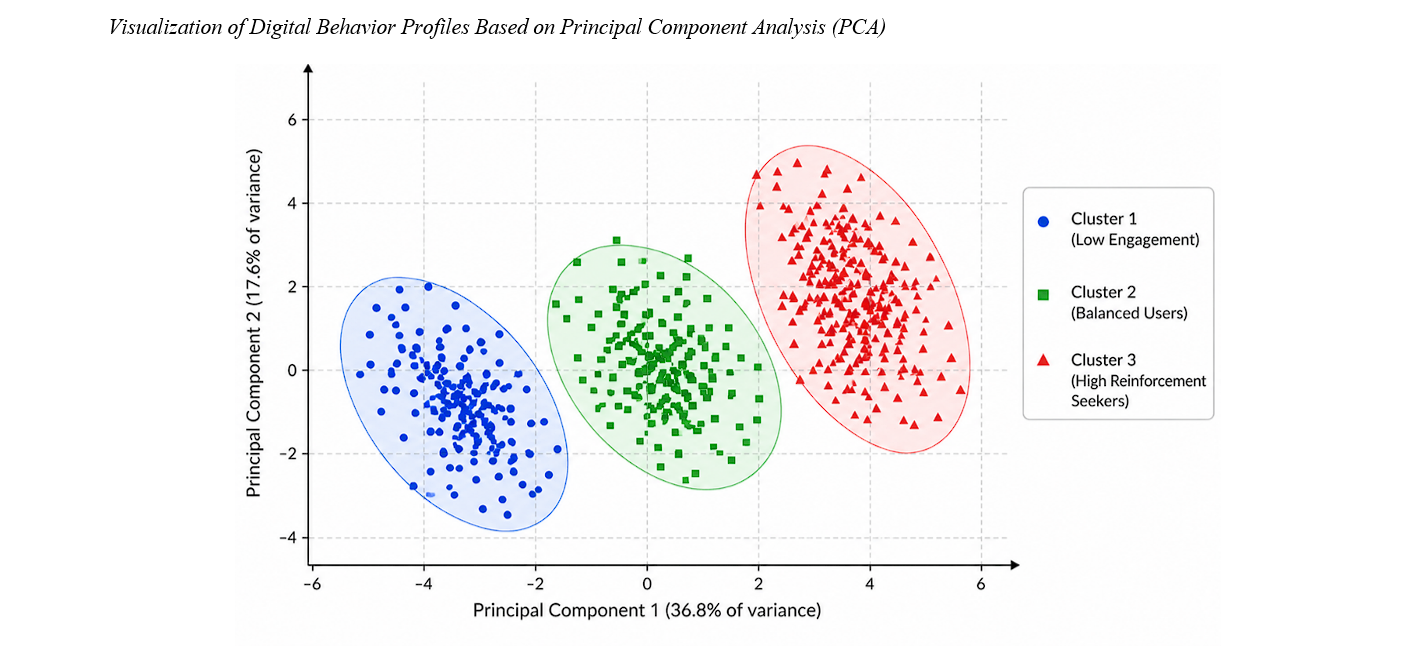
Findings: The analysis revealed a three-cluster solution representing distinct digital behavior profiles: Low Engagement, Balanced Users, and High Reinforcement Seekers. Significant differences were observed across clusters in terms of screen time, multitasking behavior, reward sensitivity, and social reinforcement indicators, with the High Reinforcement Seekers cluster demonstrating the highest levels across all variables. The clustering structure showed strong separation and internal consistency, as confirmed by PCA visualization. Supervised classification models achieved high predictive performance, with the random forest model demonstrating superior accuracy, precision, recall, and F1-score compared to the support vector machine model, indicating robust classification of behavioral profiles based on the selected features.
Conclusion: The findings highlight the multidimensional nature of digital behavior and demonstrate the effectiveness of machine learning techniques in identifying meaningful behavioral profiles. The results underscore the importance of integrating psychological constructs such as reward sensitivity and social reinforcement with behavioral data to better understand digital engagement patterns. This approach provides a foundation for developing targeted interventions and personalized digital well-being strategies, particularly for individuals at risk of excessive or maladaptive digital use.
Downloads
References
Amirthalingam, J., & Khera, A. (2024). Understanding Social Media Addiction: A Deep Dive. Cureus. https://doi.org/10.7759/cureus.72499
Cemiloglu, D., Naiseh, M., Catania, M., Oinas‐Kukkonen, H., & Ali, R. (2021). The Fine Line Between Persuasion and Digital Addiction. 289-307. https://doi.org/10.1007/978-3-030-79460-6_23
Del-Valle-Soto, C., López-Pimentel, J. C., Vázquez‐Castillo, J., Nolazco‐Flores, J. A., Velázquez, R., Varela-Aldás, J., & Visconti, P. (2024). A Comprehensive Review of Behavior Change Techniques in Wearables and IoT: Implications for Health and Well-Being. Sensors, 24(8), 2429. https://doi.org/10.3390/s24082429
Duresso, S. W. (2021). Psychopharmacological Perspectives and Diagnosis of Substance Use Disorder. https://doi.org/10.5772/intechopen.99531
Flayelle, M., Brevers, D., King, D. L., Maurage, P., Perales, J. C., & Billieux, J. (2023). A Taxonomy of Technology Design Features That Promote Potentially Addictive Online Behaviours. Nature Reviews Psychology, 2(3), 136-150. https://doi.org/10.1038/s44159-023-00153-4
Gosetto, L., Falquet, G., & Ehrler, F. (2025). Personalizing Mobile Applications for Health Based on User Profiles: A Preference Matrix From a Scoping Review. https://doi.org/10.1101/2025.04.22.25326205
Hao, N., Meng, C., Zhao, N., Zhang, J., & Zheng, F. (2025). Artificial Intelligence-Assisted Psychological Intervention Mechanisms for University Students in the Context of New Media Technologies: An Analysis Based on Data From the National Institute of Mental Health. Frontiers in psychology, 16. https://doi.org/10.3389/fpsyg.2025.1619818
Huang, F. Y., Li, P., Chen, M. H., Chang, Y.-X., Liu, C., Chen, P., Lin, Q., Lin, C., Huang, C. M., & Wu, S. C. (2025). Classification of Internet Addiction Using Machine Learning on Electroencephalography Synchronization and Functional Connectivity. Psychological medicine, 55. https://doi.org/10.1017/s0033291725001035
Jürjens, J., Scheider, S., Yıldırım, F., & Henke, M. (2022). Tokenomics: Decentralized Incentivization in the Context of Data Spaces. 91-108. https://doi.org/10.1007/978-3-030-93975-5_6
Khoei, T. T., & Kaabouch, N. (2023). Machine Learning: Models, Challenges, and Research Directions. Future Internet, 15(10), 332. https://doi.org/10.3390/fi15100332
Kokkonen, H., Lovén, L., Motlagh, N. H., Partala, J., González-Gil, A., Sola, E., Angulo, I., Liyanage, M., Leppänen, T., Nguyen, T. Q., Kostakos, P., Bennis, M., Tarkoma, S., Dustdar, S., Pirttikangas, S., & Riekki, J. (2022). Autonomy and Intelligence in the Computing Continuum: Challenges, Enablers, and Future Directions for Orchestration. https://doi.org/10.48550/arxiv.2205.01423
Lakhan, S. E. (2025). Hijacked by the Feed: Social Media Neuroengineering-Induced Digital Anhedonia. Cureus. https://doi.org/10.7759/cureus.83256
Liu, Z., Luo, Y., & Pang, P. C. (2025). Digital Technologies-Enhanced Older Adults Health Management: Developing a Five-Dimensional Extension of Social Learning Theory for Community Settings. Frontiers in Public Health, 13. https://doi.org/10.3389/fpubh.2025.1627983
Nasrollahi, H., Lampropoulos, I., Werning, S., Belinskiy, A., Fijnheer, J. D., Veltkamp, R. C., & Sark, W. v. (2023). Review of Serious Energy Games: Objectives, Approaches, Applications, Data Integration, and Performance Assessment. Energies, 16(19), 6948. https://doi.org/10.3390/en16196948
Nguyen, T. T., Tran, T. T. V., & Hoang, M. T. T. (2024). How Peer Privacy Concerns Affect Active and Passive Uses of Social Networking Sites: A Dual Peer Privacy Calculus Model. Social Science Computer Review, 42(6), 1440-1463. https://doi.org/10.1177/08944393231224539
Osser, B., Toth, C., Nistor-Cseppento, C. D., Cevei, M., Aur, C., Orodan, M., Fazakas, R., & Bondar, L. I. (2025). Predictors of Problematic Internet Use Among Romanian High School Students. Children, 12(10), 1292. https://doi.org/10.3390/children12101292
Robayo‐Pinzon, O., Berrío, S. P. R., Paredes, M. R., & Foxall, G. R. (2023). Social Media Sites Users' Choice Between Utilitarian and Informational Reinforcers Assessed Using Temporal Discounting. Frontiers in Public Health, 11. https://doi.org/10.3389/fpubh.2023.960321
Roussille, H., Gürcan, Ö., & Michel, F. (2023). A Taxonomy of Blockchain Incentive Vulnerabilities for Networked Intelligent Systems. Ieee Communications Magazine, 61(8), 108-114. https://doi.org/10.1109/mcom.005.2200904
Shafay, M., Ahmad, R. W., Salah, K., Yaqoob, I., Jayaraman, R., & Omar, M. (2022). Blockchain for Deep Learning: Review and Open Challenges. Cluster Computing, 26(1), 197-221. https://doi.org/10.1007/s10586-022-03582-7
Shannon, H., Montgomery, M., Funk, A., Kamyabi, A., Hunt, M., Pope, C. R., Hellemans, K., & Guimond, S. (2025). Beyond Problematic Social Media Use and the Brain: A Public Health and Policy Perspective. Annals of the New York Academy of Sciences, 1550(1), 14-22. https://doi.org/10.1111/nyas.15409
Sherlin, J., Veena, Sadaf, H., Ali, Z., Nagaral, M., & Ahmed, A. F. (2024). Adolescent’s Usage of Social Media and Risky Behavior: A Review of Meta-Analysis Evidence. International Journal of Science and Research Archive, 11(1), 1698-1704. https://doi.org/10.30574/ijsra.2024.11.1.0208
Tang, J. (2025). AURA: A Reinforcement Learning Framework for AI-Driven Adaptive Conversational Surveys. https://doi.org/10.48550/arxiv.2510.27126
Trajano, A. F. R., & Souza, J. N. d. (2024). Harnessing Idle Edge Resources for Execution of Cloud Services: A Comprehensive Review. Transactions on Emerging Telecommunications Technologies, 35(4). https://doi.org/10.1002/ett.4966
Vanna, K. (2025). Critical Analysis of Advanced Hybrid Models for Mobile Phishing Detection Through Data Mining and Machine Learning. International Journal of Data Warehousing and Mining, 21(1), 1-32. https://doi.org/10.4018/ijdwm.394800
Véronneau, M. H., & Schwartz‐Mette, R. A. (2021). Social Media and Peer Relationships in Adolescence: Current State of Science and Directions for Future Research. Merrill-Palmer Quarterly, 67(4), 485-508. https://doi.org/10.1353/mpq.2021.0023
Wang, J., & Shen, W. (2025). The Emotional Reinforcement Mechanism of and Phased Intervention Strategies for Social Media Addiction. Behavioral Sciences, 15(5), 665. https://doi.org/10.3390/bs15050665
Wegmann, E., Antons, S., Schmidt, L. D., Klein, L., Montag, C., Rumpf, H. J., Mueller, S. M., & Brand, M. (2025). Feels Good, and Less Bad: Problematic Use of the Internet Is Associated With Heightened Experiences of Both Gratification and Compensation. Journal of Behavioral Addictions, 14(1), 263-275. https://doi.org/10.1556/2006.2024.00067
Xu, L., Song, K., Deng, H., Geng, X., Zhang, J., Fang, X., Potenza, M. N., & Zhang, J. (2025). Beyond Screen Time: The Core Influences of Problematic Screen Use on Adolescent Development Networks. Journal of Behavioral Addictions, 14(2), 724-737. https://doi.org/10.1556/2006.2025.00035