The Relationship Between the School Social-Emotional Climate and Student Bullying Through the Mediating Variable of Alexithymia
DOI:
https://doi.org/10.61838/kman.prien.5496Keywords:
School social-emotional climate, bullying, alexithymiaAbstract
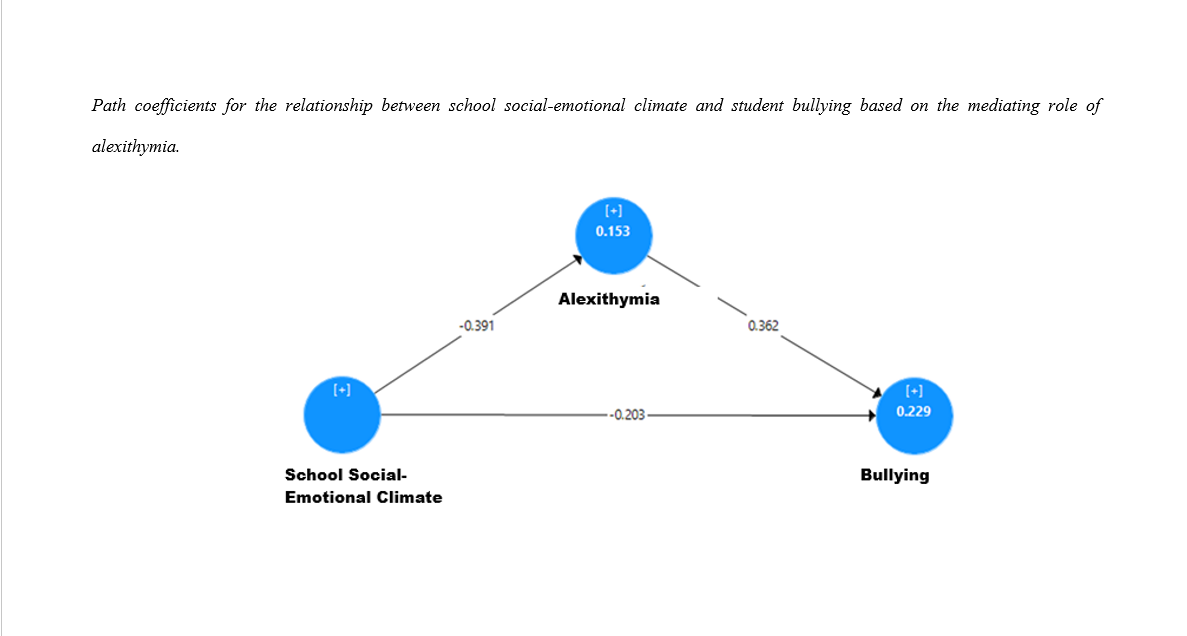
The present study aimed to determine the relationship between the school social-emotional climate and student bullying through the mediating variable of alexithymia. In terms of purpose, this study was applied research, and in terms of nature and method, it was a descriptive-correlational study. The statistical population included all secondary school students in Educational Districts 1 and 3 of Tehran. The sample size was determined using the G*Power software. The sampling method employed in this study was systematic random sampling. The participants completed the Illinois Bullying Questionnaire, the Toronto Alexithymia Scale developed by Graeme J. Taylor and colleagues (1994), and the School Social-Emotional Climate Questionnaire developed by Karami et al. (2009). The findings indicated that the path coefficient between the school social-emotional climate and students’ alexithymia (-0.39) was negative, and 15% of the variance in students’ alexithymia was explained by the school social-emotional climate. Furthermore, there was a positive and significant path coefficient between alexithymia (0.36) and student bullying, and overall, the indirect path was statistically significant.
Downloads
References
Asghari Sharbiyani, A., & Basharpoor, S. (2021). The Mediating Role of Empathy in the Relationship between Family Functions and Bullying in Students. Family Psychology, 5(2), 15-26. https://doi.org/10.22034/ijfp.2021.245542
Coelho, V. A., & Sousa, V. (2021). A Multilevel Analysis of the Relation between Bullying Roles and Social and Emotional Competencies. Journal of interpersonal violence, 36(11-12), 5122-5144. https://doi.org/10.1177/0886260518801943
Conti, C., Di Francesco, G., Lanzara, R., Severo, M., Fumagalli, L., Guagnano, M. T., & Porcelli, P. (2019). Alexithymia and Binge Eating in Obese Outpatients Who Are Starting a Weight-Loss Program: A Structural Equation Analysis. European Eating Disorders Review, 27(6), 628-640. https://doi.org/10.1002/erv.2696
Espelage, D. L., & Holt, M. K. (2013). Bullying and Victimization during Early Adolescence: Peer Influences and Psychosocial Correlates. In Bullying Behavior (pp. 123-142). Routledge.
Espelage, D. L., & Swearer, S. M. (2003). Research on School Bullying and Victimization: What Have We Learned and Where Do We Go from Here? School Psychology Review, 32(3), 365-383. https://doi.org/10.1080/02796015.2003.12086206
Gaffney, H., Ttofi, M. M., & Farrington, D. P. (2019). Evaluating the Effectiveness of School-Bullying Prevention Programs: An Updated Meta-Analytical Review. Aggression and Violent Behavior, 45, 111-133. https://doi.org/10.1016/j.avb.2018.07.001
Kalkan, F., & Dagli, E. (2021). The Relationships between School Climate, School Belonging and School Burnout in Secondary School Students. International Journal of Contemporary Educational Research, 8(4), 59-79. https://doi.org/10.33200/ijcer.878682
KarimZade, M., & Mohseni, N. (2006). Female Academic Self-Efficacy and Academic Achievement. Women's Studies Sociological and Psychological, 4(2), 29-45.
Kim, N., Park, I., Lee, Y. J., Jeon, S., Kim, S., Lee, K. H., & Kim, S. J. (2020). Alexithymia and Frontal-Amygdala Functional Connectivity in North Korean Refugees. Psychological medicine, 50(2), 334-341. https://doi.org/10.1017/S0033291719000175
Liu, Y., Chen, Z., Wang, P., & Xu, L. (2024). Relationship between Bullying Behaviors and Physical Activity in Children and Adolescents: A Systematic Review and Meta-Analysis. Aggression and Violent Behavior, 101976. https://doi.org/10.1016/j.avb.2024.101976
Manzoor, Z., Sadiq, U., & Baig, K. B. (2026). Cyberbullying and emotional vulnerabilities: role of coping styles. BMC psychology. https://doi.org/10.1186/s40359-026-04021-7
Maxwell, S., Reynolds, K. J., Lee, E., Subasic, E., & Bromhead, D. (2017). The Impact of School Climate and School Identification on Academic Achievement: Multilevel Modeling with Student and Teacher Data. Frontiers in psychology, 8, 2069. https://doi.org/10.3389/fpsyg.2017.02069
Mazzone, A., & Camodeca, M. (2018). Emotion Awareness and Somatic Complaints in Preadolescence: The Mediating Role of Coping Strategies. Infant and Child Development, 27(3), e2075. https://doi.org/10.1002/icd.2075
Nikooyeh E, S. S. A., & Mohammadi Aria, A. (2025). The Mediating Role of Cyberbullying, Self-Efficacy, and Parenting Styles in the Relationship Between Trait Emotional Intelligence and School Adjustment in Adolescents. Journal of Cognition, Behavior, Learning, 2(2), 11. https://journalcbl.com/index.php/jcbl/article/view/192
O'Dowd, M. A. (2020). Alexithymia: Advances in Research, Theory, and Clinical Practice, Oliver Luminet, R. Michael Bagby, Graeme J. Taylor, Cambridge University Press, Cambridge, United Kingdom, ISBN-13: 978-1108416641, ISBN-10: 1108416640, 372 pages, $84.99.
Rodríguez‐Hidalgo, A. J., Camargo, V. S., & Hurtado‐Mellado, A. (2025). Cyberbullying Based on Social Stigmas and Social, Emotional and Moral Competencies. Behavioral Sciences, 15(5), 646. https://doi.org/10.3390/bs15050646
Saeedi, M. A., Shabiri, S. M., & Ardeshirpei, J. (2021). Investigating the Relationship between School Emotional Climate and Family Emotional Climate in Predicting Bullying among Female Middle School Students in Shiraz. Third International Conference on Educational Sciences, Psychology, Counseling, Education, and Research,
Sarzosa, M., & Urzua, S. (2021). Bullying among Adolescents: The Role of Skills. Quantitative Economics, 12(3), 945-980. https://doi.org/10.3982/QE1215
Sen Demirdogen, E., Aluc, N., Akdeniz, B., Basar, D., Warikoo, N., & Yavuz, M. (2022). The Associations between Reading Mind in the Eyes Abilities, Alexithymia, Empathy, and Bullying Behavior in Turkish Adolescents. Journal of Child and Adolescent Psychiatric Nursing, 35(3), 230-239. https://doi.org/10.1111/jcap.12366
Shabahang, R., Sedighian, S. F., Rahiminejad, A., & Soltani Shal, R. (2019). The Role of Emotion Regulation Difficulties and Alexithymia in Predicting Bullying. Child Mental Health, 6(3), 40-50. http://childmentalhealth.ir/article-1-483-fa.html
Shirani, Z., Baramakeh, Z., & Bahramipour, M. (2021). The Role of Empathy, Emotion Regulation, and School Climate against Cyberbullying. Eighth Congress of the Iranian Psychological Association,
Smith, P. K., Lopez-Castro, L., Robinson, S., & Gorzig, A. (2019). Consistency of Gender Differences in Bullying in Cross-Cultural Surveys. Aggression and Violent Behavior, 45, 33-40. https://doi.org/10.1016/j.avb.2018.04.006
Wachs, S., Bilz, L., Fischer, S. M., & Wright, M. F. (2017). Do Emotional Components of Alexithymia Mediate the Interplay between Cyberbullying Victimization and Perpetration? International journal of environmental research and public health, 14(12), 1530. https://doi.org/10.3390/ijerph14121530
Wachs, S., & Wright, M. F. (2018). Bullying and Alexithymia: Are There Differences between Traditional, Cyber, Combined Bullies, and Nonbullies in Reading Their Own Emotions? Criminal Behaviour and Mental Health, 28(5), 409-413. https://doi.org/10.1002/cbm.2083
Xing Tan, Z. (2023). Rethinking Relational Architecture: Interpersonal Justice beyond Private Law. University of Toronto Law Journal, 73(3), 293-347. https://doi.org/10.3138/utlj-2021-0087
Yun, H. Y. (2020). New Approaches to Defender and Outsider Roles in School Bullying. Child development, 91(4), e814-e832. https://doi.org/10.1111/cdev.13312
Downloads
Additional Files
Publication Timeline
- Submitted
- Revised
- Accepted