Effectiveness of Rational Emotive Behavior Therapy on Oppositional Defiant Disorder and Sexual Deviance in Working Children
DOI:
https://doi.org/10.61838/kman.prien.5552Keywords:
Rational Emotive Behavior Therapy, Oppositional Defiant Disorder, Sexual Deviance, Working Children, Psychological InterventionAbstract
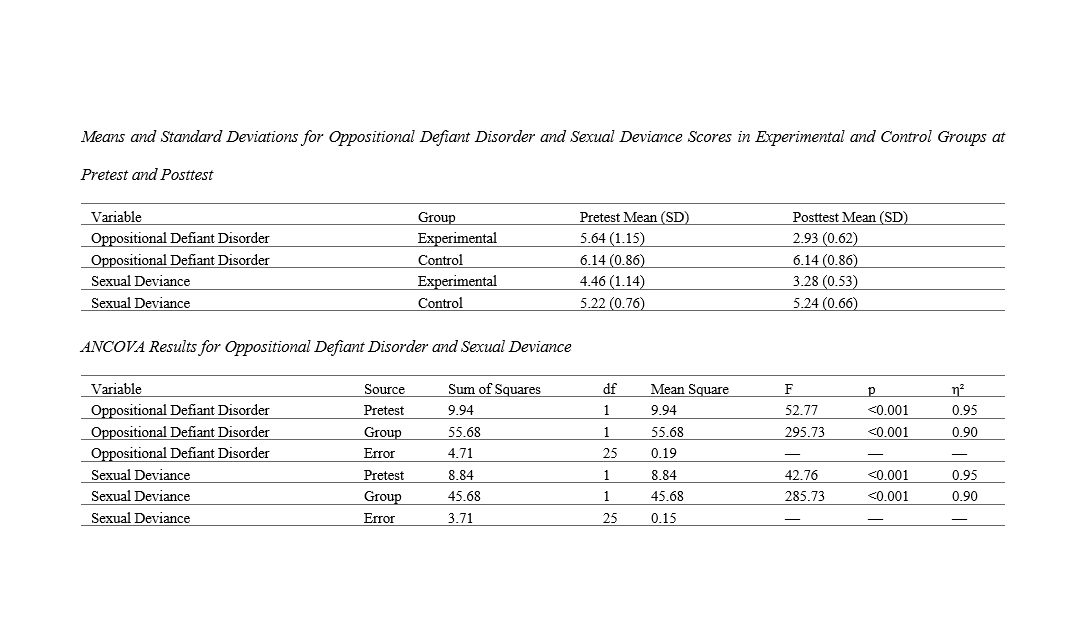
The present study aimed to investigate the effectiveness of Rational Emotive Behavior Therapy (REBT) on reducing oppositional defiant disorder and sexual deviance among working children in Tehran. This study employed a quasi-experimental design with pretest-posttest and control group. The statistical population consisted of male working children aged 9 to 11 years enrolled at Parto School affiliated with the Mehrafarin Charity Organization in Tehran during the 2025 academic year. Thirty participants were selected using convenience sampling and randomly assigned into experimental (n=15) and control (n=15) groups. The experimental group participated in eight 90-minute sessions of Rational Emotive Behavior Therapy conducted over four weeks, while the control group received no intervention. Data collection instruments included the Oppositional Defiant Disorder Questionnaire developed by Ahmadi (2013) and the Child Sexual Deviance Questionnaire developed by Rashidi (2013). Data were analyzed using analysis of covariance (ANCOVA) in SPSS version 26 after verifying statistical assumptions including normality, homogeneity of variances, and homogeneity of regression slopes. The results of ANCOVA demonstrated that Rational Emotive Behavior Therapy significantly reduced oppositional defiant disorder symptoms in the experimental group compared to the control group (F=295.73, p<0.001, η²=0.90). Furthermore, the intervention significantly decreased sexual deviance behaviors among participants in the experimental group (F=285.73, p<0.001, η²=0.90). The large effect sizes indicated that a substantial proportion of the variance in posttest scores was attributable to the REBT intervention. These findings confirmed both research hypotheses and demonstrated the strong effectiveness of REBT in improving disruptive and maladaptive behaviors among working children. The findings suggest that Rational Emotive Behavior Therapy is an effective and practical intervention for reducing oppositional defiant disorder and sexual deviance among working children. By helping children identify and modify irrational beliefs, improve emotional regulation, and develop adaptive coping strategies, REBT can significantly improve psychological and behavioral functioning in this vulnerable population.
Downloads
References
Aflakian, M., Khayatan, F., & Atashpour, H. (2023). Comparison of the effectiveness of schema therapy based on psychosocial issues and cognitive behavioral therapy on early maladaptive schemas and anxiety in patients with obsessive compulsive disorder. Journal of Adolescent and Youth Psychological Studies, 4(5), 166-178. https://doi.org/10.61838/kman.jayps.4.5.12
American Psychiatric, A. (2013). Diagnostic and Statistical Manual of Mental Disorders (5th ed.). American Psychiatric Association. https://doi.org/10.1176/appi.books.9780890425596
Carr, S. N., & Francis, A. J. (2010). Early maladaptive schemas and personality disorder symptoms: An examination in a non clinical sample. Psychology and Psychotherapy: Theory, Research and Practice, 83(4), 333-349. https://doi.org/10.1348/147608309X481351
Ellis, A. (1994). Reason and Emotion in Psychotherapy: A Comprehensive Method of Treating Human Disturbances. Citadel Press.
Ganji, H. (2025). Abnormal Psychology (10th ed.). Savalan Publications.
Gonzalez, J. E., Nelson, J. R., Gutkin, T. B., Saunders, A., Galloway, A., & Shwery, C. S. (2004). Rational emotive therapy with children and adolescents: A meta analysis. Journal of Emotional and Behavioral Disorders, 12(4), 222-235. https://doi.org/10.1177/10634266040120040301
James, N., & Omondi, M. P. (2021). The efficacy of behavioral and rational emotive behavior therapies on conduct disorder among juvenile delinquents in selected rehabilitation schools in Kenya. American Journal of Applied Psychology, 10(1), 1-9. https://doi.org/10.11648/j.ajap.20211001.11
Khanjani, Z., Sohrabi, F., & Azami, M. (2021). Effectiveness of resilience training on mental health of working children. Journal of Health Psychology, 10(3), 54-71.
Lorzangeneh, S., & Esazadegan, A. (2022). The role of early maladaptive schema domains and childhood trauma in predicting cognitive distortions. Journal of Research in Psychopathology, 3(8), 1-8.
McCart, M. R., & Sheidow, A. J. (2016). Evidence based psychosocial treatments for adolescents with disruptive behavior. Journal of Clinical Child & Adolescent Psychology, 45(5), 529-563. https://doi.org/10.1080/15374416.2016.1146990
Norouzi, M., & Zemestani, M. (2020). Comparative study of the relationship between childhood trauma and personality functioning and pathological traits in patients with borderline personality disorder and non patient group. Journal of Psychology and Psychiatry of Cognition, 7(6), 86-99. https://doi.org/10.52547/shenakht.7.6.85
Norouzi, M., & Zemestani, M. (2021). Comparative study of the relationship between emotion dysregulation and dissociative symptoms with personality functioning and pathological traits in patients with borderline personality disorder and non patient group. Journal of Psychology and Psychiatry of Cognition, 8(6), 2-16.
Radfar, A., Asgharzadeh, S. A. A., Quesada, F., & Filip, I. (2018). Challenges and perspectives of child labor. Industrial Psychiatry Journal, 27(1), 17-20. https://doi.org/10.4103/ipj.ipj_105_14
Rashidi, K. (2013). Investigating the causes of sexual deviance in high school boys in Javanroud city Payame Noor University].
Terjesen, M. D., Esposito, M., Kurasaki, R., & Kassay, K. (2009). Rational emotive behavior therapy (REBT) with children and adolescents: Theory, applications, and research. NYS Psychologist, 20(2), 13-20.
Downloads
Additional Files
Publication Timeline
- Submitted
- Revised
- Accepted