Explainable Artificial Intelligence Modeling of Social Participation in Children with Intellectual Disabilities: A SHAP-Based CatBoost Analysis of Adaptive Behavior, Communication Competence, and Parental Involvement
Keywords:
Social Participation, Intellectual Disabilities, Adaptive Behavior, Communication Competence, Parental InvolvementAbstract
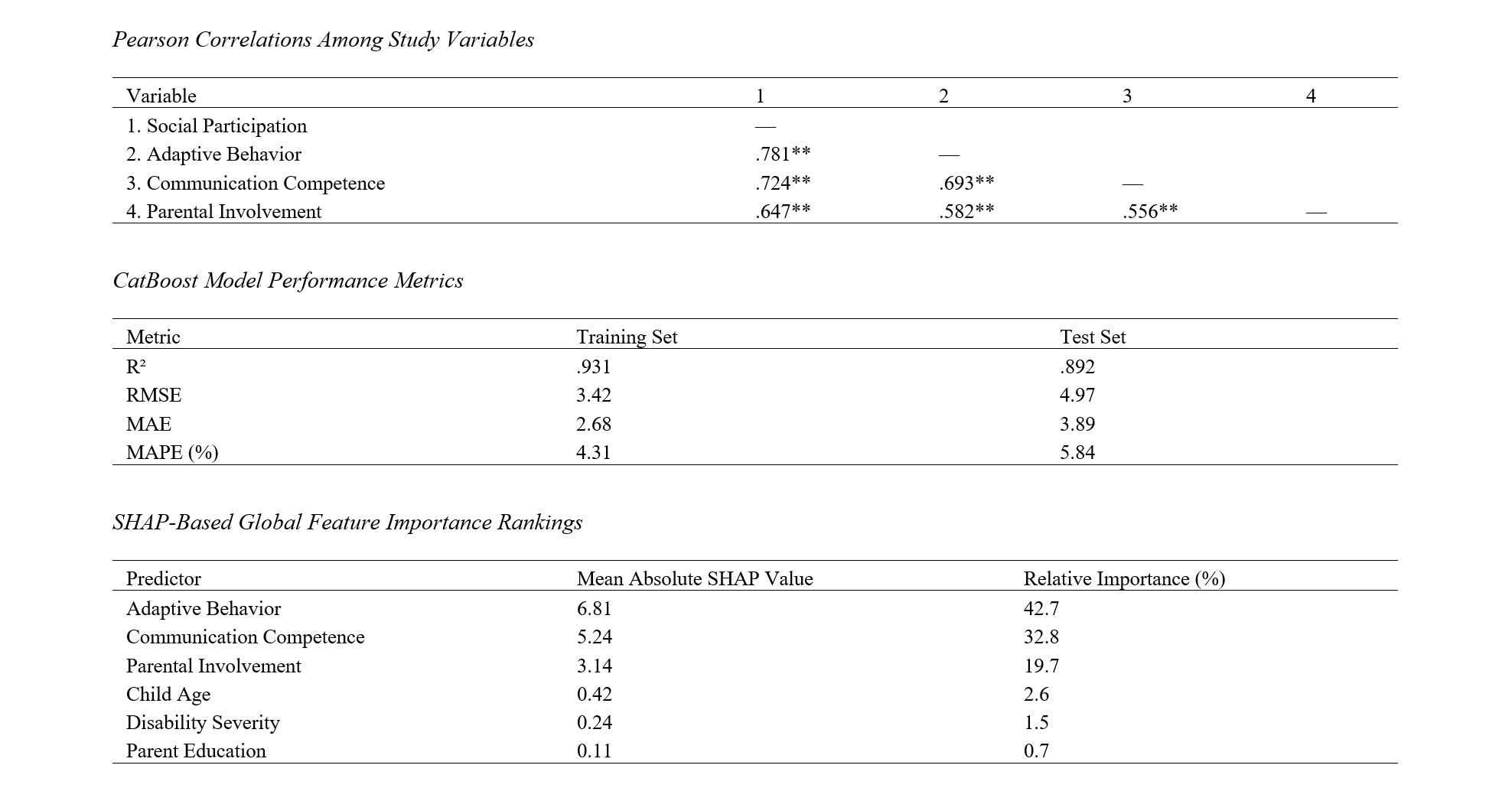
The present study aimed to develop and interpret an explainable artificial intelligence model of social participation in children with intellectual disabilities by examining the predictive contributions of adaptive behavior, communication competence, and parental involvement using a SHAP-based CatBoost algorithm. This cross-sectional predictive modeling study was conducted among 412 children with mild to moderate intellectual disabilities aged 8–16 years who were recruited from special education schools, rehabilitation centers, and inclusive educational settings across Hungary. Social participation was assessed using the Participation and Environment Measure for Children and Youth (PEM-CY), while adaptive behavior, communication competence, and parental involvement were measured using standardized psychometric instruments. Following data preprocessing and screening procedures, a CatBoost machine learning model was developed to predict social participation outcomes. Model performance was evaluated using the coefficient of determination (R²), Root Mean Square Error (RMSE), Mean Absolute Error (MAE), and Mean Absolute Percentage Error (MAPE). To enhance interpretability, SHapley Additive exPlanations (SHAP) analyses were conducted to determine the relative importance and direction of predictor contributions. Pearson correlation analyses demonstrated significant positive associations between social participation and adaptive behavior (r = .781, p < .001), communication competence (r = .724, p < .001), and parental involvement (r = .647, p < .001). The CatBoost model exhibited excellent predictive performance, explaining 89.2% of the variance in social participation within the test dataset (R² = .892), with RMSE = 4.97, MAE = 3.89, and MAPE = 5.84%. SHAP analyses identified adaptive behavior as the strongest predictor of social participation (42.7% relative importance), followed by communication competence (32.8%) and parental involvement (19.7%). Together, these three variables accounted for more than 95% of the model’s total explanatory influence. Furthermore, SHAP dependence analyses revealed nonlinear interactions, indicating that the positive effects of adaptive behavior became increasingly pronounced at higher levels of communication competence and parental involvement. The findings demonstrate that social participation among children with intellectual disabilities is primarily influenced by adaptive behavior, communication competence, and parental involvement. The SHAP-based CatBoost model provided highly accurate and interpretable predictions, highlighting the value of explainable artificial intelligence for understanding participation outcomes in developmental disability research. These results support the development of family-centered and skills-focused interventions aimed at enhancing social inclusion and community participation among children with intellectual disabilities.
Downloads
References
Abualait, T., Alabbad, M., Kaleem, I., Imran, H., Khan, H., Kiyani, M. M., & Bashir, S. (2024). Autism Spectrum Disorder in Children: Early Signs and Therapeutic Interventions. Children, 11(11), 1311. https://doi.org/10.3390/children11111311
Alhammashi, A. N. A., Yousefi, Z., Radhi, A. J., & Khayatan, F. (2024). Exploring the Multifaceted Relationships Between Mindful Parenting, Family Relationships, and Mothers' Reflective Functioning With the Emotional Social Adaptation of Children With Autism. Hn, 2(2), 8-16. https://doi.org/10.61838/kman.hn.2.2.2
Bach, B., & Vestergaard, M. (2023). Differential Diagnosis of ICD-11 Personality Disorder and Autism Spectrum Disorder in Adolescents. Children, 10(6), 992. https://doi.org/10.3390/children10060992
Chen, X. (2023). An Overview on Children With Autism. SHS Web of Conferences, 180, 02025. https://doi.org/10.1051/shsconf/202318002025
Cheney, L., Dudas, R. B., Traynor, J., Beatson, J., Rao, S., & Choi‐Kain, L. W. (2023). Co-Occurring Autism Spectrum and Borderline Personality Disorder: An Emerging Clinical Challenge Seeking Informed Interventions. Harvard Review of Psychiatry, 31(2), 83-91. https://doi.org/10.1097/hrp.0000000000000361
Costa‐Cordella, S., Soto‐Icaza, P., Borgeaud, K., Grasso‐Cladera, A., & Malberg, N. (2023). Towards a Comprehensive Approach to Mentalization-Based Treatment for Children With Autism: Integrating Attachment, Neurosciences, and Mentalizing. Frontiers in Psychiatry, 14. https://doi.org/10.3389/fpsyt.2023.1259432
Ferrara, R., Iovino, L., Ricci, L., Latina, R., & Ricci, P. (2025). Food Selectivity and Autism: A Systematic Review. World Journal of Clinical Pediatrics, 14(3). https://doi.org/10.5409/wjcp.v14.i3.101974
Ferrara, R., Ricci, P., Damato, F. M., Iovino, L., Ricci, L., Cicinelli, G., Simeoli, R., & Keller, R. (2023). Pregnancy in Autistic Women and Social Medical Considerations: Scoping Review and Meta- Synthesis. Frontiers in Psychiatry, 14. https://doi.org/10.3389/fpsyt.2023.1222127
Ferrera-Fernández, M.-Á., Torre, H. G. l., Auyanet-Franchy, J., & Rodríguez-Suárez, C.-A. (2025). Adapting Pediatric Emergency Services for Children With Autism Spectrum Disorder: A Phenomenological Approach. Children, 12(9), 1275. https://doi.org/10.3390/children12091275
Filipova, S., Jovchevski, V. G., & Milankov, V. (2023). Types and Frequency of Dysfunction of Sensory Integration in Children With Autism Spectrum Disorder. Journal of Education Society and Behavioural Science, 36(7), 96-105. https://doi.org/10.9734/jesbs/2023/v36i71240
Fotoglou, A., Moraiti, I., Stergios, V., Ashley, P. E., Vogindroukas, I., Speis, P. D., Papantoniou, S., Chrysouli, K., Karabatzaki, Z., & Stathopoulou, A. (2023). Sociability: The Key to Sensory Processing Disorder. Brazilian Journal of Science, 2(1), 82-97. https://doi.org/10.14295/bjs.v2i1.214
Ghosh, P., Ghosh, S., Mondal, S., & Moulik, M. S. (2022). Assessing Sensory Processing Disorders in a Child Guidance Clinic With Focus on ADHD. Eastern Journal of Psychiatry, 22(1), 1-10. https://doi.org/10.5005/ejp-22-1-1
Greaves‐Lord, K., Skuse, D., & Mandy, W. (2022). Innovations of the ICD-11 in the Field of Autism Spectrum Disorder: A Psychological Approach. Clinical psychology in Europe, 4(Special Issue). https://doi.org/10.32872/cpe.10005
Hirota, T., & King, B. H. (2023). Autism Spectrum Disorder. JAMA, 329(2), 157. https://doi.org/10.1001/jama.2022.23661
Johnson, E., Zijl, K. V., & Kuyler, A. (2023). Pain Communication in Children With Autism Spectrum Disorder: A Scoping Review. Paediatric and Neonatal Pain, 5(4), 127-141. https://doi.org/10.1002/pne2.12115
Kozak, A., Czepczor‐Bernat, K., Modrzejewska, J., Modrzejewska, A., Matusik, E., & Matusik, P. (2023). Avoidant/Restrictive Food Disorder (ARFID), Food Neophobia, Other Eating-Related Behaviours and Feeding Practices Among Children With Autism Spectrum Disorder and in Non-Clinical Sample: A Preliminary Study. International journal of environmental research and public health, 20(10), 5822. https://doi.org/10.3390/ijerph20105822
Labarca, P., Oyanadel, C., González-Loyola, M., & Castro, W. P. (2025). Effective Interventions in the Treatment of Self-Harming Behavior in Children and Adolescents With Autism Spectrum Disorder: A Review. Children, 12(9), 1184. https://doi.org/10.3390/children12091184
Lawson, L. M., Foster, L., Hodges, M., Murphy, M., O’Neal, M., & Peters, L. (2022). Effects of Sensory Garments on Sleep of Children With Autism Spectrum Disorder. Occupational Therapy International, 2022, 1-9. https://doi.org/10.1155/2022/2941655
Lei, J., Mason, C., Russell, A., Hollocks, M. J., & Leigh, E. (2024). Understanding Mechanisms That Maintain Social Anxiety Disorder in Autistic Individuals Through the Clark and Wells (1995) Model and Beyond: A Systematic Review. Clinical Child and Family Psychology Review, 27(4), 966-1030. https://doi.org/10.1007/s10567-024-00509-z
Li, X., Zhan, X., & Zhang, Y. (2023). The Promotion of Music to Autistic Children's Perceptual Ability. Academic Journal of Humanities & Social Sciences, 6(20). https://doi.org/10.25236/ajhss.2023.062010
Makheti, J. (2024). The Use of Dance as a Therapeutic Intervention for Individuals With Autism Spectrum Disorder. International Journal of Arts Recreation and Sports, 3(2), 37-48. https://doi.org/10.47941/ijars.1938
Marukyan, V. (2023). Child With Autistic Spectrum Disorder: Care and Challenges. Armenian Journal of Special Education, 7(2), 78-91. https://doi.org/10.24234/se.v7i2.11
Michna, G. A., Trudel, S. M., Bray, M. A., Reinhardt, J. S., Dirsmith, J., Theodore, L. A., Zhou, Z., Patel, I., Jones, P., & Gilbert, M. L. (2022). Best Practices and Emerging Trends in Assessment of Trauma in Students With Autism Spectrum Disorder. Psychology in the Schools, 60(2), 479-494. https://doi.org/10.1002/pits.22769
Neu, C., & Bradford, A. B. (2025). Autism in Romantic Relationships: A Content Analysis of Challenges and Strengths (2013–2024). Journal of Family Theory & Review, 17(3), 600-635. https://doi.org/10.1111/jftr.70001
Nimbley, E., Golds, L., Sharpe, H., Gillespie‐Smith, K., & Duffy, F. (2022). Sensory Processing and Eating Behaviours in Autism: A Systematic Review. European Eating Disorders Review, 30(5), 538-559. https://doi.org/10.1002/erv.2920
Pride, N. A., Haebich, K. M., Walsh, K. S., Lami, F., Rouel, M., Maier, A., Chisholm, A. K., Lorenzo, J., Hearps, S., North, K. N., & Payne, J. M. (2023). Sensory Processing in Children and Adolescents With Neurofibromatosis Type 1. Cancers, 15(14), 3612. https://doi.org/10.3390/cancers15143612
Romeo, V. M. (2025). Attachment as a Developmental Lens for Understanding Neurodivergence: A Clinical-Theoretical Proposal. Children, 12(12), 1703. https://doi.org/10.3390/children12121703
Savarese, G., Mandia, R., Diavoletto, A., Impemba, F., Siervi, A. D., Carpinelli, L., Bottiglieri, F., & Corrivetti, G. (2025). Preliminary Results of Sensorimotor Room Training for the Improvement of Sensory and Motor Skills in Children With Autism Spectrum Disorders. Pediatric Reports, 17(1), 4. https://doi.org/10.3390/pediatric17010004
Sideraki, A., & Drigas, A. (2022). Comparative Analysis On: Metacognition and Mindfulness in Twins With Attachment and Children With ASD Through I.C.T. Technium Social Sciences Journal, 34, 90-109. https://doi.org/10.47577/tssj.v34i1.6998
Suprunowicz, M., Bogucka, J., Szczerbińska, N., Modzelewski, S., Oracz, A. J., Konarzewska, B., & Waszkiewicz, N. (2025). Neuroplasticity-Based Approaches to Sensory Processing Alterations in Autism Spectrum Disorder. International Journal of Molecular Sciences, 26(15), 7102. https://doi.org/10.3390/ijms26157102
Trudel, S. M., Winter, E. L., Fitzmaurice, B., Norman, G., & Bray, C. R. (2022). Integration of Physical Health and Sensory Processing Assessment for Children With Autism Spectrum Disorder in Schools. Psychology in the Schools, 60(2), 378-400. https://doi.org/10.1002/pits.22704
Zhai, J., Li, X., Zhou, Y., Fan, L., Xia, W., Wang, X., Li, Y., Hou, M., Wang, J., & Wu, L. (2023). Correlation and Predictive Ability of Sensory Characteristics and Social Interaction in Children With Autism Spectrum Disorder. Frontiers in Psychiatry, 14. https://doi.org/10.3389/fpsyt.2023.1056051
Zotti, L., Esposito, D., Iorio, G. D., Covuccia, M., Orecchio, S., Ferrara, M., & Conte, G. (2025). Challenges to High-Quality Care in Autism With Functional Somatic Symptoms: A Case-Inspired Narrative Review and Exploratory Biopsychosocial Model. Clinical Child Psychology and Psychiatry, 30(3), 562-587. https://doi.org/10.1177/13591045251343692
Downloads
Additional Files
Publication Timeline
- Submitted
- Revised
- Accepted