The Relationship Between Social Cognition and Loneliness in Gifted Underachievers: The Mediating Role of Rejection Sensitivity
DOI:
https://doi.org/10.61838/kman.prien.3.3.3Keywords:
Gifted underachievers, social cognition, rejection sensitivity, loneliness, structural equation modelingAbstract
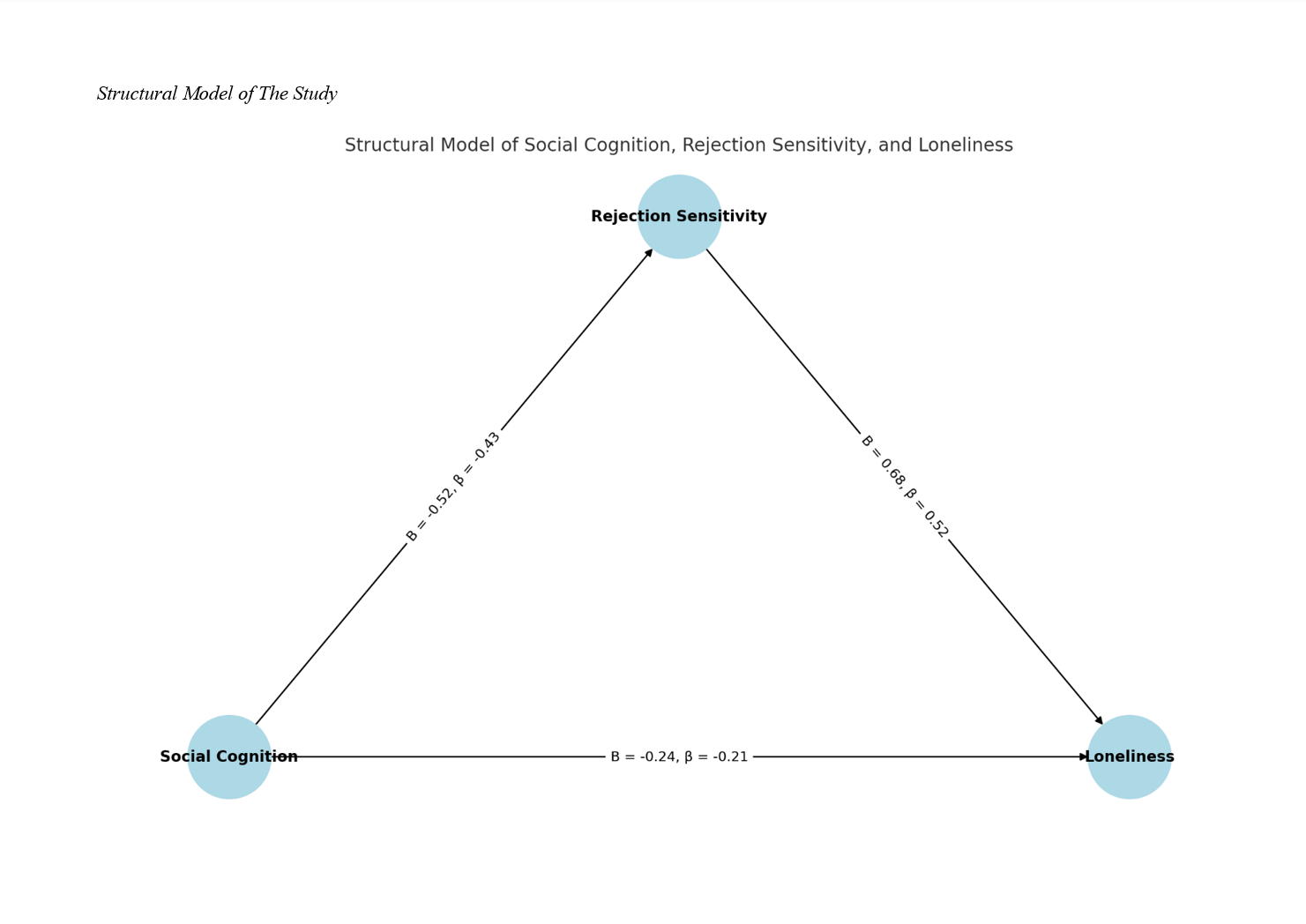
This study aimed to examine the relationship between social cognition and loneliness in gifted underachievers, with a specific focus on the mediating role of rejection sensitivity. A descriptive correlational design was employed with a sample of 399 gifted underachieving adolescents from Argentina, selected according to Morgan and Krejcie's (1970) sample size table. Standardized tools were used to assess social cognition, rejection sensitivity, and loneliness. Data analysis was conducted using SPSS-27 and AMOS-21. Pearson correlation was used to evaluate bivariate relationships between variables, and Structural Equation Modeling (SEM) was applied to test the proposed mediational model. Fit indices, including χ², RMSEA, GFI, CFI, and TLI, were reported to evaluate model adequacy. Results indicated that social cognition was significantly and negatively correlated with both rejection sensitivity (r = –.43, p < .01) and loneliness (r = –.39, p < .01). Rejection sensitivity showed a significant positive correlation with loneliness (r = .58, p < .01). SEM analysis confirmed the mediating role of rejection sensitivity in the relationship between social cognition and loneliness. The indirect path from social cognition to loneliness via rejection sensitivity was significant (β = –.28, p < .001), and the total effect of social cognition on loneliness was substantial (β = –.49, p < .001). Model fit indices indicated a good fit (χ²/df = 2.22, CFI = 0.96, RMSEA = 0.054). These findings suggest that deficits in social cognition contribute to heightened feelings of loneliness in gifted underachievers, primarily through increased sensitivity to perceived rejection. Interventions aimed at reducing rejection sensitivity may mitigate the impact of social cognitive difficulties on emotional well-being in this vulnerable group.
Downloads
References
Borawski, D., & Nowak, A. (2022). As Long as You Are Self‐compassionate, You Will Never Walk Alone. The Interplay Between Self‐compassion and Rejection Sensitivity in Predicting Loneliness. International journal of psychology, 57(5), 621-628. https://doi.org/10.1002/ijop.12850
Du, X., Ding, C., Xiang, G., Li, Q., Liu, X., Xiao, M., Song, S., & Chen, H. (2022). Rejection Sensitivity and Reactive Aggression in Early Adults: The Mediating Role of Loneliness and Maladaptive Coping. Psychological Reports, 127(2), 786-806. https://doi.org/10.1177/00332941221125771
Fan, Z., Chen, M., & Lin, Y. (2022). Self-Control and Problematic Internet Use in College Students: The Chain Mediating Effect of Rejection Sensitivity and Loneliness. Psychology research and behavior management, Volume 15, 459-470. https://doi.org/10.2147/prbm.s352060
He, D., Niu, G., Hu, Y., Song, K., Lan, P., Zhang, Y., & Zhou, Z. (2024). Parental Phubbing and Cyberloafing in Chinese Adolescent: The Mediating Roles of Rejection Sensitivity and Loneliness. Child & Family Social Work. https://doi.org/10.1111/cfs.13222
Heu, L. (2023). The Loneliness of the Odd One Out: How Deviations From Social Norms Can Help Explain Loneliness Across Cultures. https://doi.org/10.31234/osf.io/yqnj3
Katulis, G., Kaniušonytė, G., & Laursen, B. (2023). Positive Classroom Climate Buffers Against Increases in Loneliness Arising From Shyness, Rejection Sensitivity and Emotional Reactivity. Frontiers in Psychiatry, 14. https://doi.org/10.3389/fpsyt.2023.1081989
Kong, Q., Currie, N., Du, K., Hunter, J., & Ruffman, T. (2025). Older Adults Know When They Have Been Left Out but They Respond Rationally. European Journal of Ageing, 22(1). https://doi.org/10.1007/s10433-025-00845-1
Lyu, M., Xiong, Y., Wang, H., Yang, L., Chen, J., & Ren, P. (2024). Why Rejection Sensitivity Leads to Adolescents' Loneliness: Differential Exposure, Reactivity, and Exposure‐reactivity Models. Journal of adolescence, 97(1), 137-147. https://doi.org/10.1002/jad.12405
Noda, S., Masaki, M., Kishimoto, T., & Kaiya, H. (2022). Effect of Rejection Sensitivity on the Development of Anxious-Depressive Attack in Japanese Outpatients: The Mediating Roles of Rumination, Social Anxiety, and Depressive Symptoms. Frontiers in psychology, 13. https://doi.org/10.3389/fpsyg.2022.1016879
Park, J., & Yoo, N. (2025). The Effect of College Students’ Rejection-Sensitivity on Loneliness: The Mediation Effect of Multidimensional Experiential Avoidance Moderated by Emotional Clarity. J Edu Ther, 17(1), 73-90. https://doi.org/10.35185/kjet.17.1.4
Razvaliaeva, A. Y., & Polskaya, N. A. (2021). Psychometric Properties of the Russian Three-Factor Interpersonal Sensitivity Measure. Counseling Psychology and Psychotherapy, 29(4), 73-94. https://doi.org/10.17759/cpp.2021290405
Reinhard, M. A., Nenov-Matt, T., & Padberg, F. (2022). Loneliness in Personality Disorders. Current psychiatry reports, 24(11), 603-612. https://doi.org/10.1007/s11920-022-01368-7
Rowney-Smith, A., Sutton, B. S., Quadt, L., & Eccles, J. (2024). The Lived Experience of Rejection Sensitivity in ADHD - A Qualitative Exploration. https://doi.org/10.1101/2024.11.16.24317418
Schulze, A., Rommelfanger, B., Schendel, E., Kammler-Sücker, K., & Lis, S. (2024). You Say It‘s Not Me: The Influence of Offering External Explanations of Rejection and Acceptance Behavior on the Perception of Benevolence in Borderline Personality Disorder. Borderline personality disorder and emotion dysregulation, 11(1). https://doi.org/10.1186/s40479-024-00275-y
Seewer, N., Skoko, A., Käll, A., Andersson, G., Luhmann, M., Berger, T., & Krieger, T. (2024). Efficacy of an Internet-Based Self-Help Intervention With Human Guidance or Automated Messages to Alleviate Loneliness: A Three-Armed Randomized Controlled Trial. Scientific reports, 14(1). https://doi.org/10.1038/s41598-024-57254-0
Souza, E. G. (2025). Existential Elements: Death, Boredom, Loneliness and Fear as Manifestations of Meaning. Poly, 18(1), e25008. https://doi.org/10.52521/poly.v18i1.14176
Vasyura, S. А., & Byakova, D. Y. (2024). Correlation Between Experiencing Loneliness and Machiavellianism by Students With Social Frustration. Herald of Omsk University Series Psychology(3), 5-14. https://doi.org/10.24147/2410-6364.2024.3.5-14
Xu, C., Liao, M., & Hong, Y. (2025). Rejection Sensitivity and Problematic Internet Use Among Medical Students: A Moderated Mediation Model Involving Loneliness and Self-Control. Behavioral Sciences, 15(5), 589. https://doi.org/10.3390/bs15050589
Xu, C., Qiu, M., Jiang, X., Liao, M., Lei, L., Liu, L., Yu, L., & Hong, Y. (2024). The Rejection Sensitivity and Problematic Internet Use Among Medical Students: A Moderated Mediation Model Involving Loneliness and Self-Control. https://doi.org/10.21203/rs.3.rs-3958231/v1
Zhang, J., Mollandsøy, A. B., Nornes, C., Erevik, E. K., & Pallesen, S. (2024). Predicting Hostility Towards Women: Incel‐related Factors in a General Sample of Men. Scandinavian journal of psychology, 66(1), 35-46. https://doi.org/10.1111/sjop.13062
Downloads
Additional Files
Publication Timeline
- Submitted
- Revised
- Accepted
Issue
Section
License
Copyright (c) 2025 Victoria Saco (Corresponding Author); Carlos Lucía Gómez (Author)

This work is licensed under a Creative Commons Attribution-NonCommercial 4.0 International License.