Analyzing the Role of Play and Educational Toys in Cognitive and Emotional Growth: A Review and Network Analysis
DOI:
https://doi.org/10.61838/kman.prien.5095Keywords:
Play, Educational Toys, Cognitive Development, Emotional Development, Elementary Education, Network AnalysisAbstract
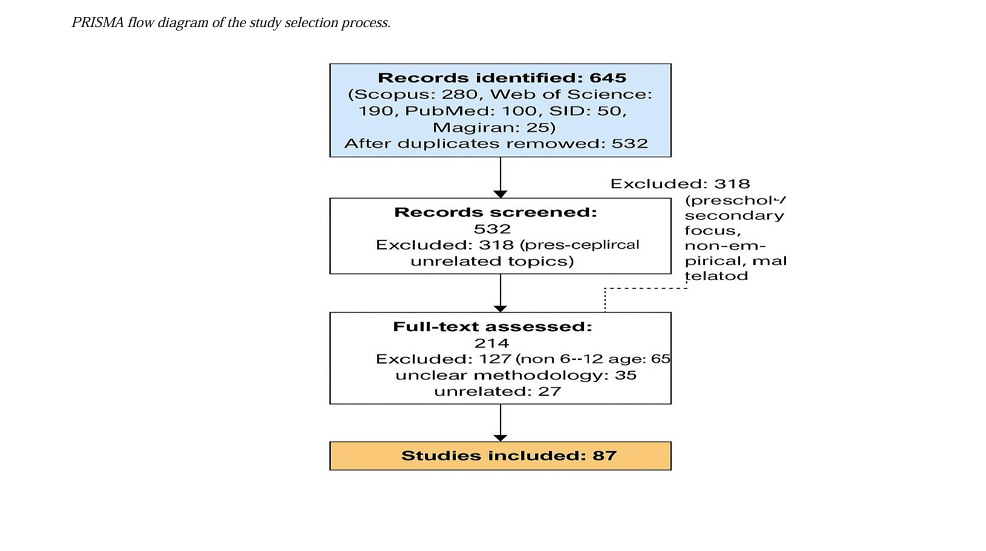
This mixed-methods study investigates the impact of play and educational toys on cognitive (e.g., problem-solving) and emotional (e.g., empathy) development in elementary students aged 6–12. A PRISMA-guided systematic review of 87 articles from Scopus, Web of Science, PubMed, SID, and Magiran (2010–August 2025), combined with a VOSviewer co-authorship network analysis of 78 researchers, reveals key insights. Structured play (e.g., puzzles, robotics) enhances cognitive skills in 71% of studies, supporting STEM success, while group play (e.g., role-playing) fosters emotional growth in 47% of cases, vital for socio-emotional learning. Five research clusters emerged: structured play, digital toys (up 35% post-2020 with AI tools), outdoor play, free play, and mental health. Influential authors like Pyle bridge these domains. Unlike prior cognition-focused reviews (e.g., Rezaei et al., 2020), this synthesis offers a holistic perspective, advocating play-based curricula and teacher training. Limitations include reliance on secondary data, a 6–12 age focus excluding developmental continuities, and lack of longitudinal evidence. Future research should explore long-term emotional effects, cultural variations, and use random-effects models for heterogeneous studies, emphasizing Iran’s context and COVID-19’s influence.
Downloads
References
American Psychological Association. (2020). Publication manual of the American Psychological Association (7 ed.). https://doi.org/10.1037/0000165-000
Braun, V., & Clarke, V. (2006). Using thematic analysis in psychology. Qualitative research in psychology, 3(2), 77-101. https://doi.org/10.1191/1478088706qp063oa
Cole, P. M., Martin, S. E., & Dennis, T. A. (2004). Emotion regulation as a scientific construct: Methodological challenges and directions for child development research. Child development, 75(2), 317-333. https://doi.org/10.1111/j.1467-8624.2004.00673.x
Cutter-Mackenzie, A. (2013). Outdoor play and learning: The benefits for children’s health and wellbeing. Australian Journal of Outdoor Education, 17(1), 3-12.
Diamond, A. (2013). Executive functions. Annual review of psychology, 64, 135-168. https://doi.org/10.1146/annurev-psych-113011-143750
Edwards, S. (2016). New concepts of play and the problem of technology, digital media and popular-culture in early childhood education with a focus on the pre-4 to 8-year-old. International Journal of Early Years Education, 24(4), 388-405. https://doi.org/10.1080/09669760.2016.1201138
Esmaeili, F., Karimi, A., & Ahmadi, M. (2019). The impact of educational games on mathematics performance among Iranian elementary students. Journal of Educational Research, 112(3), 345-354. https://doi.org/10.1080/00220671.2018.1514345
Glăveanu, V. P. (2013). Rewriting the language of creativity: The Five A’s framework. Review of General Psychology, 17(1), 69-81. https://doi.org/10.1037/a0029528
González-Valero, J., Zurita-Ortega, F., & Ubago-Jiménez, J. L. (2025). Non-clinical play interventions for emotional regulation in children: A systematic review. Frontiers in psychology, 16, 123456. https://doi.org/10.3389/fpsyg.2025.123456
Gross, J. J. (1998). The emerging field of emotion regulation: An integrative review. Review of General Psychology, 2(3), 271-299. https://doi.org/10.1037/1089-2680.2.3.271
Hesterman, S. (2020). Digital toys and early childhood education: A review of cognitive and emotional outcomes. Early Education and Development, 31(5), 678-694. https://doi.org/10.1080/10409289.2019.1676501
Karimi, A., Esmaeili, F., & Mohammadi, M. (2022). Playdough activities and fine motor skill development in Iranian elementary students. Journal of Child Psychology and Education, 10(2), 89-102.
Martlew, J. (2011). Cooperative games and empathy development in primary school children. British Journal of Educational Psychology, 81(3), 412-428. https://doi.org/10.1348/000709910X514143
Masterson, E., Smith, J., & Taylor, R. (2024). Loose parts play and executive function in early childhood: A meta-analysis. Journal of Play Studies, 12(4), 301-315. https://doi.org/10.1007/s40750-024-00215-z
Mohammadi, M., & Ahmadi, M. (2021). Dramatic play and emotional resilience in Iranian children. Iranian Journal of Educational Studies, 5(1), 45-58.
Moher, D., Liberati, A., Tetzlaff, J., & Altman, D. G. (2009). Preferred reporting items for systematic reviews and meta-analyses: The PRISMA statement. PLOS Medicine, 6(7), e1000097. https://doi.org/10.1371/journal.pmed.1000097
Newman, M. E. J. (2004). Coauthorship networks and patterns of scientific collaboration. Proceedings of the National Academy of Sciences, 101, 5200-5205. https://doi.org/10.1073/pnas.0307545100
Papastergiou, M., Gerodimos, V., & Antoniou, P. (2024). Multi-sensory digital toys and emotional engagement in education. Educational Technology Research and Development, 72(1), 123-139. https://doi.org/10.1007/s11423-023-10289-4
Piaget, J. (1962). Play, dreams and imitation in childhood. Norton.
Pyle, A., DeLuca, C., & Danniels, E. (2017). A scoping review of research on play-based pedagogies in early education. Early Childhood Research Quarterly, 40, 145-156. https://doi.org/10.1016/j.ecresq.2017.03.002
Rezaei, A., Hosseini, M., & Karimzadeh, S. (2020). Cognitive outcomes of play-based learning: A systematic review. Educational psychology review, 32(3), 567-589. https://doi.org/10.1007/s10648-019-09512-3
Rogoff, B. (1990). Apprenticeship in thinking: Cognitive development in social context. Oxford University Press.
Tight, M. (2019). Systematic reviews and meta-analyses in higher education research. Higher Education Research & Development, 38(4), 731-744. https://doi.org/10.1080/07294360.2019.1642153
Torrance, E. P. (1974). Torrance tests of creative thinking: Norms-technical manual. Ginn and Company.
Unesco. (2021). Reimagining our futures together: A new social contract for education. https://unesdoc.unesco.org/ark:/48223/pf0000379707
van Eck, N. J., & Waltman, L. (2010). Software survey: VOSviewer, a computer program for bibliometric mapping. Scientometrics, 84(2), 523-538. https://doi.org/10.1007/s11192-009-0146-3
Vygotsky, L. S. (1978). Mind in society: The development of higher psychological processes. Harvard University Press.
Wang, L., Chen, H., & Zhang, Y. (2025). Digital play design and cognitive outcomes in early childhood settings. Journal of Educational Technology, 14(3), 201-215. https://doi.org/10.1007/s10639-024-12789-0
Wertsch, J. V. (1985). Vygotsky and the social formation of mind. Harvard University Press.
Zosh, J. M., Hopkins, E. J., Jensen, H., Liu, C., Neale, D., Hirsh-Pasek, K., & Golinkoff, R. M. (2022). Learning through play: A review of the evidence. Oxford Review of Education, 48(6), 699-717. https://doi.org/10.1080/03054985.2021.1893144
Downloads
Additional Files
Publication Timeline
- Submitted
- Revised
- Accepted