The Effectiveness of Acceptance and Commitment Therapy on Rejection Sensitivity and Self-Acceptance in Individuals with Visual Impairment
DOI:
https://doi.org/10.61838/kman.prien.5124Keywords:
self-acceptance, rejection sensitivity, Acceptance and Commitment Therapy, visually impaired individualsAbstract
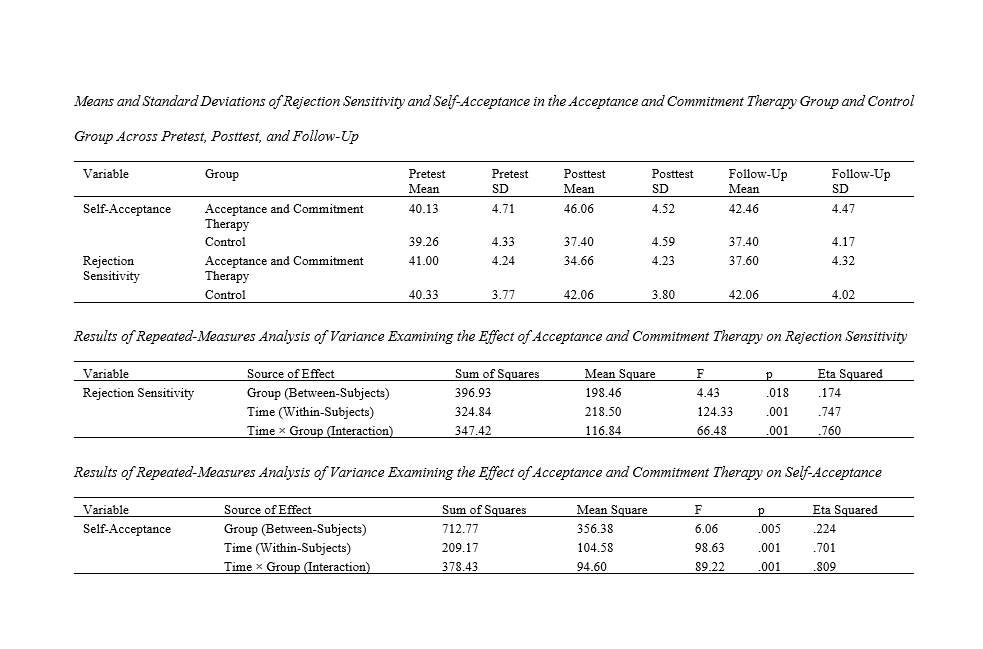
The present study aimed to examine the effectiveness of Acceptance and Commitment Therapy (ACT) on rejection sensitivity and self-acceptance among individuals with visual impairment. The research employed a quasi-experimental design with a pretest–posttest–follow-up structure including a control group. The statistical population consisted of all visually impaired individuals who were members of associations supporting persons with visual impairment and the Welfare Organization of Kurdistan Province during Spring 2025. From this population, 45 participants were selected using convenience sampling and were randomly assigned to two experimental groups and one control group. Participants completed the Rejection Sensitivity Questionnaire developed by Downey and Feldman (1996) and the Unconditional Self-Acceptance Questionnaire designed by Chamberlain and Haaga (2001) at pretest, posttest, and follow-up stages. Group sessions of Acceptance and Commitment Therapy were conducted for the intervention group based on the treatment protocol proposed by Hayes and Strosahl (2005) across eight 90-minute sessions. Acceptance and Commitment Therapy significantly reduced rejection sensitivity in the intervention group compared with the control group (p = .018). Furthermore, Acceptance and Commitment Therapy significantly increased self-acceptance in the intervention group compared with the control group (p = .005). The findings indicate that Acceptance and Commitment Therapy can be utilized as an effective intervention for reducing rejection sensitivity and enhancing self-acceptance among individuals with visual impairment. The implementation of this therapeutic approach in rehabilitation centers and psychological service settings may play an important role in promoting mental health, emotional adjustment, and improving the quality of life of visually impaired individuals.
Downloads
References
Bowins, B. (2021). Self-acceptance. In States and Processes for Mental Health (pp. 75-84). Academic Press. https://doi.org/10.1016/B978-0-323-85049-0.00007-6
Chagas Ferreira, M. C., Pellegrini, M. A., & Sequeira, B. J. (2025). Prevalence of blindness and visual impairment among Yanomami Indigenous people in the Brazilian Amazon region: a cross-sectional observational study at CASAI-Y. The Lancet Regional Health - Americas, 48, 101161. https://doi.org/10.1016/j.lana.2025.101161
Chamberlain, J. M., & Haaga, D. A. F. (2001). Unconditional Self-Acceptance and Psychological Health. Journal of Rational-Emotive and Cognitive-Behavior Therapy, 19(3), 163-176. https://doi.org/10.1023/A:1011189416600
Chandola, T., & Conibere, R. (2015). Social Exclusion, Social Deprivation and Health. In International Encyclopedia of the Social & Behavioral Sciences (pp. 285-290). Elsevier. https://doi.org/10.1016/B978-0-08-097086-8.14087-5
Chin, F., & Hayes, S. C. (2017). Acceptance and Commitment Therapy and the Cognitive Behavioral Tradition: Assumptions, Model, Methods, and Outcomes. In The Science of Cognitive Behavioral Therapy (pp. 155-173). Academic Press. https://doi.org/10.1016/B978-0-12-803457-6.00007-6
Flaxman, P. E., Blackledge, J. T., & Bond, F. W. (2014). Acceptance and commitment therapy: Distinctive features. Arjmand. https://api.taylorfrancis.com/content/books/mono/download?identifierName=doi&identifierValue=10.4324/9780203834688&type=googlepdf
Gould, R. L., & Wetherell, J. L. (2022). Acceptance and Commitment Therapy and Other Third Wave Therapies. In Comprehensive Clinical Psychology (pp. 355-366). Elsevier. https://doi.org/10.1016/B978-0-12-818697-8.00024-8
Hayes, S. C., & Smith, S. (2005). Get Out of Your Mind and Into Your Life: The New Acceptance and Commitment Therapy. New Harbinger Publications. https://www.amazon.com/Get-Your-Mind-Into-Life/dp/1572244259
Huisman, M., & van Tilburg, T. G. (2021). Social exclusion and social isolation in later life. In Handbook of Aging and the Social Sciences (pp. 99-114). Academic Press. https://doi.org/10.1016/B978-0-12-815970-5.00007-3
Javaheri Moghanlou, A., Sadri, E., & Kiani, A. (2024). Comparison of self-acceptance, self-compassion and fear of negative evaluation by others in blind, visually impaired and normal people. Preventive Counseling, 5(2), 73-90. https://doi.org/10.22098/jpc.2024.14636.1217
Klimczak, K. S., & Levin, M. E. (2023). Acceptance and commitment therapy. In Encyclopedia of mental health (pp. 1-9). Academic Press. https://doi.org/10.1016/B978-0-323-91497-0.00121-1
Kong, L., Gao, Z., Xu, N., Shao, S., Ma, H., He, Q., Zhang, D., Xu, H., & Qu, H. (2021). The relation between self-stigma and loneliness in visually impaired college students: Self-acceptance as mediator. Disability and Health Journal, 14(2), 101054. https://doi.org/10.1016/j.dhjo.2020.101054
Mirmohammadi, F., & Pourmohammadreza-Tajrishi, M. (2024). The effect of acceptance and commitment group therapy on emotional maturity of female adolescents with visual impairment. Journal of Rehabilitation, 25(1), 48-71. http://rehabilitationj.uswr.ac.ir/browse.php?a_id=3287&slc_lang=fa&sid=1&ftxt=1&html=1
Mirmohammadi, F., Pourmohammadreza-Tajrishi, M., Dolatshahi, B., & Bakhshi, E. (2021). The effectiveness of group-based acceptance and commitment therapy on self-esteem of female students with visual impairment. Journal of Rehabilitation, 22(4), 462-481. https://www.sid.ir/paper/997607/fa
Mirzaie Varzaneh, M., Yazdkhasti, F., Ghamarani, A., & Abbasi Jondani, J. (2020). Effectiveness of Acceptance and Commitment Therapy on Reducing Perceived Stress and Enhancing Social Adjustment in Youths with Visual Impairment. The Scientific Journal of Rehabilitation Medicine, 9(4), 71-81. https://doi.org/10.22037/jrm.2020.112738.2246
Morris, E., Johns, L., & Oliver, J. E. (2017). Acceptance and commitment therapy and mindfulness for psychosis. Arjmand. https://books.google.com/books?hl=en&lr=&id=qGPeSqI-ZjEC&oi=fnd&pg=PR14&dq=Morris,+E.,+et+al.+(2017).+Acceptance+and+commitment+therapy+and+mindfulness+for+psychosis.+Tehran,+Arjmand.+%09&ots=2xqhavqsuw&sig=SI9Vm-ZQCsyKYBF3VobSBaCgYnE
Nakade, A., Rohatgi, J., Bhatia, M. S., & Dhaliwal, U. (2017). Adjustment to acquired vision loss in adults presenting for visual disability certification. Indian Journal of Ophthalmology, 65(3), 228-232. https://doi.org/10.4103/ijo.IJO_483_16
Zettle, R. D. (2016). The self in acceptance and commitment therapy. In The self in understanding and treating psychological disorders (pp. 50-58). Cambridge University Press. https://doi.org/10.1017/CBO9781139941297.007
Downloads
Additional Files
Publication Timeline
- Submitted
- Revised
- Accepted