Assessment of Spiritual Vitality and Marital Satisfaction in Parents of Children Aged 6–12 Years with Autism Spectrum Disorder
DOI:
https://doi.org/10.61838/kman.prien.5374Keywords:
Autism Spectrum Disorder, marital satisfaction, satisfaction scale, spiritual vitality, parentsAbstract
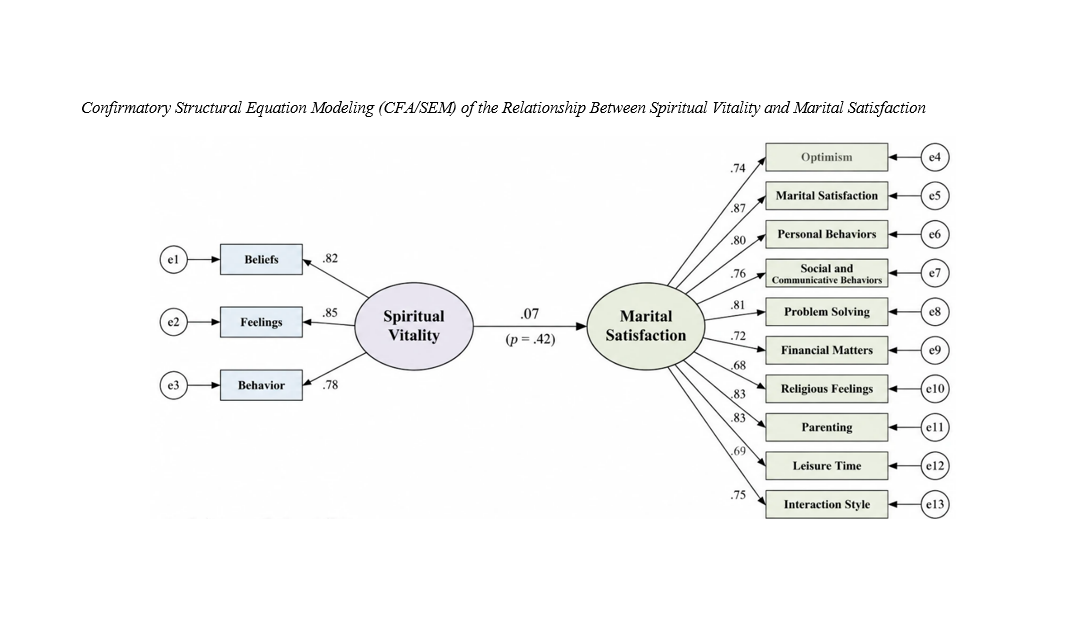
The aim of this study was to investigate the relationship between spiritual vitality and marital satisfaction among parents of children aged 6–12 years diagnosed with Autism Spectrum Disorder (ASD). This study employed a descriptive-correlational design with a quantitative approach. The statistical population consisted of parents referring to the Iranian Autism Association in Tehran Province, from whom 100 participants (50 couples) were selected using purposive sampling. Data were collected using the standardized Afrouz Marital Satisfaction Questionnaire and the Afrouz Spiritual Vitality Scale. Data analysis was conducted through correlation coefficients and analysis of variance using SPSS software. The findings indicated that there was no significant relationship between the total score of spiritual vitality and marital satisfaction among the parents. However, subscale analyses revealed that certain dimensions of marital satisfaction, including marital contentment, positive thinking, and communicational-social behaviors, were correlated with spiritual vitality, and the relationships among these components were statistically significant. In addition, no significant differences were observed between fathers and mothers regarding spiritual vitality and marital satisfaction; nevertheless, the mean scores reflected relatively low to moderate levels of these two variables among the parents. These findings suggest that although spiritual vitality alone is not a direct predictor of marital satisfaction in this group, fostering spirituality-oriented dimensions within married life may indirectly influence the quality of the relationship among couples raising a child with autism. The results highlight the necessity of designing holistic interventions focused on strengthening spiritual and communicational resources in these families.
Downloads
References
Abolkheirian, S., Sadeghi, R., & Shojaeizadeh, D. (2021). What do parents of children with autism spectrum disorder think about their quality of life? A qualitative study. Journal of education and health promotion, 11(1), 169.
Admiral, R. (2023). Navigating consent: On women's sexual agency in the premodern Islamic West. Journal of Feminist Studies in Religion, 39(1), 69-86.
Araghian, M., Heidari, G., & Yaghoubi. (2022). Factors affecting students’ spiritual vitality: A narrative review. Journal of Nursing Development in Health, 12(1), 12-21.
Bazrafshan, B., Kargar Dolatabadi, A., Mohammadi, M., Sarmadi, P., Lakzaei, J., Hosseini Nejad, S. M., Sanagoo, A., Kavosi, A., & Jouybari, A. (2019). Quality of life of mothers of children with autism disorder. Journal of Gorgan University of Medical Sciences, 20(4), 1-4.
Dadkhah Kalashmi, Z., Asaseh, M., Vakili, S., Afrooz, G., & Hasanzadeh, S. (2022). Structural equation modeling of marital satisfaction and spiritual vitality based on personality traits with the mediating role of coping behaviors among parents of 14- to 18-year-old adolescent girls with conduct disorder symptoms. Journal of Disability Studies.
Desiningrum, D. R., Suminar, D. R., & Surjaningrum, E. R. (2019). Psychological well-being among mothers of children with autism spectrum disorder: The role of family function. Humanitas, 16(2), 106. https://doi.org/10.26555/humanitas.v16i2.10981
Estes, A., Swain, D. M., & MacDuffie, K. E. (2019). The effects of early autism intervention on parents and family adaptive functioning. Pediatric Medicine, 2. https://doi.org/10.21037/PM.2019.05.05
Farahini, N., Afrooz, G., Ghobari Bonab, B., & Arjmandnia, A. A. (2019). Effectiveness of an Islamic-Iranian values-based meaning therapy program on marital satisfaction among parents of exceptional children.
Fortien, W. S., & Kusumiati, R. Y. E. (2023). Forgiveness and emotional well-being: A study of parents of children with autism spectrum disorders. Jurnal Bimbingan dan Konseling Terapan, 8(2), 127-139.
Hayati, A., Handari, S., Awaliah, F. K., Azizah, A. R., & Kurniad, I. B. A. (2025). Are Resilience, and Spirituality Related to Marital Peace? Explorations in Silver Age Couples. Edu Consilium Jurnal Bimbingan Dan Konseling Pendidikan Islam, 6(1), 1-14. https://doi.org/10.19105/ec.v6i1.17189
Irshad, B., Pervez, R., Nayab, G., Naseem, N., Khan, M. N., & Awan, Z. (2023). Parenting stress and marital satisfaction among parents of children with neurodevelopmental disorders: Moderating role of resilience. The Rehabilitation Journal, 7(02), 525-531. https://doi.org/10.52567/trj.v7i02.201
Jassim, M. M., Ali, M. H., Elamer, A. S., Jaber, M. M., Mohammed, M. Q., & Alkhayyat, A. (2022). Multi-Criteria Decision Making for Machine Learning Algorithms Using AHP-VIKOR techniques: Case Study Adult Autism Diagnosis. 2022 5th International Conference on Engineering Technology and its Applications (IICETA),
Matiei, Z., Borjali, A., & Taghvaei, D. (2014). The mediating role of love story in the relationship between early maladaptive schemas and marital satisfaction. International Journal of Behavioral Sciences, 194.
Mohammadi, Afrooz, Gholamali, Shahnazari, Ghasemzadeh, & Sogand. (2022). Spiritual vitality and communication skills of gifted students and graduates who entered university before age 15. Journal of Jundishapur Education Development, 13(2), 282-294.
Mostafa, S., Karim, Z., & Hossain, M. I. (2023). Autism detection based on MRI images using Deep Learning. 2023 26th International Conference on Computer and Information Technology (ICCIT),
Omoboye, M., Eneh, N. E., & Titor-Addingi, M. C. (2024). Communication patterns and marital satisfaction: A review of English language discourse in family counseling. World Journal of Advanced Research and Reviews, 21(2), 1883-1891. https://doi.org/10.30574/wjarr.2024.21.2.0634
Saadat Talab, A., & Jafari, M. (2020). Analysis of the role of spiritual vitality in the relationship between social capital and social support with employees’ resilience against the COVID-19 pandemic during social distancing. Quarterly Journal of Research in Psychological Health, 14(1), 115-129.
Saraei Jamab, M., Hasanabadi, H., Mashhadi, A., & Asghari Nekah, M. (2011). The effect of parent training on the self-efficacy of mothers of children with autism. Journal of Fundamentals of Mental Health, 1, 84-93.
Soltani, F., Mardani Hamuleh, M., Seyedfatemi, N., Hamidi, H., & Haghani, S. (2022). Spiritual health of mothers of children with autism disorder in Tehran: A descriptive study.
Williamson, I. (2024). The Associations Between Adverse Childhood Experiences, Shared Religious/Spiritual Practices, and Relationship Satisfaction in Couple Therapy. Pastoral Psychology. https://onlinelibrary.wiley.com/doi/abs/10.1111/jmft.12761
Xu, J., & Yang, W. (2023). Autism Diagnosis using Linear and Nonlinear Analysis of Resting-State EEG and Self-Organizing Map. International Journal of Advanced Computer Science and Applications, 14(9). https://doi.org/10.14569/ijacsa.2023.01409123
Yoon, S. H., Choi, J., Lee, W. J., & Do, J. T. (2020). Genetic and epigenetic etiology underlying autism spectrum disorder. Journal of clinical medicine, 9(4), 966.
Downloads
Additional Files
Publication Timeline
- Submitted
- Revised
- Accepted