Comparison of the Effectiveness of Transcranial Direct Current Stimulation and Cognitive Emotion Regulation Training on Impulsivity in Adults with Attention-Deficit/Hyperactivity Disorder
DOI:
https://doi.org/10.61838/kman.prien.5568Keywords:
Adult Attention-Deficit/Hyperactivity Disorder, Impulsivity, Transcranial Direct Current Stimulation, Cognitive Emotion Regulation Training, Non-pharmacological InterventionsAbstract
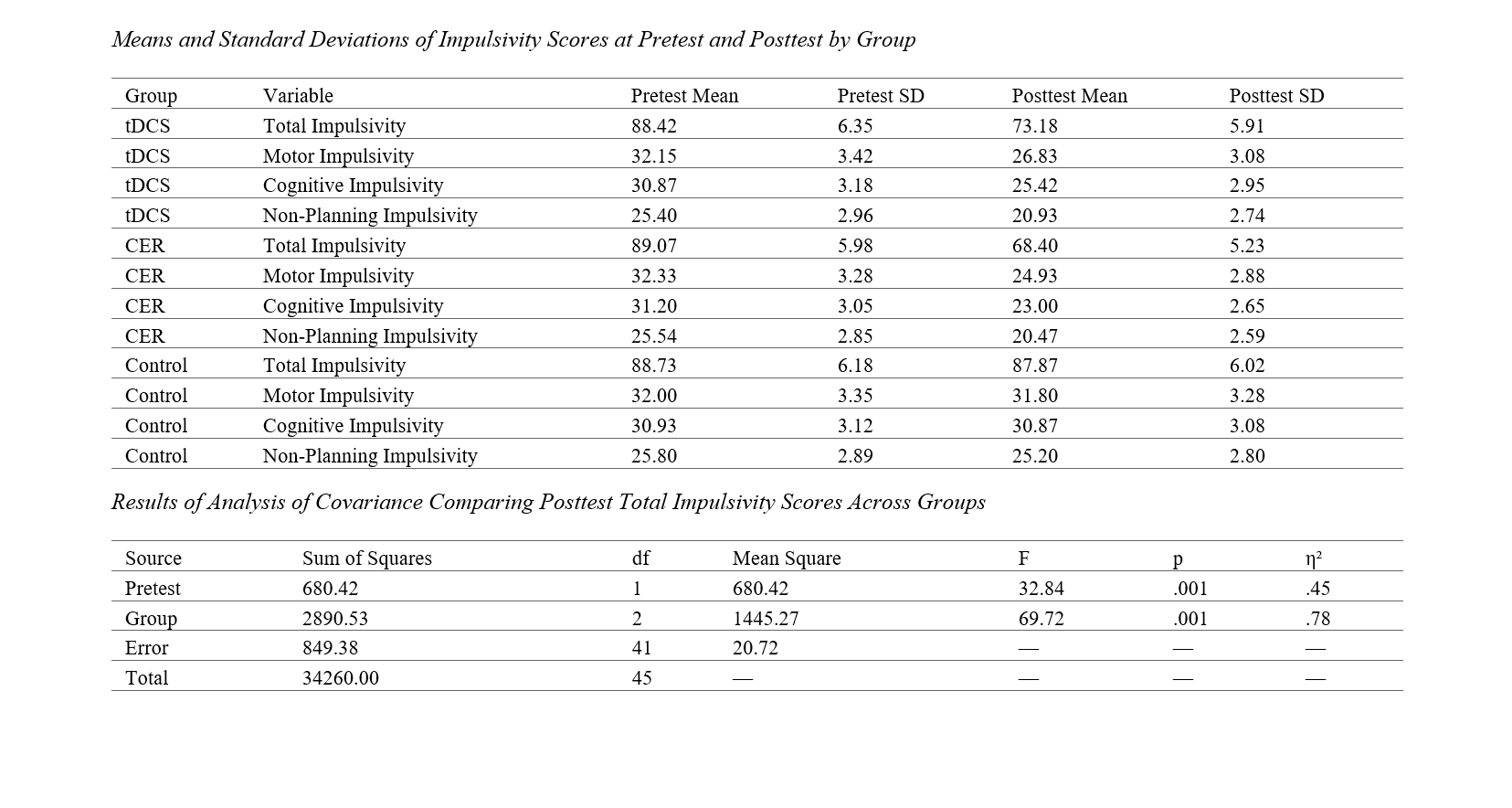
This study was conducted to compare the effectiveness of two non-invasive interventions, namely transcranial direct current stimulation (tDCS) and cognitive emotion regulation training, in reducing impulsivity among adults with Attention-Deficit/Hyperactivity Disorder (ADHD). The study employed a quasi-experimental design with a pretest–posttest control group. A total of 45 adults diagnosed with ADHD were selected through convenience sampling and randomly assigned to three groups of 15 participants each: a transcranial direct current stimulation group, a cognitive emotion regulation training group, and a control group. The transcranial direct current stimulation group received anodal stimulation over the left dorsolateral prefrontal cortex (DLPFC) at an intensity of 2 mA for 20 minutes across 10 sessions. The cognitive emotion regulation training group participated in 10 sessions of 90 minutes each, receiving cognitive emotion regulation training based on standardized protocols. The control group was placed on a waiting list. Data were collected using the Barratt Impulsiveness Questionnaire and the ADHD Impulsivity Scale during the pretest and posttest phases. Data were analyzed using analysis of covariance (ANCOVA) in SPSS version 26. The results of the ANCOVA indicated that, after controlling for pretest effects, significant differences existed among the groups in posttest impulsivity scores. Pairwise comparisons revealed that both transcranial direct current stimulation and cognitive emotion regulation training significantly reduced overall impulsivity and its subscales (motor impulsivity, cognitive impulsivity, and non-planning impulsivity) compared with the control group. Furthermore, cognitive emotion regulation training produced greater reductions in impulsivity scores than transcranial direct current stimulation, particularly in the cognitive impulsivity subscale. Based on the findings, both transcranial direct current stimulation and cognitive emotion regulation training are effective approaches for reducing impulsivity in adults with ADHD. However, cognitive emotion regulation training demonstrated greater effectiveness due to its influence on the cognitive-emotional mechanisms associated with impulsivity.
Downloads
References
Alipour, S., Sadeghi, A., & Karimi, M. (2023). Comparison of Brain-Behavioral Systems, Decision Making Styles and Cognitive Emotion Regulation in Adults with and without ADHD. Clinical Psychology and Personality, 21(2), 45-58. https://doi.org/10.22070/CPAP.2023.17189.1287
Cortese, S., Bellgrove, M. A., Brikell, I., Franke, B., Goodman, D. W., Hartman, C. A., Larsson, H., Levin, F. R., Ostinelli, E. G., Parlatini, V., Ramos-Quiroga, J. A., Sibley, M. H., Tomlinson, A., Wilens, T. E., Wong, I. C. K., Hovén, N., Didier, J., Correll, C. U., Rohde, L. A., & Faraone, S. V. (2025). Attention-Deficit/Hyperactivity Disorder (ADHD) in Adults: Evidence Base, Uncertainties and Controversies. World Psychiatry, 24(3), 347-371. https://doi.org/10.1002/wps.21374
Courrèges, M., Hoareau, M., Levenes, C., & Rahioui, H. (2025). Comparative Efficacy of Neurofeedback, tDCS, and TMS: The Future of Therapy for Adults with ADHD. A Systematic Review and Meta-Analysis. Journal of affective disorders. https://doi.org/10.1016/j.jad.2025.06.009
Garnefski, N., Kraaij, V., & Spinhoven, P. (2001). Negative Life Events, Cognitive Emotion Regulation and Emotional Problems. Personality and individual differences, 30(8), 1311-1327.
Liang, X., Wei, X., Huang, Y., Li, J., Feng, H., Fan, J., Zhang, L., Wang, Z., Zhao, X., Pan, W., & Liu, R. (2025). Comparative Efficacy of Non-Invasive Brain Stimulation for Attention-Deficit/Hyperactivity Disorder: A Systematic Review and Network Meta-Analysis. Frontiers in Neurology, 16, 1650154. https://doi.org/10.3389/fneur.2025.1650154
Liu, Q., Feng, Y., Chen, W., Zhu, Y., Preece, D. A., Gao, Y., & Liu, L. (2025). Emotion Regulation Strategy and Its Relationship with Emotional Dysregulation in Children with Attention-Deficit/Hyperactivity Disorder: Behavioral and Brain Findings. European Child & Adolescent Psychiatry, 34(7), 2241-2252. https://doi.org/10.1007/s00787-025-02643-7
Nejati, V., Khorrami, A. S., & Nitsche, M. A. (2024). Transcranial Direct Current Stimulation (tDCS) Improves Emotion Regulation in Children with Attention-Deficit Hyperactivity Disorder (ADHD). Scientific reports, 14, 13889. https://doi.org/10.1038/s41598-024-64886-9
Park, J., Murray, R., Duffy, R. D., & Zhou, Z. E. (2026). Longitudinal Relationship of Childhood Attention-Deficit/Hyperactivity Disorder (ADHD) Symptoms with Perceived Stress and Job Satisfaction in Adulthood. Child Psychiatry & Human Development. https://doi.org/10.1007/s10578-026-02036-0
Rodríguez-Prieto, P., Soler-Vázquez, J., & Ibáñez-Alfonso, J. A. (2026). Combined tDCS and Neuropsychological Treatment for Adult ADHD: A Single-Case Feasibility Study on Cognitive and Emotional Outcomes. Brain Sciences, 16(3), 339. https://doi.org/10.3390/brainsci16030339
Shi, J., Jiang, L., Jia, F., Li, C., & Wang, F. (2024). Effects of Non-Invasive Brain Stimulation on Emotion Regulation in Patients with Attention Deficit Hyperactivity Disorder: A Systematic Review. Frontiers in Psychiatry, 15, 1483753. https://doi.org/10.3389/fpsyt.2024.1483753
Siqueira, I. M. V., Carreiro, L. R. R., Dias, N. M., Delorenzi, J. C. M. O. B., Blascovi-Assis, S. M., & Seabra, A. G. (2025). ADHD in Adults and Relationship with Executive Functioning and Quality of Life. European Psychiatry, 38(Supplement), EPV1315. https://doi.org/10.1192/j.eurpsy.2025.1872
Tharaud, J. B., & Nikolas, M. A. (2025). Emotion Regulation as a Transdiagnostic Link between ADHD and Depression Symptoms: Evidence from a Network Analysis of Youth in the ABCD Study. Child and adolescent psychiatry and mental health, 19, 113. https://doi.org/10.1186/s13034-025-00966-6
Tung, C. B., Liang, S. C., Sun, C. K., Cheng, Y. S., & Hung, K. C. (2025). Behavioral Outcomes after tDCS Treatment during Immediate Post-Intervention and Follow-Up Periods in Children and Adolescents Diagnosed with Attention-Deficit/Hyperactivity Disorder: A Systematic Review and Meta-Analysis on Randomized Sham-Controlled Trials. Journal of psychiatric research, 191, 8-14. https://doi.org/10.1016/j.jpsychires.2025.09.008
Wang, L., Liao, W., & Yang, R. (2025). Efficacy and Safety of Transcranial Direct Current Stimulation for Attention Deficit Hyperactivity Disorder: A Meta-Analysis. Alpha Psychiatry, 26(5), 47294. https://doi.org/10.31083/AP47294
Wen, Y. H., Pan, W. F., Sun, C. K., Cheng, Y. S., & Hung, K. C. (2025). Therapeutic Effects of tDCS on Behavioral and Cognitive Functions in Adults Diagnosed with Attention-Deficit/Hyperactivity Disorder: A Systematic Review and Meta-Analysis on Randomized Controlled Trials. European Archives of Psychiatry and Clinical Neuroscience. https://doi.org/10.1007/s00406-025-02162-1
Yang, X., Zhang, L., Yu, J., & Wang, M. (2025). Short-Term and Long-Term Effect of Non-Pharmacotherapy for Adults with ADHD: A Systematic Review and Network Meta-Analysis. Frontiers in Psychiatry, 16, 1516878. https://doi.org/10.3389/fpsyt.2025.1516878
Downloads
Additional Files
Publication Timeline
- Submitted
- Revised
- Accepted