The Effectiveness of Problem-Solving Training on Coping Behavior and Academic Adjustment in Students with Learning Disabilities
DOI:
https://doi.org/10.61838/kman.prien.5614Keywords:
Problem-Solving Training, Coping Behavior, Academic Adjustment, Learning DisabilityAbstract
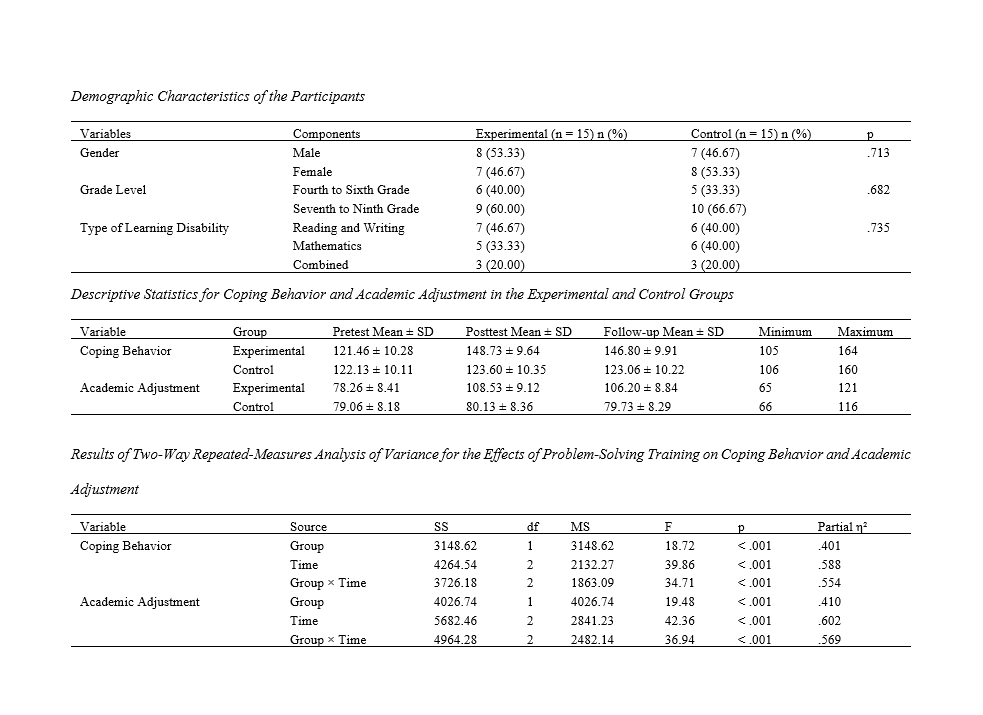
The present study was conducted to determine the effectiveness of problem-solving training on coping behavior and academic adjustment among students with learning disabilities. This study employed a quasi-experimental design with a pretest–posttest and two-month follow-up assessment, including a control group. The statistical population consisted of students with learning disabilities in Tehran during 2026 who had been identified through learning disability centers, schools providing special educational services, academic counseling centers, and selected schools across Tehran. Following the initial screening process, participants completed the Children's Coping Behaviors Questionnaire developed by Hernandez and the Academic Adjustment Questionnaire developed by Baker and Siryk. Subsequently, 30 participants were selected using purposive sampling and randomly assigned to either the experimental group or the control group, with 15 students in each group. The experimental group received problem-solving training based on the D’Zurilla and Goldfried model in eight 60-minute sessions, while the control group received no intervention during this period. Data were analyzed using the independent-samples t-test, Fisher’s exact test, and two-way repeated-measures analysis of variance in SPSS version 26. The results indicated that there were no significant differences between the experimental and control groups regarding demographic characteristics. Furthermore, the findings of the two-way repeated-measures analysis of variance revealed that the interaction effect of group and time was significant for both coping behavior and academic adjustment. Comparison of mean scores showed that coping behavior and academic adjustment scores in the experimental group increased from the pretest to the posttest stage, and these improvements remained largely stable at the two-month follow-up assessment. In contrast, no substantial changes were observed in the control group. Based on the findings, problem-solving training can improve coping behavior and enhance academic adjustment among students with learning disabilities.
Downloads
References
Ahmadi, A., Adibsereshki, N., & Vahedi, M. (2025). Academic Stress and Coping Strategies among Students with and without Learning Disabilities. Health and Development Journal, 14(1), 1-6. https://doi.org/10.34172/jhad.1170
Babazadeh, Z., Mojaver, S., & Fathi, K. (2021). Examining the Effect of Problem-Solving Training on Self-Concept, Self-Esteem, and Self-Regulation of Students with Learning Disabilities. Learning Disabilities, 11(1), 6-19.
Bordfarzam, S., Morovati, Z., & Yousefi Afrashteh, M. (2025). Effectiveness of Social Problem-Solving Training on Adjustment and Assertiveness in Female Elementary School Students as Victims of Bullying. Iranian Journal of Educational Research, 4(4), 1-19. https://doi.org/10.22034/4.4.1
Cristofani, P., Di Lieto, M. C., Casalini, C., Pecini, C., Baroncini, M., Pessina, O., Gasperini, F., Dasso Lang, M. B., Bartoli, M., Chilosi, A. M., & Milone, A. (2023). Specific Learning Disabilities and Emotional-Behavioral Difficulties: Phenotypes and Role of the Cognitive Profile. Journal of clinical medicine, 12(5), 1882. https://doi.org/10.3390/jcm12051882
Dashti, N., Panahali, A., & Azmoudeh, M. (2021). The Effectiveness of Social-Cognitive Problem-Solving Training on Social Self-Empowerment and Social Adjustment of Students. Journal of New Psychological Research, 16(61), 52-64.
Deepthi, D. P., Jeyavel, S., Subhasree, G., & Jojo, C. E. (2022). Proactive Coping and Social-Emotional Adjustment among Students with and without Learning Disabilities in Kerala, India. Frontiers in psychology, 13, 949708. https://doi.org/10.3389/fpsyg.2022.949708
Fattahi, O., Jadidi, H., Ahmadian, H., & Moradi, O. (2021). The Effectiveness of an Academic Resilience, School Attachment, Academic Self-Concept, and Academic Engagement Training Package on Academic Adjustment. Journal of Educational Psychology Studies, 18(43), 63-84.
Grigorenko, E. L., Compton, D. L., Fuchs, L. S., Wagner, R. K., Willcutt, E. G., & Fletcher, J. M. (2020). Understanding, Educating, and Supporting Children with Specific Learning Disabilities: 50 Years of Science and Practice. American psychologist, 75(1), 37-51. https://doi.org/10.1037/amp0000452
Rajabian, F., Adibsereshki, N., Poshtmashhadi, M., & Vahedi, M. (2025). The Effect of Problem-Focused Coping Skills Training on Coping Styles and Stress Levels of Mothers of Children with Learning Disorders: An Experimental Study. Health Research and Development, 3(1), 10-21.
Sarid, M., & Lipka, O. (2023). Students with Learning Disabilities/Attention-Deficit/Hyperactivity Disorder in Higher Education Dealing with Remote Learning: Lessons Learned from COVID-19 Era. Frontiers in psychology, 14, 1172771. https://doi.org/10.3389/fpsyg.2023.1172771
Zare, M., Khorrami, F., & Arbazi, M. (2021). The Structural Relationship between Positive Moral Traits and Academic Adjustment in Shiraz University Students. Education and Evaluation, 14(55), 35-55.
Zhao, Y., Ding, Y., Chekired, H., & Wu, Y. (2022). Student Adaptation to College and Coping in Relation to Adjustment during COVID-19: A Machine Learning Approach. PLoS One, 17(12), e0279711. https://doi.org/10.1371/journal.pone.0279711
Downloads
Additional Files
Publication Timeline
- Submitted
- Revised
- Accepted