The Effectiveness of Acceptance and Commitment Therapy on Positive Thinking and Lifestyle among Mothers of Children with Autism
DOI:
https://doi.org/10.61838/kman.prien.5630Keywords:
Acceptance and Commitment Therapy (ACT), Positive Thinking, Lifestyle, Autism Spectrum Disorder, Mothers of Children with Autism, Psychological FlexibilityAbstract
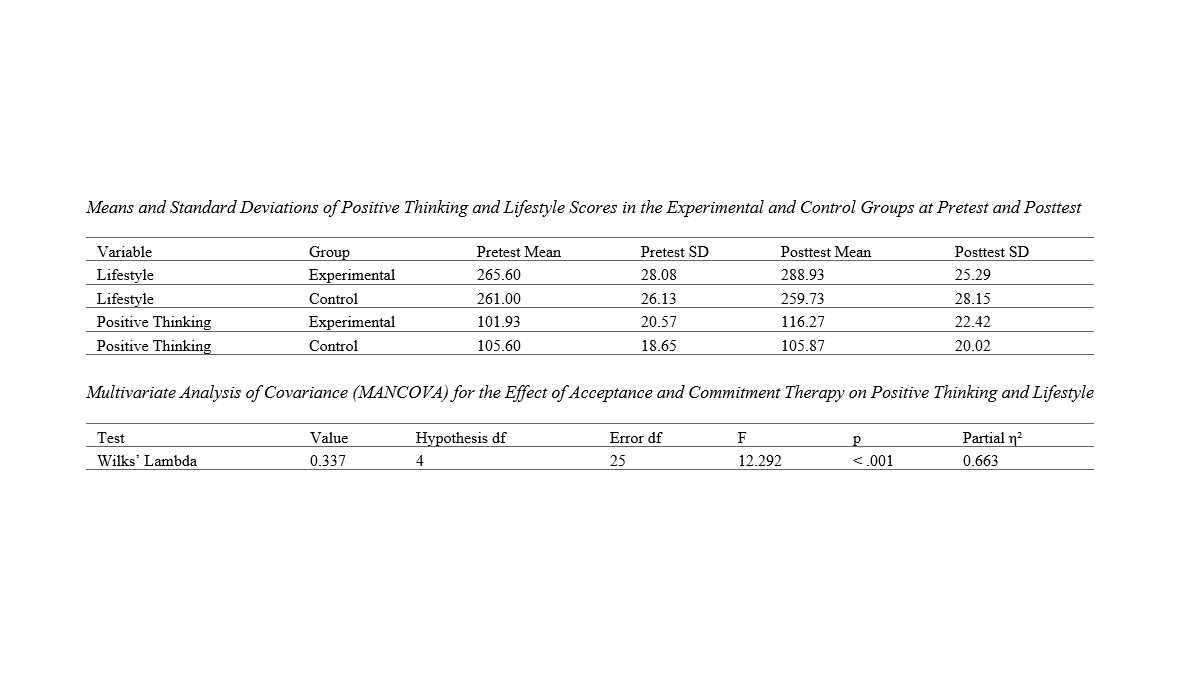
The present study aimed to investigate the effectiveness of Acceptance and Commitment Therapy (ACT) on positive thinking and lifestyle among mothers of children with autism in Tonekabon, Iran. This study employed a quasi-experimental design with pretest–posttest measurements and a control group. The statistical population consisted of mothers of children diagnosed with autism spectrum disorder in Tonekabon during 2022. Initially, 45 mothers completed the Positive Thinking Questionnaire developed by Ingram and Wisnicki and the Lifestyle Questionnaire developed by Lali et al. Based on the screening results, 30 participants were selected and randomly assigned to either an experimental group (n = 15) or a control group (n = 15). The experimental group participated in eight 90-minute sessions of Acceptance and Commitment Therapy, while the control group received no intervention. Following the intervention, both groups completed the study measures again. Data were analyzed using descriptive statistics, multivariate analysis of covariance (MANCOVA), and univariate analysis of covariance (ANCOVA) through SPSS software. Multivariate covariance analysis revealed a significant overall effect of the intervention on the combined dependent variables of positive thinking and lifestyle (Wilks’ Lambda = 0.337, F(4,25) = 12.292, p < .001, η² = .663). The results indicated significant differences between the experimental and control groups in posttest scores after controlling for pretest values. Descriptive findings showed that the experimental group demonstrated substantial increases in both lifestyle and positive thinking scores from pretest to posttest, whereas changes in the control group were negligible. The effect size suggested that approximately 66% of the variance in the combined dependent variables was attributable to the ACT intervention. These findings support the effectiveness of Acceptance and Commitment Therapy in improving psychological and lifestyle-related outcomes among mothers of children with autism. The findings indicate that Acceptance and Commitment Therapy is an effective intervention for enhancing positive thinking and improving lifestyle among mothers of children with autism. By fostering psychological flexibility, acceptance of difficult experiences, value-based action, and adaptive coping strategies, ACT contributes to improved psychological well-being and healthier life patterns in this population.
Downloads
References
Aghaverdinejad, S., Akbari, B., & Sadeghi, A. (2022). Comparison of the Effectiveness of Cognitive-Behavioral Therapy and Acceptance and Commitment Therapy on Quality of Life and Subjective Well-Being of Mothers of Children with Autism Spectrum Disorder. Community Health, 16(3), 14-26.
Alavi, Z., & Dehghani, M. (2020). Examining the Factor Structure, Reliability, and Validity of the Short Form of the Parenting Stress Index (PSI-SF) among Mothers of 7-12-Year-Old Normal Children. Journal of Behavioral Sciences Research, 16, 81-91.
Bennett, K. M., & Twohig, M. P. (2023). The Impact of Acceptance and Commitment Therapy on Parental Well-Being and Child Outcomes: A Randomized Controlled Trial. Journal of Contextual Behavioral Science, 20, 100582.
Cachia, R., Anderson, A., & Moore, D. (2020). Mindfulness, Stress and Well-Being in Parents of Children with Autism Spectrum Disorder: A Systematic Review. Journal of Child and Family Studies, 25, 1-14. https://doi.org/10.1007/s10826-015-0193-8
Damreihani, N., Behzadipour, S., Haghpanh, S., & Bordbar, M. (2018). The Effectiveness of Positive Psychology Intervention on the Wellbeing, Meaning, and Life Satisfaction of Mothers of Children with Cancer: A Brief Report. Journal of Psychosocial Oncology, 1-9. https://doi.org/10.1080/07347332.2018.1427173
Eini, S. (2021). Autism Disorder: From Diagnosis to Treatment (3rd ed.). Avaye Noor Publishing.
García, M., López, S., & Martínez, A. (2023). Exploring the Lifestyle and Self-Care Practices of Mothers of Children with Autism Spectrum Disorder. Journal of Developmental and Physical Disabilities, 35(4), 515-530.
Ghadiri, M. (2020). Effectiveness of Forgiveness Training on Positive Thinking, Lifestyle, and Happiness of Mothers of Students with Specific Learning Disorder in Tabas. Psychology of Exceptional Individuals Quarterly, 7(28), 187-207.
Gobrial, E. (2018). The Lived Experiences of Mothers of Children with the Autism Spectrum Disorders in Egypt. Social Sciences, 7(133), 1-11. https://doi.org/10.3390/socsci7080133
Hayes, S. C., Strosahl, K. D., & Wilson, K. G. (2020). A Practical Guide to Acceptance and Commitment Therapy (2nd ed.). Springer.
Lundahl, B. W., & Risser, H. J. (2021). Acceptance and Commitment Therapy (ACT) for Anxiety and Depression in Parents: A Randomized Controlled Trial. Journal of Clinical Psychology, 77(1), 123-138.
Miri, R. (2019). Comparison of the Effectiveness of Acceptance and Commitment Therapy and Cognitive-Behavioral Therapy on Symptoms of Patients with Obsessive-Compulsive Disorder. Journal of Behavioral Research Sciences, 1(12), 19-33.
Moradi, M. (2018). Effectiveness of Positive Thinking Skills Training on Positive Thinking, Lifestyle, and Loneliness among Elderly Women. Piri Psychology, 1(2), 61-71.
Nakhaei, S., Akati, A., Ranjbarnoori, H., & Mir, A. (2022). Evaluating the Effect of Emotion Control on Positive Thinking and Social Anxiety of Students. New Ideas in Psychology, 13(17), 28-42.
Resch, J. A., Mireles, G., Benz, M. R., Grenwelge, C., Peterson, R., & Zhang, D. (2025). The Effectiveness of Acceptance and Commitment Therapy on Parental Stress in Parents of Special Children: A Meta-Analysis. Child and adolescent psychiatry and mental health. https://doi.org/10.1186/s13034-025-00944-y
Samadi, S. A., & McConkey, R. (2019). The Impact on Iranian Mothers and Fathers Who Have Children with an Autism Spectrum Disorder. Journal of Intellectual Disability Research, 58(3), 243-254. https://doi.org/10.1111/jir.12005
Downloads
Additional Files
Publication Timeline
- Submitted
- Revised
- Accepted