Machine Learning Prediction of Vocational Success Among Young Adults with Intellectual Disabilities: The Roles of Self-Determination, Career Adaptability, and Family Empowerment
DOI:
https://doi.org/10.61838/kman.prien.5662Keywords:
intellectual disabilities, vocational success, self-determination, career adaptability, family empowerment, machine learningAbstract
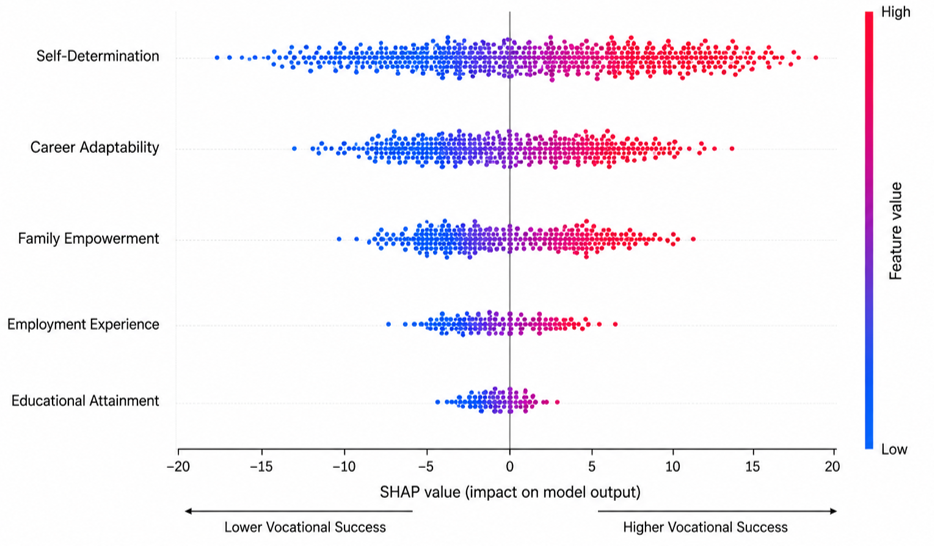
The present study aimed to develop and evaluate an explainable machine learning model for predicting vocational success among young adults with intellectual disabilities based on self-determination, career adaptability, and family empowerment. This cross-sectional predictive study was conducted among 428 young adults with mild to moderate intellectual disabilities recruited from vocational rehabilitation centers, supported employment programs, and transition-to-work services across Canada. Participants completed standardized measures of vocational success, self-determination, career adaptability, and family empowerment. Data preprocessing procedures included standardization, missing-value imputation, and quality screening. Several machine learning algorithms, including Linear Regression, Support Vector Regression, Random Forest, Gradient Boosting, and Extreme Gradient Boosting (XGBoost), were trained and evaluated using a 70:30 training-testing split and five-fold cross-validation. Model performance was assessed using the coefficient of determination (R²), root mean squared error (RMSE), mean absolute error (MAE), and mean absolute percentage error (MAPE). SHapley Additive exPlanations (SHAP) analysis was employed to identify feature importance and improve interpretability of model predictions. Significant positive associations were observed between vocational success and self-determination (r = .68, p < .001), career adaptability (r = .61, p < .001), and family empowerment (r = .54, p < .001). Among the predictive models tested, XGBoost demonstrated the highest predictive accuracy, accounting for 76% of the variance in vocational success (R² = .76), with the lowest prediction errors (RMSE = 6.94, MAE = 5.13, MAPE = 6.95%). SHAP analysis revealed that self-determination was the most influential predictor, contributing 41.5% of total model importance, followed by career adaptability (30.4%) and family empowerment (22.7%). Collectively, these three variables accounted for more than 94% of the predictive contribution within the final model. The findings indicate that vocational success among young adults with intellectual disabilities can be predicted with high accuracy using machine learning techniques. Self-determination emerged as the strongest predictor, followed by career adaptability and family empowerment, highlighting the importance of both personal agency and supportive family environments. The results support the use of explainable artificial intelligence approaches in disability and vocational research and suggest that interventions targeting these psychosocial factors may enhance employment outcomes and long-term vocational success.
Downloads
References
Alfieri, E., Giaquinto, V., Belluzzo, M., & Amodeo, A. L. (2025). Effective Interventions for Employment: A Systematic Review for Individuals With Disabling Conditions of Severe Mental Illnesses. Journal of Vocational Rehabilitation, 64(1), 73-84. https://doi.org/10.1177/10522263251394320
Álvarez‐Aguado, I., Córdova, V. V., Roselló‐Peñaloza, M., González‐Carrasco, F., Farhang, M., Vilo, K. C., Spencer, H., Rivera, F. M., & Aguado, L. Á. (2024). Self‐Determination Skills in Ageing Women With Intellectual Disabilities. British Journal of Learning Disabilities, 53(2), 248-258. https://doi.org/10.1111/bld.12630
Álvarez‐Aguado, I., Córdova, V. V., Spencer, H., González‐Carrasco, F., Azagra, M. J., & Cid, K. E. (2021). Levels of Self‐determination in the Ageing Population With Intellectual Disabilities. British Journal of Learning Disabilities, 50(4), 494-503. https://doi.org/10.1111/bld.12419
Castro-Durán, L., Sanzana-Vallejos, G., Zapata-Lamana, R., Vallejos-Garcías, V., Sandoval-Cárcamo, M., Dávila-Opazo, L., Duhart-Carrión, J., Huaiquipan-Ortega, I., Cigarroa, I., Espejo-Sepúlveda, E., & Mendoza-Mardones, A. I. (2024). Linguistic and Cultural Adaptation of a Self-Determination Scale for People With Intellectual Disabilities. https://doi.org/10.20944/preprints202407.0856.v1
Choi, H., & Sung, C. (2025). Impact of Self-Stigma and Basic Psychological Needs on Career Engagement Among Transition-Age Individuals With Disabilities. Stigma and Health. https://doi.org/10.1037/sah0000653
Cooper, O., Springer, C., & Elleman, B. (2023). Occupational Therapy Services for Transition-Age Youth With Moderate to Severe Disabilities: A Scoping Review. Research Directs in Therapeutic Sciences, 2(1). https://doi.org/10.53520/rdts2023.10565
DaWalt, L. S., Taylor, J. L., & Mailick, M. R. (2021). The Transition to Adulthood for Individuals With Intellectual and Developmental Disabilities. 281-298. https://doi.org/10.1037/0000195-011
García-Candel, J. A., Belmonte, M. L., & Bernárdez-Gómez, A. (2023). Expectations of Personal Life Development and Decision-Making in People With Moderate Intellectual Disabilities. Journal of Intelligence, 11(2), 24. https://doi.org/10.3390/jintelligence11020024
Gilson, C. B., Sinclair, J., Whirley, M. L., Li, Y., & Blustein, D. L. (2022). “More Than a Job, It’s a Purpose”: A Psychology of Working Perspective of the Working Experiences for Individuals With Intellectual and Developmental Disabilities. Journal of Career Assessment, 30(2), 367-386. https://doi.org/10.1177/10690727211048898
Giummarra, M. J., Randjelovic, I., & O’Brien, L. (2022). Interventions for Social and Community Participation for Adults With Intellectual Disability, Psychosocial Disability or on the Autism Spectrum: An Umbrella Systematic Review. Frontiers in Rehabilitation Sciences, 3. https://doi.org/10.3389/fresc.2022.935473
Grigal, M., Dukes, L. L., & Walker, Z. (2021). Advancing Access to Higher Education for Students With Intellectual Disability in the United States. Disabilities, 1(4), 438-449. https://doi.org/10.3390/disabilities1040030
Kavitha, R. (2023). Self – Advocacy Significance in Work Placement Adjustment of PwID. International Journal for Multidisciplinary Research, 5(6). https://doi.org/10.36948/ijfmr.2023.v05i06.9296
Kļaviņa, A., Pérez-Fuster, P., Daems, J., Lyhne, C. N., Dervishi, E., Pajalić, Z., Øderud, T., Fuglerud, K. S., Markovska-Simoska, S., Przybyła, T., Klichowski, M., Štiglic, G., Laganovska, E., Alarcão, S. M., Tkaczyk, A. H., & Sousa, C. (2024). The Use of Assistive Technology to Promote Practical Skills in Persons With Autism Spectrum Disorder and Intellectual Disabilities: A Systematic Review. Digital Health, 10. https://doi.org/10.1177/20552076241281260
Kraemer, B., Rentschler, L. F., Tomaszewski, B., McIntyre, N. S., DaWalt, L. S., & Hume, K. (2024). Life After High School: The Employment Experiences of Autistic Young Adults. Remedial and Special Education, 46(4), 299-310. https://doi.org/10.1177/07419325241289534
Krishnan, S. R. G., & Meena, B. P. (2023). Working With Adults With Intellectual Challenges to Enhance Their Employability Skills. Journal of Intellectual Disabilities, 28(3), 647-660. https://doi.org/10.1177/17446295231171198
Liljeholm, U., Argentzell, E., & Bejerholm, U. (2020). An Integrated Mental Health and Vocational Intervention: A Longitudinal Study on Mental Health Changes Among Young Adults. Nursing Open, 7(6), 1755-1765. https://doi.org/10.1002/nop2.560
Martínez, R. S. (2025). Exploring Resilience and Empowerment in Adults With Reduced Mobility. Healthcare, 13(17), 2161. https://doi.org/10.3390/healthcare13172161
Matthews, N. L., Christenson, K., Kiefer, S. L., & Smith, C. J. (2021). A Mixed-Methods Examination of the Gap Between Intelligence and Adaptive Functioning in Autistic Young Adults Without Intellectual Disability. Autism, 25(8), 2317-2330. https://doi.org/10.1177/13623613211018334
Mazzotti, V. L., Rowe, D. A., Kwiatek, S. M., Voggt, A., Chang, W. H., Fowler, C., Poppen, M., Sinclair, J., & Test, D. W. (2020). Secondary Transition Predictors of Postschool Success: An Update to the Research Base. Career Development and Transition for Exceptional Individuals, 44(1), 47-64. https://doi.org/10.1177/2165143420959793
Moreira, C., Oliveira, A., Shogren, K. A., Hagiwara, M., Pereira, A. C., Rosário, P., Gomes, F. V., & Santos, S. M. (2026). Linking Self‐Determination to Life Outcomes of People With Intellectual and Developmental Disabilities: Criterion Validity of the Self‐Determination Inventory. Journal of Applied Research in Intellectual Disabilities, 39(1). https://doi.org/10.1111/jar.70191
Mumbardó‐Adam, C., Guàrdia‐Olmos, J., & Giné, C. G. (2020). An Integrative Model of Self‐determination and Related Contextual Variables in Adolescents With and Without Disabilities. Journal of Applied Research in Intellectual Disabilities, 33(5), 856-864. https://doi.org/10.1111/jar.12705
Murray, C., Kosty, D., Doren, B., Gau, J. M., & Seeley, J. R. (2021). Patterns of Early Adult Work and Postsecondary Participation Among Individuals With High-Incidence Disabilities: A Longitudinal Person-Centered Analysis. Developmental Psychology, 57(4), 584-596. https://doi.org/10.1037/dev0001163
Newman, L., Trainor, A. A., & Javitz, H. S. (2022). Effect of Self-Determination on Postsecondary Enrollment of English Learners With Disabilities. Remedial and Special Education, 44(2), 113-125. https://doi.org/10.1177/07419325221081502
Paxinos, I., Chaldi, D., & Paxinou, N. (2021). The Quality of Life, Anxiety, and Depression in Adults With Mild Intellectual Disability During Lockdown Due to COVID-19 Pandemic in Greece. Scirea Journal of Clinical Medicine. https://doi.org/10.54647/cm32685
Salt, E., & Jahoda, A. (2020). Comparing Everyday Autonomy and Adult Identity in Young People With and Without Intellectual Disabilities. Journal of Applied Research in Intellectual Disabilities, 33(6), 1318-1327. https://doi.org/10.1111/jar.12751
Sánchez, E. V., Mumbardó‐Adam, C., Guillén, V. M., Coma-Roselló, T., Bravo-Álvarez, M. A., & Sánchez, S. (2020). Self-Determination in People With Intellectual Disability: The Mediating Role of Opportunities. International journal of environmental research and public health, 17(17), 6201. https://doi.org/10.3390/ijerph17176201
Smith, P., & Parmenter, T. R. (2023). Measuring the Impact of Employment on Persons With a Disability as a Means of Improving the Quality of Employment Outcomes. Journal of Health and Rehabilitation Sciences, 2(1), 1-15. https://doi.org/10.33700/jhrs.2.1.61
Subramanyam, A. A., Somaiya, M., & Sousa, A. D. (2024). Mental Health and Well-Being in Children and Adolescents. Indian Journal of Psychiatry, 66(Suppl 2), S304-S319. https://doi.org/10.4103/indianjpsychiatry.indianjpsychiatry_624_23
Taylor, J. P., Avellone, L., Brooke, V., Wehman, P., Inge, K. J., Schall, C., & Iwanaga, K. (2022). The Impact of Competitive Integrated Employment on Economic, Psychological, and Physical Health Outcomes for Individuals With Intellectual and Developmental Disabilities. Journal of Applied Research in Intellectual Disabilities, 35(2), 448-459. https://doi.org/10.1111/jar.12974
Tomaszewski, B., Kraemer, B., Steinbrenner, J. R., DaWalt, L. S., Hall, L. J., Hume, K., & Odom, S. L. (2020). Student, Educator, and Parent Perspectives of Self‐Determination in High School Students With Autism Spectrum Disorder. Autism Research, 13(12), 2164-2176. https://doi.org/10.1002/aur.2337
Tuckett, A. (2023). Lifelong Learning, Young Adults and the Challenges of Disadvantage in Europe. International Review of Education, 69(4), 583-587. https://doi.org/10.1007/s11159-023-10022-0
Voermans, M. A. C., Wilthagen, T., & Embregts, P. J. C. M. (2023). Informal Network Members’ Perspectives and Experiences on Work for People With Intellectual Disabilities: A Thematic Synthesis. Journal of Occupational Rehabilitation, 34(1), 37-55. https://doi.org/10.1007/s10926-023-10128-0
White, S. W., Schall, C., Santos, J. D., Maddox, B. B., Hillier, A., Klinger, L. G., & Pugliese, C. (2023). Promoting Quality of Life: Suggestions for Mental Health Care Providers Working With Young Autistic Adults. Autism in Adulthood, 5(4), 347-355. https://doi.org/10.1089/aut.2022.0106
Ye, Y., & Ji-qing, G. U. (2025). Reconceptualising Independence in Autistic Adulthood: Comparing Chinese Parents’ Perspectives on Autistic Adults With and Without Intellectual Disabilities. Autism, 30(1), 150-162. https://doi.org/10.1177/13623613251374905
Downloads
Additional Files
Publication Timeline
- Submitted
- Revised
- Accepted