A LightGBM-Based Analysis of Academic Resilience Among Gifted Students with Twice-Exceptional Profiles: Contributions of Metacognitive Awareness, Emotional Regulation, and Perceived Teacher Support
DOI:
https://doi.org/10.61838/kman.prien.5678Keywords:
academic resilience, twice-exceptional students, gifted education, metacognitive awareness, emotional regulation, perceived teacher supportAbstract
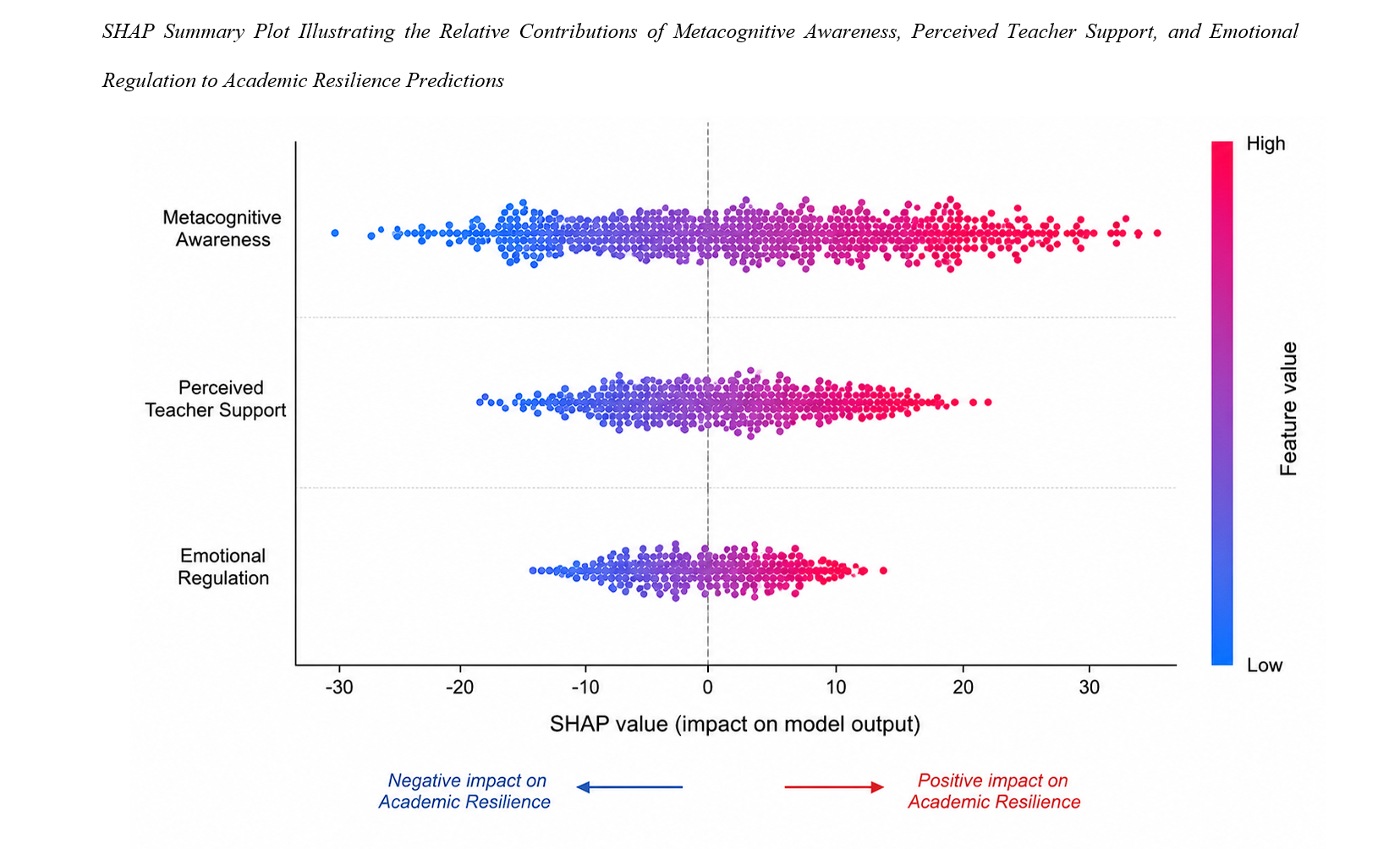
The present study aimed to examine the predictive contributions of metacognitive awareness, emotional regulation, and perceived teacher support to academic resilience among gifted students with twice-exceptional profiles using a Light Gradient Boosting Machine (LightGBM) model. This cross-sectional predictive study was conducted among 428 gifted students with documented twice-exceptional profiles recruited from educational institutions across Canada. Participants completed standardized measures assessing academic resilience, metacognitive awareness, emotional regulation, and perceived teacher support. Preliminary statistical analyses included descriptive statistics and Pearson correlation coefficients. Subsequently, a LightGBM machine learning model was developed to predict academic resilience. The dataset was divided into training (80%) and testing (20%) subsets, and model performance was evaluated using the coefficient of determination (R²), root mean square error (RMSE), mean absolute error (MAE), and mean absolute percentage error (MAPE). Feature importance and SHAP (Shapley Additive Explanations) analyses were performed to determine the relative contributions of the predictor variables. Inferential analyses revealed significant positive correlations between academic resilience and metacognitive awareness (r = .71, p < .01), perceived teacher support (r = .63, p < .01), and emotional regulation (r = .58, p < .01). The LightGBM model demonstrated excellent predictive performance, explaining 84.7% of the variance in academic resilience within the testing dataset (R² = .847), with low prediction error values (RMSE = 6.84, MAE = 5.18, MAPE = 5.03%). Feature importance analysis indicated that metacognitive awareness was the strongest predictor of academic resilience (43.82%), followed by perceived teacher support (33.76%) and emotional regulation (22.42%). SHAP analyses confirmed these findings, revealing that metacognitive awareness exerted the greatest influence on resilience predictions, followed by teacher support and emotional regulation. Higher levels of all three predictors were consistently associated with increased predicted resilience scores. The findings demonstrate that academic resilience among gifted students with twice-exceptional profiles is strongly influenced by a combination of cognitive, emotional, and contextual factors. Metacognitive awareness emerged as the most powerful predictor, highlighting the importance of self-regulated learning processes in facilitating adaptive academic functioning. Perceived teacher support and emotional regulation also made substantial contributions, underscoring the critical roles of supportive educational relationships and emotional competencies. The results suggest that interventions designed to strengthen metacognitive skills, enhance emotional regulation, and foster supportive teacher-student interactions may effectively promote resilience and educational success among twice-exceptional learners.
Downloads
References
Ayasrah, M. N., Khasawneh, M. A. S., Almulla, M. O., & Aboutaleb, A. H. (2025). Design and Validation of the AI‐Integrated Metacognitive Learning Resilience Scale (AIIMLR Scale) for Secondary School Students in Jordan: Insights From the Network Analysis Perspective. Journal of Computer Assisted Learning, 41(5). https://doi.org/10.1111/jcal.70127
Chelouche-Dwek, G., & Fonagy, P. (2024). Mentalization-Based Interventions in Schools for Enhancing Socio-Emotional Competencies and Positive Behaviour: A Systematic Review. European Child & Adolescent Psychiatry, 34(4), 1295-1315. https://doi.org/10.1007/s00787-024-02578-5
Choi, D., & Kaufman, J. C. (2025). The Iceberg of Creativity in the Schools: Do We Aim for Excellence or Inclusion? Gifted Education International, 42(1), 61-78. https://doi.org/10.1177/02614294251390991
Clark, C. A. C., Hatton‐Bowers, H., Akhavein, K., Rasby, S., & Parra, G. R. (2024). Growing Through Adversity: The Relation of Early Childhood Educator Post-Traumatic Growth to Young Children’s Executive Function. Frontiers in psychology, 15. https://doi.org/10.3389/fpsyg.2024.1272294
Desmet, O. A., Austin, G. M., & Pereira, N. (2025). Resolving Relative Underachievement Through an Achievement Motivation Intervention: A Single-Case Study. Gifted Education International, 41(3), 435-473. https://doi.org/10.1177/02614294251364808
Elias, M. J., Marsili, F., Fullmer, L., Morganti, A., & Bruno, E. (2024). The Social-Emotional Competencies of Gifted Children Must Be Intentionally Developed, Ideally in Inclusive Education Contexts. Gifted Education International, 41(1), 57-75. https://doi.org/10.1177/02614294241300393
Gallardo, T. M. M., & Luna, M. M. G. (2024). Mindfulness Enhancing Concentration in English Foreign Language Reading Comprehension. Resistances Journal of the Philosophy of History, 5(10), e240147. https://doi.org/10.46652/resistances.v5i10.147
Guo, J. (2025). Metacognitive Knowledge, Personality and Openness to Diversity Among EFL Teachers: The Mediating Role of Self‐Efficacy and Emotions. European Journal of Education, 61(1). https://doi.org/10.1111/ejed.70352
Jennings, P. A., Álamos, P., Baelen, R. N., Jeon, L., & Nicholas-Hoff, P. Y. (2024). Emotional Schemas: Critical Elements of Educators’ Social and Emotional Competencies to Promote Student SEL. https://doi.org/10.31234/osf.io/ea284
Lai, Z. C. (2025). The Impact of AI-Assisted Blended Learning on Writing Efficacy and Resilience. International Journal of Computer-Assisted Language Learning and Teaching, 15(1), 1-21. https://doi.org/10.4018/ijcallt.377174
Mitsea, E., Drigas, A., & Skianis, C. (2024). Well-Being Technologies and Positive Psychology Strategies for Training Metacognition, Emotional Intelligence and Motivation Meta-Skills in Clinical Populations: A Systematic Review. Psych, 6(1), 305-344. https://doi.org/10.3390/psych6010019
Obrovská, J., Majcík, M., & Simonová, J. (2024). Achievement vs. Engagement: Providing Support in Socially Disadvantaged Schools. British Educational Research Journal, 51(2), 1039-1072. https://doi.org/10.1002/berj.4105
Parmigiani, D. (2025). Self‐ and Peer‐assessment in Upper Secondary Schools. A Quasi‐experimental Study to Investigate the Educational Effectiveness of Formative Assessment. British Educational Research Journal. https://doi.org/10.1002/berj.70056
Ragusa, A., González‐Bernal, J. J., Trigueros, R., Caggiano, V., Gómez, N. N., Mínguez-Mínguez, L. A., Obregón, A. I., & Fernandez-Ortega, C. (2023). Effects of Academic Self-Regulation on Procrastination, Academic Stress and Anxiety, Resilience and Academic Performance in a Sample of Spanish Secondary School Students. Frontiers in psychology, 14. https://doi.org/10.3389/fpsyg.2023.1073529
Raoof, K., Shokri, O., Fathabadi, J., & Panaghi, L. (2024). Unpacking the Underachievement of Gifted Students: A Systematic Review of Internal and External Factors. Heliyon, 10(17), e36908. https://doi.org/10.1016/j.heliyon.2024.e36908
Suting, H., & Veloo, A. (2024). The Influence of Well-Being on Learning Strategies Among Chinese University Students Learning Korean. Journal of Digitainability Realism & Mastery (Dream), 3(11), 1-24. https://doi.org/10.56982/dream.v3i11.276
Turgut, S., & Uğurlu, M. (2024). A Moderated Mediation Analysis on the Relationship Between Metacognition and Mathematical Resilience of Gifted Students. Psychology in the Schools, 61(5), 1848-1867. https://doi.org/10.1002/pits.23141
Xie, C. (2024). Teacher Support Behavior, Self-Regulated Learning Strategies and EFL Learner Resilience: A Study of Chinese Vocational Students in an EFL Context. International Journal of Research Studies in Language Learning, 10(3). https://doi.org/10.5861/ijrsll.2024.024
Zanetti, M. A., Intra, F. S., Taverna, L., Brighi, A., & Marinoni, C. (2024). The Influence of Gifted Children’s Stress Management on Parental Stress Levels. Children, 11(5), 538. https://doi.org/10.3390/children11050538
Zhou, S., & Hou, H. (2025). The Interplay of Self-Efficacy, Grit, and Metacognition in Shaping Work Engagement Among EFL Teachers: A Comparative Study of Mainland China and Hong Kong. BMC psychology, 13(1). https://doi.org/10.1186/s40359-025-02761-6
Downloads
Additional Files
Publication Timeline
- Submitted
- Revised
- Accepted