Regulation of the GLUT4 Translocation Pathway in Diabetic Skeletal Muscle: Comparative Effects of Aerobic and Resistance Training on AS160 and GLUT4 Gene Expression in Type 2 Diabetic Mice
DOI:
https://doi.org/10.61838/Keywords:
type 2 diabetes mellitus; aerobic training; resistance training; AS160; GLUT4; glucose transport; skeletal muscleAbstract
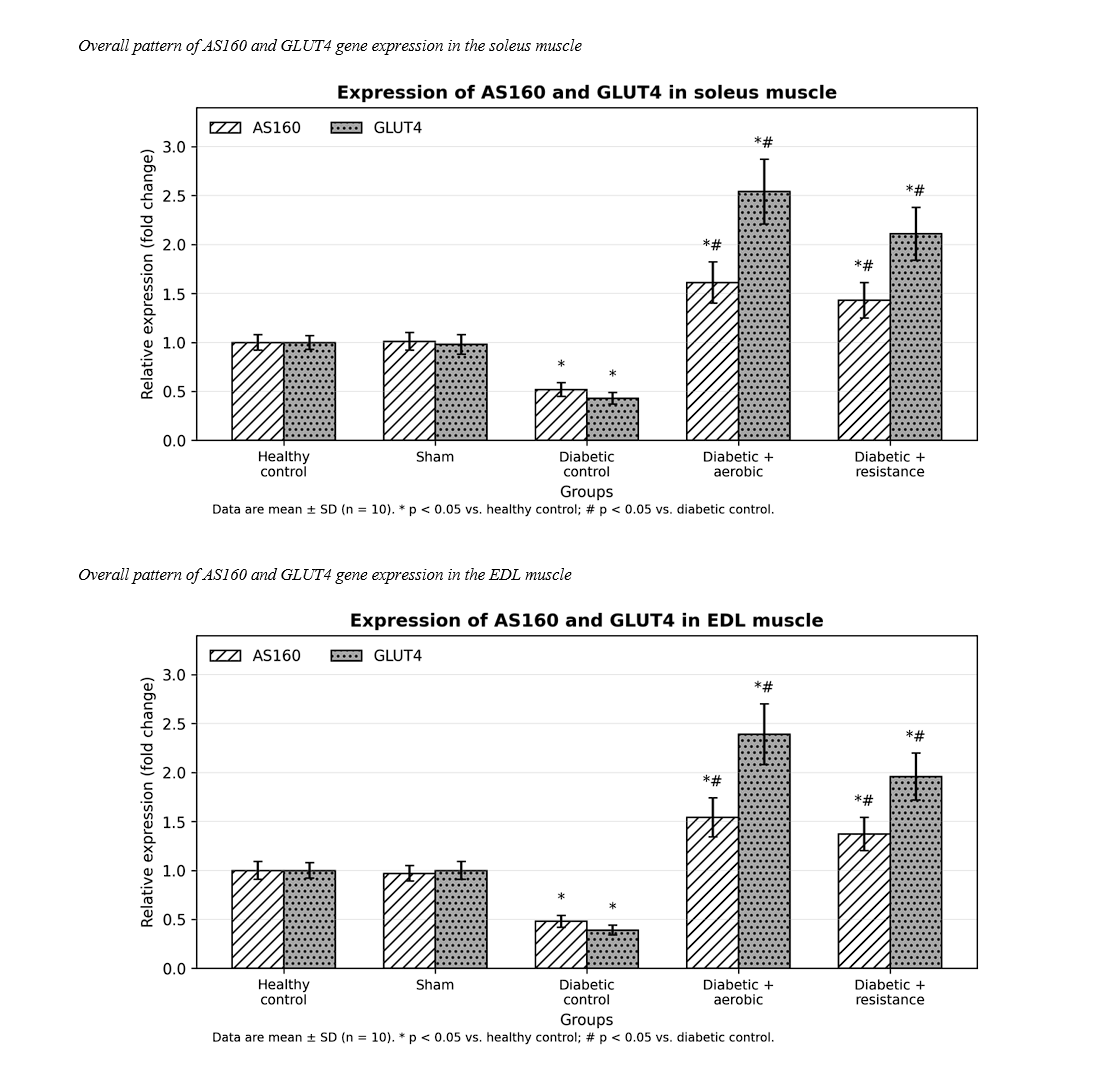
Background: Impaired glucose transport into skeletal muscle is a central mechanism in insulin resistance and type 2 diabetes mellitus. AS160 (TBC1D4) and glucose transporter type 4 (GLUT4) are key molecular components of the insulin-dependent glucose transport pathway. Exercise training is an established non-pharmacological intervention for improving glucose homeostasis; however, the comparative effects of aerobic and resistance training on AS160 and GLUT4 gene expression in diabetic skeletal muscle remain insufficiently clarified. Objective: This study compared the effects of aerobic and resistance training on AS160 and GLUT4 gene expression in the soleus and extensor digitorum longus (EDL) muscles of type 2 diabetic mice. Methods: Fifty male C57BL/6 mice were assigned to five groups: healthy control, sham, diabetic control, diabetic plus aerobic training, and diabetic plus resistance training. Type 2 diabetes was induced using a high-fat diet followed by low-dose streptozotocin injection. The training protocols were performed for 8 weeks, 5 sessions per week. AS160 and GLUT4 gene expression in the soleus and EDL muscles was measured by real-time polymerase chain reaction and normalized to GAPDH using the 2^-ΔΔCt method. Data were analyzed using two-way mixed analysis of variance with Bonferroni post hoc comparisons. Results: Diabetes reduced AS160 and GLUT4 expression in both muscles. Both exercise modalities increased the expression of the two genes compared with the diabetic control group. The GLUT4 response was stronger than the AS160 response, and aerobic training produced a larger increase in GLUT4 expression than resistance training. The soleus muscle showed a stronger metabolic response than the EDL muscle. Conclusion: Exercise training, particularly aerobic training, partially restored defects in the skeletal muscle glucose transport pathway in type 2 diabetic mice. These findings support structured exercise as a molecularly relevant strategy for improving insulin sensitivity in diabetes.
Downloads
References
1. World Health O. Diabetes. 2024.
2. Mann G, Riddell MC, Adegoke OAJ. Effects Of Acute Muscle Contraction On The Key Molecules In Insulin And Akt Signaling In Skeletal Muscle In Health And In Insulin Resistant States. Diabetology. 2022;3(3):423-46.
3. Han X, Yang Y, Liu S, Niu Y, Shao H, Fu L. Aerobic Exercise Ameliorates Insulin Resistance In C57Bl/6J Mice Via Activating Sestrin3. Biochimica et Biophysica Acta (BBA) - Molecular Basis of Disease. 2023;1869(1):166568. [PMID: 36220588]
4. Wang T, Niu Y, Liu S, Yuan H, Liu X, Fu L. Exercise Improves Glucose Uptake In Murine Myotubes Through The Ampkα2-Mediated Induction Of Sestrins. Biochimica et Biophysica Acta (BBA) - Molecular Basis of Disease. 2018;1864(10):3368-77. [PMID: 30048751]
5. Holten MK, Zacho M, Gaster M, Juel C, Wojtaszewski JFP, Dela F. Strength Training Increases Insulin-Mediated Glucose Uptake, Glut4 Content, And Insulin Signaling In Skeletal Muscle In Patients With Type 2 Diabetes. Diabetes. 2004;53(2):294-305. [PMID: 14747278]
6. Czajkowska A, Czajkowski M, Szczerbinski L, Jurczuk K, Reska D, Kwedlo W, et al. Exploring Protein Relative Relations In Skeletal Muscle Proteomic Analysis For Insights Into Insulin Resistance And Type 2 Diabetes. Scientific Reports. 2024;14:17631. [PMID: 39085321] [PMCID: PMC11292014]
7. Garavandpour F, Valipour Dehnou V, Eslami R. The Effect Of Eight Weeks Of Aerobic Training On Glut4 And As160 Protein Levels And Insulin Resistance In The Edl Muscle Of Type 2 Diabetic Rats. Feyz Journal of Kashan University of Medical Sciences. 2024;28(4):335-43.
8. Banaeifar A, Ebrahimpor S, Tabatabaei H, Ebadi Ghahremani M. The Effect Of Resistance Training On Muscle Glut4 Gene Expression, Blood Glucose And Insulin Resistance In Type 2 Diabetic Rats. Journal of Ilam University of Medical Sciences. 2019;26(6):46-57.
9. Li N, Zhang L, Guo Q, Shi H, Gan Y, Wang W, et al. Aerobic Exercise Improves Inflammation And Insulin Resistance In Skeletal Muscle By Regulating Mir-221-3P Via Jak/STAT Signaling Pathway. Frontiers in Physiology. 2025;16:1534911. [PMID: 40070461] [PMCID: PMC11893602]
Downloads
Additional Files
Publication Timeline
- Submitted
- Revised
- Accepted