The Effectiveness of Mindfulness Training for Mothers on Parenting Stress and the Quality of the Parent–Child Relationship in Families with a Child with Autism
Keywords:
mindfulness training, parenting stress, quality of the parent–child relationship, autismAbstract
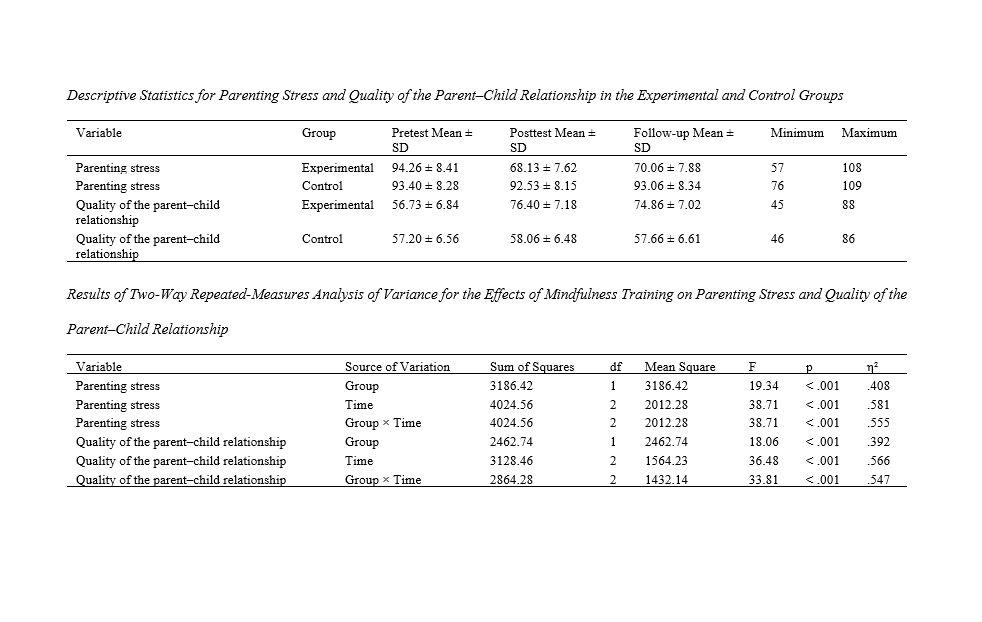
The present study aimed to determine the effectiveness of mindfulness training for mothers on parenting stress and the quality of the parent–child relationship in families with a child with autism. This was a quasi-experimental study with a pretest, posttest, and two-month follow-up design with a control group. The statistical population included mothers of children with autism spectrum disorder who referred to the Golha Autism Center in Chalus, Iran, during 2025–2026. Following the initial screening, eligible mothers completed the Autism Parenting Stress Index developed by Fetroswan and Miles and the Parent–Child Interaction Questionnaire developed by Lange et al. Subsequently, 30 participants were selected through purposive sampling and randomly assigned to an experimental group and a control group, with 15 participants in each group. The experimental group received mindfulness training based on Kabat-Zinn’s mindfulness-based stress reduction model in eight 90-minute sessions, while the control group received no intervention during this period. Data were analyzed using the independent samples t-test, Fisher’s exact test, and two-way repeated-measures analysis of variance in SPSS version 26. The results showed that there was no significant difference between the experimental and control groups in terms of demographic characteristics. In addition, the results of the two-way repeated-measures analysis of variance indicated that the interaction effect of group and time on parenting stress and the quality of the parent–child relationship was significant. Based on the comparison of means, parenting stress scores in the experimental group decreased from the pretest to the posttest, and this reduction remained largely stable at the two-month follow-up. Moreover, the scores for the quality of the parent–child relationship in the experimental group increased from the pretest to the posttest, and this improvement was relatively maintained at follow-up, whereas no considerable change was observed in the control group. Based on the study findings, mindfulness training for mothers can reduce parenting stress and improve the quality of the parent–child relationship in families with a child with autism.
Downloads
References
Frosch, C. A., Schoppe-Sullivan, S. J., & O'Banion, D. D. (2019). Parenting and child development: A relational health perspective. American Journal of Lifestyle Medicine, 15(1), 45-59. https://doi.org/10.1177/1559827619849028
Ghanavati, M., Hamid, N., & Mehrabizadeh Honarmand, M. (2020). The effect of mindful parenting training on parental stress in mothers of children with autism spectrum disorders. Pediatric Nursing, 7(2), 75-86.
Hodis, B., Mughal, S., & Saadabadi, A. (2025). Autism Spectrum Disorder. In StatPearls. StatPearls Publishing. https://www.ncbi.nlm.nih.gov/books/NBK525976/
Hosseini Yazdi, S. A., Mashhadi, A., Kimiaei, S. A., & Amin Yazdi, S. A. (2023). Comparison of the effectiveness of the mindfulness parenting training program along with parent management training (combined training) with mindfulness parenting training and parent management training alone on coping strategies and marital satisfaction. Applied Family Therapy Journal, 4(3), 425-448. https://doi.org/10.61838/kman.aftj.4.3.27
Levante, A., Martis, C., & Lecciso, F. (2025). The quality of the parent-child relationship in the context of autism: The role of parental resolution of the child's diagnosis, parenting stress, and caregiving burden. European Journal of Investigation in Health, Psychology and Education, 15(7), 142. https://doi.org/10.3390/ejihpe15070142
Neece, C. L. (2014). Mindfulness-based stress reduction for parents of young children with developmental delays: Implications for parental mental health and child behavior problems. Journal of Applied Research in Intellectual Disabilities, 27(2), 174-186. https://doi.org/10.1111/jar.12064
Peng, Q., Dong, Y., Jin, J., Ao, H., Zhang, C., & Ma, Y. (2025). The effectiveness of mindfulness-based interventions for children with autism and their parents: A systematic review and meta-analysis. Frontiers in psychology, 16, 1526001. https://doi.org/10.3389/fpsyg.2025.1526001
Picardi, A., Gigantesco, A., Tarolla, E., Stoppioni, V., Cerbo, R., Cremonte, M., Alessandri, G., Lega, I., & Nardocci, F. (2018). Parental burden and its correlates in families of children with autism spectrum disorder: A multicentre study with two comparison groups. Clinical Practice and Epidemiology in Mental Health, 14, 143-176. https://doi.org/10.2174/1745017901814010143
Quan, H., He, J., & Li, C. (2023). The influence of parental mindfulness on preschool child behavior problems: A chain-mediated model analysis. International journal of environmental research and public health, 20(1), 812. https://doi.org/10.3390/ijerph20010812
Ridderinkhof, A., de Bruin, E. I., Blom, R., & Bogels, S. M. (2018). Mindfulness-based program for children with autism spectrum disorder and their parents: Direct and long-term improvements. Mindfulness, 9(3), 773-791. https://doi.org/10.1007/s12671-017-0815-x
Weitlauf, A. S., Broderick, N., Stainbrook, J. A., Taylor, J. L., Herrington, C. G., Nicholson, A. G., Santulli, M., Dykens, E. M., Juarez, A. P., & Warren, Z. E. (2020). Mindfulness-based stress reduction for parents implementing early intervention for autism: An RCT. Pediatrics, 145(Suppl 1), S81-S92. https://doi.org/10.1542/peds.2019-1895K
Downloads
Additional Files
Publication Timeline
- Submitted
- Revised
- Accepted