Development of a Computerized Cognitive Skills Package and Evaluation of Its Effectiveness on Selective Attention, Response Inhibition, and Working Memory in Children with Dyslexia
Keywords:
computerized cognitive skills package, dyslexia, selective attention, response inhibition, working memory.Abstract
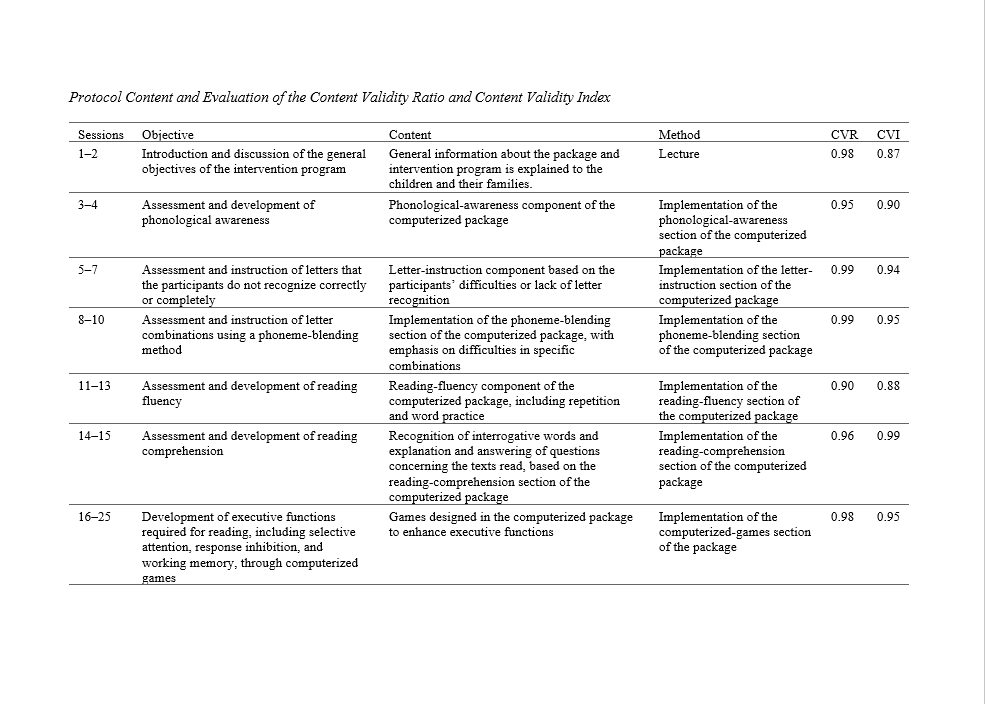
The present study aimed to develop a computerized cognitive skills package and investigate its effects on selective attention, response inhibition, and working memory in children with dyslexia. In the package-development phase, a qualitative research method was employed in two stages. In the first stage, a triangulation strategy was used to enhance the credibility of the findings. In the second stage, the designed computerized package was validated using the Delphi method and the opinions of 10 psychology specialists. The quantitative phase employed a quasi-experimental design. Thirty third-, fourth-, and fifth-grade children in Tabriz were selected through convenience sampling and randomly assigned to an experimental group and a control group, with 15 participants in each group. Following the implementation of the researcher-developed computerized cognitive skills package for the experimental group, the d2 Test, Stroop Test, and N-back Test were administered to both groups as posttests. The resulting data were subsequently analyzed using one-way analysis of variance. The findings indicated significant differences between the experimental and control groups in selective attention, response inhibition, and working memory. It can therefore be concluded that the developed computerized cognitive skills package is effective in improving selective attention, response inhibition, and working memory among children with dyslexia.
Downloads
References
Abbariki, A., Yazdanbakhsh, K., & Momeni, K. (2017). The Effectiveness of Computerized Cognitive Rehabilitation in Reducing Cognitive Failure Among Students with Learning Disabilities. Psychology of Exceptional Individuals, 7(26).
Akyurek, G., Koca, R. B., & Gunal Gunser, R. (2024). Systematic Review of Current Approaches to Cognitive Skills in Children with Dyslexia. Current Psychology, 43(18), 16247-16263. https://doi.org/10.1007/s12144-023-05568-z
Amani, A., Fadaei, A., Tavakoli, M., Shiri, A., & Shiri, V. (2018). Comparison of Planning, Selective Attention, and Cognitive Flexibility in Students with and Without Specific Learning Disorder (Reading Deficiency). Journal of Learning Disabilities, 7(2/111).
American Psychiatric, A. (2023). Diagnostic and Statistical Manual of Mental Disorders: DSM-5 (5th ed.). American Psychiatric Publishing. https://doi.org/10.1176/appi.books.9780890425787
Arjmandnia, A. A., Hassanvand, M., & Asgharinekah, M. (2018). The Effect of Cognitive Games on Attention and Response Inhibition in Students with Dyscalculia. JOEC, 18(1), 5-18.
Baghlari, M., Maleki, M., & Ghaeini, S. (2018). The Relationship Between Cardiovascular Fitness and Response-Inhibition Ability. Journal of Sport Management and Motor Behavior Research, 14(28), 277-287.
Ballesteros, S., Mayas, J., Prieto, A., Ruiz-Marquez, E., Toril, P., & Reales, J. M. (2017). Effects of Video Game Training on Measures of Selective Attention and Working Memory in Older Adults: Results from a Randomized Controlled Trial. Frontiers in Aging Neuroscience, 9(354), 1-15. https://doi.org/10.3389/fnagi.2017.00354
Bergo, E., Lombardi, G., Pambuku, A., Della Puppa, A., Bellu, L., D'Avella, D., & Zagonel, V. (2016). Cognitive Rehabilitation in Patients with Gliomas and Other Brain Tumors: State of the Art. BioMed Research International, 1-11. https://doi.org/10.1155/2016/3041824
Carlos Farias, A., Cordeiro, M. L., Felden, E. P., Bara, T. S., Benko, C. R., Countinho, D., & McCracken, J. T. (2017). Attention-Memory Training Yields Behavior and Academic Improvements in Children Diagnosed with Attention-Deficit/Hyperactivity Disorder Comorbid with a Learning Disorder. Neuropsychiatric Disease and Treatment, 13, 1761-1769. https://doi.org/10.2147/NDT.S136663
Farhad, R., Vahid, N., & Jalil, F. (2016). The Impact of Cognitive Rehabilitation on Working Memory and Verbal Fluency in Dyslexic Students: A Single Case Study. Thought and Behavior in Clinical Psychology, 10(40), 17.
Gashaj, V., Oberer, N., Mast, F. W., & Roebers, C. M. (2019). Individual Differences in Basic Numerical Skills: The Role of Executive Functions and Motor Skills. Journal of Experimental Child Psychology, 182, 187-195. https://doi.org/10.1016/j.jecp.2019.01.021
Gray-Burrows, K., Taylor, N., O'Connor, D., Sutherland, E., Stoet, G., & Conner, M. (2019). A Systematic Review and Meta-Analysis of the Executive Function-Health Behavior Relationship. Health Psychology and Behavioral Medicine, 7(1), 253-268. https://doi.org/10.1080/21642850.2019.1637740
Hokken, M. J., Krabbendam, E., van der Zee, Y. J., & Kooiker, M. J. (2023). Visual Selective Attention and Visual Search Performance in Children with CVI, ADHD, and Dyslexia: A Scoping Review. Child Neuropsychology, 29(3), 357-390. https://doi.org/10.1080/09297049.2022.2057940
Horowitz-Kraus, T., Cirino, P. T., Cutting, L. E., Hughes-Berheim, S. S., Wilkey, E. D., Barnes, M. A., Rosch, K. S., & Church, J. A. (2026). The Interplay Between Executive Function and Learning Disabilities: Developmental Cognitive Neuroscience Perspectives on Reading, Math, and ADHD. Developmental Cognitive Neuroscience, 79, 101722. https://doi.org/10.1016/j.dcn.2026.101722
Kamarzarin, H., Mardookhi, M. S., & Karimi, R. (2019). The Effect of Cognitive Rehabilitation on Selective Attention and Executive Functions of Students with Attention-Deficit/Hyperactivity Disorder. JOEC, 18(3), 77-90.
Khaksar Boldaji, M., Abdollahi, M., Kadivar, P., Hassanabadi, H., & Arjmandnia, A. (2018). The Effectiveness of Computerized Cognitive Educational Interventions for Working Memory on Attention, Response Control, and the Central Executive Component of Working Memory in Students with Specific Learning Disorder. Social Cognition, 7(2), 173-186.
Krause, T. H. (2015). Pinpointing the Deficit in Executive Functions in Adolescents with Dyslexia Performing the Wisconsin Card Sorting Test. Journal of Learning Disabilities, 47(3), 208-223. https://doi.org/10.1177/0022219412453084
Lambert, K. T. (2021). Improving Inhibitory Control in a Kindergarten Classroom Louisiana State University].
Lee, C., Landre, N., & Sweet, J. J. (2019). Performance Validity on the Stroop Color and Word Test in a Mixed Forensic and Patient Sample. The Clinical Neuropsychologist, 33(8), 1403-1419. https://doi.org/10.1080/13854046.2019.1594385
Leong, A. Y. C., Yong, M. H., & Lin, M. H. (2022). The Effect of Strategy Game Types on Inhibition. Psychology Research, 1-16.
Lin, Y., Qiu, Y., Gao, Y., Wu, X., Zeng, Y., & Wu, J. (2025). Effects of Computerized Cognitive Training in Children and Adolescents with Autism Spectrum Disorder: A Systematic Review. Journal of Autism and Developmental Disorders, 1-13. https://doi.org/10.1007/s10803-025-06913-w
Liu, H., Sun, Y., Wang, Z., Guo, J., Song, Y., & Meng, X. (2024). Atypical Visual Selective Attention in Children with Dyslexia: Evidence from N2pc and PD. (Vol. 12, pp. 630-685): bioRxiv.
Maghsoudlou, M., Nejati, V., & Fathabadi, J. (2019). The Effectiveness of the Aram Cognitive Rehabilitation Package in Improving Executive Functions Based on Behavioral Assessments in Preschool Children with Symptoms of Attention-Deficit/Hyperactivity Disorder. Psychology of Exceptional Individuals, 9(33), 23-43.
Nazarboland, N., Tahmasi, A., & Nejati, V. (2019). The Effectiveness of Cognitive Rehabilitation Based on the Aram Package in Improving Executive Functions of Selective Attention, Inhibitory Control, and Working Memory in Older Adults with Mild Cognitive Impairment. Quarterly Journal of Cognitive Psychology, 7(3), 40-59.
Novaes, C. B., Zuanetti, P. A., & Fukuda, M. T. (2019). Effects of Working Memory Intervention on Students with Reading Comprehension Difficulties. Revista Cefac, 21(4), 1-11. https://doi.org/10.1590/1982-0216/201921417918
Podsiadlik, A. (2023). The Blended Learning Experiences of Students with Specific Learning Difficulties: A Qualitative Case Study Located in One British Higher Education Institution. International Journal of Disability, Development and Education, 70(3), 366-381. https://doi.org/10.1080/1034912X.2021.1876217
Rodriguez Timana, L. C., Castillo Garcia, J. F., Bastos Filho, T., Ocampo Gonzalez, A. A., Hincapie Monsalve, N. R., & Valencia Jimenez, N. J. (2024). Use of Serious Games in Interventions of Executive Functions in Neurodiverse Children: Systematic Review. JMIR serious games, 12, e59053. https://doi.org/10.2196/59053
Shafiei Tabar, M., & Akbari Chaharmini, S. (2022). Emotion Regulation and Resilience in Children with Attention-Deficit/Hyperactivity Disorder. Journal of Psychology, 26(2).
Shakeri Chenari, H., Akbarnataj Bisheh, K., & Mohammadian Akerdi, A. (2026). Comparing the Effectiveness of Cognitive Behavioral Play Therapy and Cognitive Rehabilitation on the Academic Achievement of Students with Dyslexia. Rooyesh-e-Ravanshenasi, 15(1), 169-180.
Shamshiri, D., Havasci, Tari, M., & Arezoo. (2025). Comparison of the effectiveness of computer-based cognitive rehabilitation with cognitive-behavioral play therapy on improving executive functions in students with dyslexia. Journal of Psychiatry and Clinical Psychology in Iran, 31(1), 0-0. https://doi.org/10.32598/ijpcp.31.1977.2
Shamshiri, M., Amiri, S., & Farrahi, A. (2025). Comparing the Effectiveness of Cognitive-Behavioral Play Therapy and Computerized Cognitive Rehabilitation on Executive Functions in Students with Dyslexia. Journal of Learning Disabilities, 14(2), 45-62.
Shamshiri, M., Danesh, E., Havasi, N., & Tari Moradi, A. (2025). Comparing the Effectiveness of Computerized Cognitive Rehabilitation and Cognitive-Behavioral Play Therapy on Improving Executive Functions in Students with Dyslexia. Iranian Journal of Psychiatry and Clinical Psychology, 31(1).
Shamshiri, M., Havasi Somar, N., Danesh, A., & Tari Moradi, A. (2024). The Effectiveness of Captain's Log Computerized Cognitive Rehabilitation in Improving Reading Performance and Executive Functions of Elementary-School Students with Dyslexia. Rooyesh-e-Ravanshenasi, 13(5), 125-134.
Yaghoubi, H., Vaghef, L., & Ebadi, M. (2016). Examining the Role of Executive Functions in Children with Learning Disorders. Third National Conference on Strategies for the Development and Promotion of Educational Sciences, Psychology, Counseling, and Education in Iran,
Downloads
Additional Files
Publication Timeline
- Submitted
- Revised
- Accepted