The Effects of Exergaming and Neurofeedback on Working Memory in Children with Attention-Deficit/Hyperactivity Disorder
Keywords:
Attention-deficit/hyperactivity disorder, working memory, neurofeedback, exergaming, executive functions, childrenAbstract
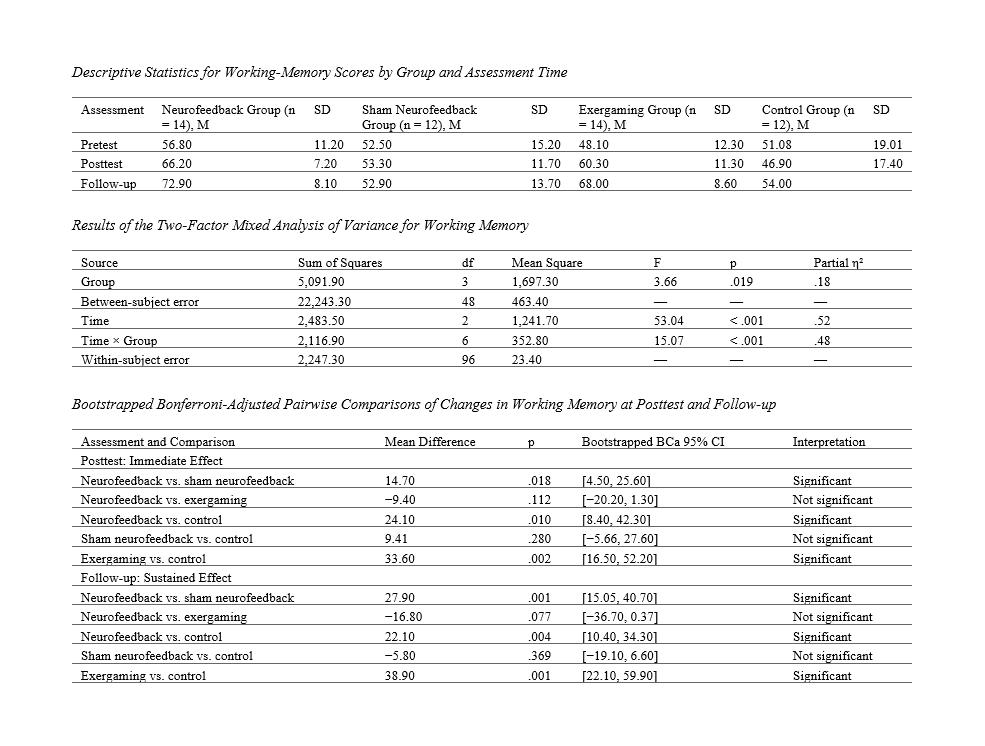
This study aimed to compare the immediate and sustained effects of neurofeedback and exergaming on working memory in children with attention-deficit/hyperactivity disorder. This applied experimental study used a randomized pretest–posttest–follow-up design with four groups. The participants were 52 boys aged 7–10 years with attention-deficit/hyperactivity disorder who attended mainstream primary schools in Qazvin, Iran, during the 2021–2022 academic year. After matching for intelligence and selected demographic characteristics, participants were randomly assigned to neurofeedback, sham neurofeedback, exergaming, and control groups. The neurofeedback and exergaming groups each included 14 participants, whereas the sham neurofeedback and control groups each included 12 participants. The intervention groups completed 30 sessions, conducted three times per week for 45 minutes. Working memory was assessed using the computerized N-Back Task at pretest, posttest, and one-month follow-up. Data were analyzed using a two-factor mixed analysis of variance and bootstrapped Bonferroni-adjusted pairwise comparisons in SPSS version 26. The main effect of time on working memory was significant, F(2, 96) = 53.04, p < .001, partial η² = .52. The main effect of group was also significant, F(3, 48) = 3.66, p = .019, partial η² = .18, and the time-by-group interaction was significant, F(6, 96) = 15.07, p < .001, partial η² = .48. At posttest, neurofeedback produced significantly greater improvement than sham neurofeedback (p = .018) and control (p = .010), while exergaming outperformed control (p = .002). At follow-up, neurofeedback remained superior to sham neurofeedback (p = .001) and control (p = .004), and exergaming remained superior to control (p = .001). No significant differences were found between neurofeedback and exergaming at posttest or follow-up. Both neurofeedback and exergaming were effective in improving working memory in children with attention-deficit/hyperactivity disorder, and their effects were maintained one month after treatment; however, neither intervention demonstrated clear superiority over the other.
Downloads
References
Adam, B., & Young-Walker, L. (2014). The Evolution of the ADHD Diagnosis and Its Implications for DSM-5. Journal of Pediatrics and Congenital Disorders, 1, 1-2.
Alrahili, N., Alreefi, M., Alkhonain, I. M., Aldakhilallah, M., Alothaim, J. S., Alzahrani, A., Alshargi, A., & Baabbad, N. M. (2023). The Prevalence of Video Game Addiction and Its Relation to Anxiety, Depression, and Attention Deficit Hyperactivity Disorder (ADHD) in Children and Adolescents in Saudi Arabia: A Cross-Sectional Study. Cureus. https://doi.org/10.7759/cureus.42957
Arjmandi, S., Keykhaavandi, S., & Sayehmiri, K. (2015). Prevalence of Attention-Deficit/Hyperactivity Disorder among Elementary School Students from the Perspectives of Teachers and Parents: A Systematic Review and Meta-Analysis. Principles of Mental Health, 17(5).
Bolea-Alamanac, B., Nutt, D. J., Adamou, M., Asherson, P., Bazire, S., Coghill, D., Heal, D., Muller, U., Nash, J., Santosh, P., Sayal, K., Sonuga-Barke, E., & Young, S. J. (2014). Evidence-Based Guidelines for the Pharmacological Management of Attention-Deficit Hyperactivity Disorder: Update on Recommendations from the British Association for Psychopharmacology. Journal of Psychopharmacology, 1-25.
Boot, W. R., Kramer, A. F., Simons, D. J., Fabiani, M., & Gratton, G. (2008). The Effects of Video Game Playing on Attention, Memory, and Executive Control. Acta Psychologica, 129(3), 387-398. https://doi.org/10.1016/j.actpsy.2008.09.005
Brandeis, D. (2011). Neurofeedback Training in ADHD: More News on Specificity. Clinical Neurophysiology, 122, 856-857. https://doi.org/10.1016/j.clinph.2010.08.011
Cortese, S., Ferrin, M., Brandeis, D., Holtmann, M., Aggensteiner, P., & Daley, D. (2016). Neurofeedback for Attention-Deficit/Hyperactivity Disorder: Meta-Analysis of Clinical and Neuropsychological Outcomes from Randomized Controlled Trials. Journal of the American Academy of Child & Adolescent Psychiatry, 55(6), 444-455. https://doi.org/10.1016/j.jaac.2016.03.007
Dasht Bozorgi, Z., Dadashpour, M., Amin al-Sharia, S., Ashouri, J., & Alizadeh, M. (2016). The Effect of Neurofeedback Training on Sustained Attention and Working Memory in Elementary School Boys with Attention-Deficit/Hyperactivity Disorder. Shafa Khatam, 5(4).
Fauzan, N., & Nazaruddin, M. (2012). Neurofeedback Training to Improve Neuronal Regulation in ADD: A Case Report. Procedia - Social and Behavioral Sciences, 33, 399-402. https://doi.org/10.1016/j.sbspro.2012.01.060
Gelade, K., Bink, M., Janssen, T. W., van Mourik, R., Maras, A., & Oosterlaan, J. (2016). An RCT into the Effects of Neurofeedback on Neurocognitive Functioning Compared to Stimulant Medication and Physical Activity in Children with ADHD. European Child & Adolescent Psychiatry, 26(4), 1-12. https://doi.org/10.1007/s00787-016-0902-x
Gray, S., Chaban, P., Martinussen, R., Goldberg, R., Gotlieb, H., Kronitz, R., & Tannock, R. (2012). Effects of a Computerized Working Memory Training Program on Working Memory, Attention, and Academics in Adolescents with Severe Learning Disabilities and Comorbid ADHD: A Randomized Controlled Trial. Journal of Child Psychology and Psychiatry, 53(12), 1277-1284. https://doi.org/10.1111/j.1469-7610.2012.02592.x
Heidari Nasab, L., Madani, A. S., Yaghoubi, H., Rostami, R., & Kazemi, R. (2016). Effectiveness of Neurofeedback Combined with Computerized Cognitive Exercises in Improving Working Memory in Adults with Attention-Deficit/Hyperactivity Disorder. Journal of Lorestan University of Medical Sciences, 18(1).
Heinrich, H., Strehl, U., Arns, M., Rothenberger, A., & Ros, T. (2016). Neurofeedback in ADHD. Frontiers Media SA. https://doi.org/10.3389/978-2-88919-722-4
Holtmann, M., Sonuga-Barke, E., Cortese, S., & Brandeis, D. (2014). Neurofeedback for ADHD: A Review of Current Evidence. Child and Adolescent Psychiatric Clinics of North America, 23(4), 789-806. https://doi.org/10.1016/j.chc.2014.05.006
Huron, D. (2007). Sweet Anticipation: Music and the Psychology of Expectation. MIT Press. https://doi.org/10.7551/mitpress/6575.001.0001
Jalili, F., Nejati, V., Asadi, H., & Katanforoush, S. A. (2019). Effectiveness of Movement-Based Computerized Cognitive Rehabilitation in Improving Working Memory in Children with Attention-Deficit/Hyperactivity Disorder. Medical Sciences Journal of Islamic Azad University, 29(2).
Ji, H., Wu, S., Won, J., Weng, S., Lee, S., Seo, S., & Park, J. J. (2023). The effects of exergaming on attention in children with attention deficit/hyperactivity disorder: randomized controlled trial. JMIR serious games, 11(1), e40438. https://doi.org/10.2196/40438
Lotfinia, S., Shahkaram, H., Yaseri, A., Kianimoghadam, A. S., & Sarani Yaztappeh, J. (2025). A clinical trial comparing the efficacy of two EEG-based neurofeedback protocols for generalized anxiety disorder: Sensory motor rhythm and alpha-theta. Iranian journal of psychiatry and behavioral sciences, 19(2), e158451. https://doi.org/10.5812/ijpbs-158451
Melo, D. N., Mendonça, A. L. M., Santos, F. C., Coelho, F. R., Teixeira, G. M., & Júnior, V. A. R. (2025). Biofeedback and Neurofeedback in the Clinical Setting: A Review of Their Application and Efficacy in Neurological and Psychiatric Conditions. International Health Sciences Review, 1(4), 21-35. https://doi.org/10.70164/ihsr.v1i4.39
Mohammadi, S. Y., & Hosseini, M. (2018). Comparison of the Effectiveness of Neurofeedback Therapy and Pharmacotherapy in Treating Attention-Deficit/Hyperactivity Disorder in Children in Isfahan. Neuropsychology, 12(1).
Mollazadeh, M., Gharayagh Zandi, H., & Rostamizadeh, M. J. (2018). Effectiveness of Yoga Training on Visual and Auditory Attention in Children with Hyperactivity Symptoms. Razi Journal of Medical Sciences, 25(8).
Narimani, M., Rajabi, S., & Delavar, S. (2013). The Effect of Neurofeedback Training on Reducing Hyperactivity and Attention-Deficit Symptoms in Female University Students. Journal of Arak University of Medical Sciences(2).
Nazerieh, N., & Niknam, M. (2024). The Effectiveness of Computer Games Rehabilitation and Cognitive Play Therapy Rehabilitation on the Risk-Taking of Children with Attention Deficit Hyperactivity Disorder. International Journal of Applied Behavioral Sciences, 11(2), 1-7. https://doi.org/10.61838/kman.jarac.7.1.17
Nejati, V., & Derakhshan, Z. (2024). Attention training improves executive functions and ameliorates behavioral symptoms in children with attention-deficit hyperactivity disorder: Implication of tele-cognitive-rehabilitation in the era of coronavirus disease. Games for Health Journal, 13(1). https://doi.org/10.1089/g4h.2023.0002
Nemati, S., & Alizadeh, H. (2017). Examining the Effectiveness of Neurofeedback in Treating Attention-Deficit/Hyperactivity Disorder: A Review Study. Psychology of Exceptional Individuals, 7(28).
Polanczyk, G. V., Willcutt, E. G., Salum, G. A., Kieling, C., & Rohde, L. A. (2014). ADHD Prevalence Estimates across Three Decades: An Updated Systematic Review and Meta-Regression Analysis. International journal of epidemiology, 43(2), 434-442. https://doi.org/10.1093/ije/dyt261
Pritchard, A. E., Nigro, C. A., Jacobson, L. A., & Mahone, E. M. (2012). The Role of Neuropsychological Assessment in the Functional Outcomes of Children with ADHD. Neuropsychology Review, 22(1), 54-68. https://doi.org/10.1007/s11065-011-9185-7
Rostamipour, M., Zareian, E., & Aslankhani, M. A. (2019). The Effect of Computerized Motor Interventions Using Xbox Kinect on Gross Motor Skills in Children with Motor Delay: Emphasis on Modern Exercises. Motor and Behavioral Sciences, 2(1).
Sadeghi Ahouei, J., Haji Mousaei, M., & Banisi, V. (2025). The Effect of Neurofeedback on Improving Executive and Academic Functions in Children and Adolescents with Attention Deficit/Hyperactivity Disorder and Learning Disabilities: A Review Study. Mental Health in School, 3(1), 21-27.
Salleg-Cabarcas, M. J., Robledo-Castro, C., & Monsalve-Vertel, C. P. (2024). Effect of Hit-Sport-Game Exercise Training on Self-Control and Regulation in Children With Attention Deficit Hyperactivity Disorder (ADHD). Global Pediatric Health, 11, 2333794X241287095. https://doi.org/10.1177/2333794X241287095
Santamaría-Vázquez, E., Estudillo-Guerra, A., Ali, L., Martinez, D., Hornero, R., & Morales-Quezada, L. (2025). Effects of a novel non-pharmacological intervention based on respiratory biofeedback, neurofeedback and median nerve stimulation to treat children with ADHD. Frontiers in human neuroscience, 19(1), 1–10. https://doi.org/10.3389/fnhum.2025.1478501
Seilsapour, M., Hamounpeyma, E., & Pirkhaefi, A. (2015). Effectiveness of Neurofeedback Therapy in Reducing Hyperactivity and Attention-Deficit Symptoms among Elementary School Students in Varamin in 2014. Student Research Committee, Mashhad University of Medical Sciences, 18(60).
Sterman, M. B., & Egner, T. (2006). Foundation and Practice of Neurofeedback for the Treatment of Epilepsy. Applied Psychophysiology and Biofeedback, 31(1), 21-35. https://doi.org/10.1007/s10484-006-9002-x
Stevenson, J., Buitelaar, J., Cortese, S., Ferrin, M., Konofal, E., Lecendreux, M., & Sonuga-Barke, E. (2014). Research Review: The Role of Diet in the Treatment of Attention-Deficit/Hyperactivity Disorder—An Appraisal of the Evidence on Efficacy and Recommendations on the Design of Future Studies. Journal of Child Psychology and Psychiatry, 55(5), 416-427. https://doi.org/10.1111/jcpp.12215
Treves, I., Bajwa, Z., Greene, K. D., Bloom, P. A., Kim, N., Wool, E., Goldberg, S. B., Whitfield-Gabrieli, S., & Auerbach, R. P. (2025). Consumer-Grade Neurofeedback with Mindfulness Meditation: Meta-Analysis. Journal of medical Internet research, 27, e68204. https://doi.org/10.2196/68204
Yu, C. L., Cheng, M. Y., An, X., Chueh, T. Y., Wu, J. H., Wang, K. P., & Hung, T. M. (2025). The Effect of EEG Neurofeedback Training on Sport Performance: A Systematic Review and Meta-Analysis. Scandinavian Journal of Medicine & Science in Sports, 35(5), e70055. https://doi.org/10.1111/sms.70055
Zhang, R., Zhang, Y., & Wang, J. (2025). Real-time fMRI neurofeedback for depression and anxiety: A systematic review. Translational psychiatry, 15(3), 123. https://doi.org/10.1038/s41398-025-03123-4
Zhong, X., Yuan, X., & Dai, Y. (2025). Neurofeedback training for executive function in ADHD children: A systematic review and meta-analysis. Scientific reports, 15, 28148. https://doi.org/10.1038/s41598-025-94242-4
Downloads
Additional Files
Publication Timeline
- Submitted
- Revised
- Accepted