Development of a “Power of Yet” Educational Package for Underachieving Gifted Students
Keywords:
educational package development, thematic analysis, Power of Yet, underachieving gifted studentsAbstract
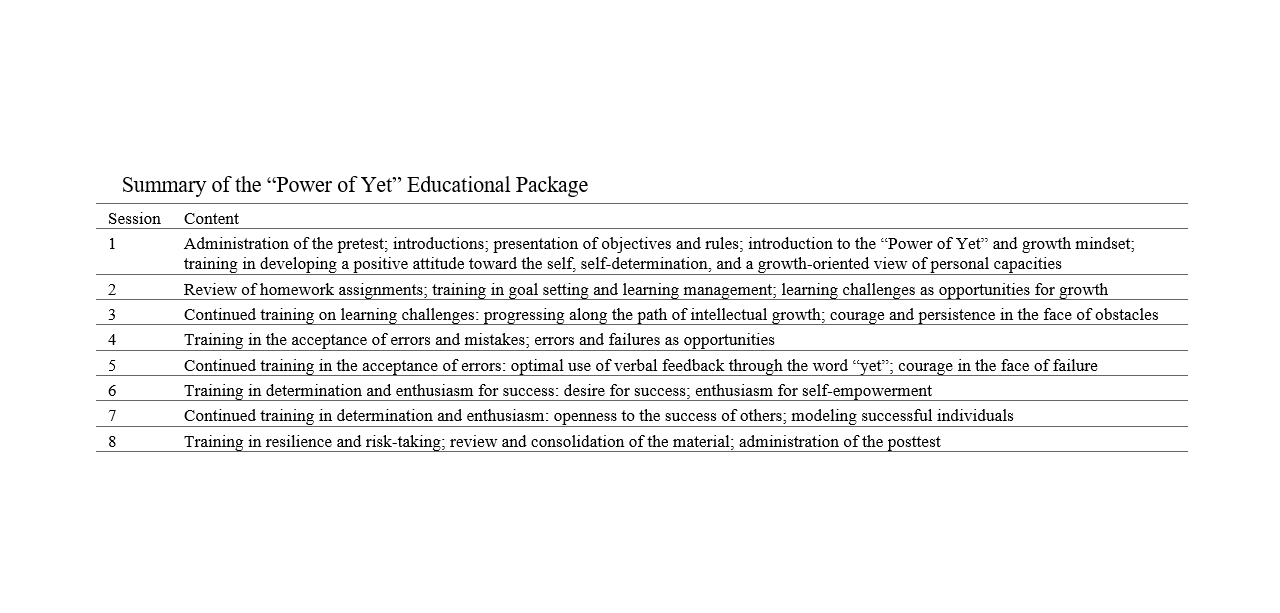
The aim of this study was to develop a “Power of Yet” educational package for underachieving gifted students. This qualitative study employed thematic analysis using a deductive (theory-driven) approach and Attride-Stirling’s technique. Accordingly, based on research literature related to growth mindset, Dweck’s theory of intelligence beliefs, and the concept of the “Power of Yet,” 35 sources—including books, articles, master’s theses, and doctoral dissertations—published between 2016 and 2025 were selected through purposive sampling based on the criterion of theoretical saturation. These sources were retrieved from reputable national and international databases, and themes relevant to the field were extracted. Thematic analysis was conducted manually using a systematic coding procedure. The analysis identified 22 basic themes, 12 organizing themes, and five global themes: learning challenges, acceptance of errors and mistakes, insight and attitudes toward the self, determination and enthusiasm for success, and resilience and risk-taking. Subsequently, based on the resulting conceptual framework, an eight-session “Power of Yet” educational package was developed. To assess the content validity and credibility of the educational package, the Content Validity Ratio (CVR) was calculated based on the evaluations of six experts. A CVR of 1.00 was obtained, indicating an acceptable level of content validity and complete agreement among the evaluators. The findings showed that the “Power of Yet” educational package incorporates the components of learning goal setting, acceptance of failure as an opportunity, use of “yet” as verbal feedback, self-determination, modeling successful individuals, persistence and flexibility in the face of obstacles, and risk-taking for personal growth and change. Based on these findings, it can be concluded that this educational package is appropriate for enhancing the “Power of Yet” among underachieving gifted students.
Downloads
References
Cai, P., Li, X., Feng, J., Mai, Z., & Guan, X. (2026). Exploring the Parallel Mediating Roles of Self-Regulation, Motivation, and Self-Efficacy in the Relationship Between Shame and Growth Mindset. BMC psychology, 14(1), 185. https://doi.org/10.1186/s40359-026-03976-x
Caprì, T., Catalano, G. B., & Fabio, R. A. (2026). The Contribution of Executive Functions to Academic Achievement in Gifted Children: A Cross-Sectional Study. Journal of Intelligence, 14(3), 44. https://doi.org/10.3390/jintelligence14030044
Desmet, O. A., Mo, F., & Pineda Medina, A. (2025). Parental Narratives of Underachievement Among Gifted Children: Onset, Factors, and Perceived Resolutions. Gifted Child Quarterly, 00169862251362841. https://doi.org/10.1177/00169862251362841
Dweck, C. (2016). The Remarkable Reach of Growth Mind-Sets. Scientific American Mind, 27(1), 36-41. https://www.jstor.org/stable/24945335
Dweck, C. S., & Yeager, D. S. (2019). Mindsets: A View from Two Eras. Perspectives on Psychological Science, 14(3), 481-496. https://doi.org/10.1177/1745691618804166
Gladstone, J. R., Tallberg, M., Jaxon, J., & Cimpian, A. (2024). What Makes a Role Model Motivating for Young Girls? The Effects of the Role Model’s Growth Versus Fixed Mindsets About Ability and Interest. Journal of Experimental Child Psychology, 238, 105775.
Jamshidian, H., Hafezi, F., Eftekharsaadi, Z., & Abedi, A. (2021). The Effectiveness of Martin's Cognitive-Behavioral Method on Academic Emotions and Academic Motivation in Gifted Upper Secondary School Students. Empowerment of Exceptional Children, 12(2 (35)), 61-71. https://sid.ir/paper/952468/fa
Muradoglu, M., Lassetter, B., Sewell, M. N., Ontai, L., Napolitano, C. M., Dweck, C., & Cimpian, A. (2025). The Structure and Motivational Significance of Early Beliefs About Ability. Developmental Psychology.
Murphy, F., & Gash, H. (2020). I Can’t Yet and Growth Mindset. Constructivist Foundations, 15(2), 83-94.
Peña-San José, J., Arruti, A., & Martínez-Izaguirre, M. (2025). Interventions With Gifted Underachieving Students: A Systematic Review. Gifted Education International, 02614294261425529. https://doi.org/10.1177/02614294261425529
Prieto-Ayuso, A., Martínez-Martínez, J., Arias-Palencia, N. M., & Pastor-Vicedo, J. C. (2026). The Relationship Between Physical Activity and Achieving/Underachieving Gifted Students. Roeper Review, 1-10. https://doi.org/10.1080/02783193.2026.2647723
Radmanesh, A., Dortaj, F., Saadipour, E., Delavar, A., & Asadzadeh, H. (2022). Development and Validation of a Growth Mindset Educational Package Based on Dweck's Theory of Intelligence Beliefs and Its Effectiveness on Academic Hardiness and Procrastination in Female Students. Quarterly Journal of Modern Psychological Research, 17(66), 131-140. https://doi.org/10.22034/jmpr.2022.15287
Sigmundsson, H., & Haga, M. (2024). Passion and Grit in Individuals with High Levels of Growth Mindset Are Different Than in Individuals Who Have Low Growth Mindset. Acta Psychologica, 250, 104480. https://doi.org/10.1016/j.actpsy.2024.104480
Sypré, S., Onghena, P., Verschueren, K., Vansteenkiste, M., & Soenens, B. (2025). Promoting Engagement and Motivation and Reducing Perceived Underachievement of Gifted Male Adolescents: A Mixed-Methods Single-Case Experimental Study. Gifted Child Quarterly, 00169862251388967. https://doi.org/10.1177/00169862251388967
Taghinejad, M., Abedi, A., & Yarmohammadian, A. (2018). Comparison of the Effectiveness of a Growth Mindset Intervention and an Independent Learning Program on Academic Resilience of Underachieving Gifted Students. Quarterly Journal of Applied Psychological Research, 9(4), 1-20. https://doi.org/10.22059/japr.2019.70398
Uğurlu, S. Y., & Taşcılar, M. Z. L. (2026). A Case Study on the Experiences of Underachieving Gifted Students. Bartın University Journal of Faculty of Education(2), 400-432. https://doi.org/10.14686/buefad.1852008
Von Bergen, C. W., & Bressler, M. S. (2021). Utilizing the Power of Yet. Journal of Behavioral Studies in, 12, 1-15.
Yang, X., Yang, J., Jia, T., Wang, L., & Zhang, J. (2024). A Meta-Analysis of the Relationship Between Growth Mindset and Mental Health in Chinese Samples. Acta Psychologica, 251, 104578.
Zhang, W., & Li, J. (2025). Sports Atmosphere and Psychological Resilience in College Students: Mediating Role of Growth Mindset. Frontiers in psychology, 16, 1532498. https://doi.org/10.3389/fpsyg.2025.1532498
Downloads
Additional Files
Publication Timeline
- Submitted
- Revised
- Accepted