Development of a Skills Training Educational Package for Children with Autism Spectrum Disorder Based on Theory of Mind and Iranian Cultural Characteristics
Keywords:
Autism Spectrum Disorder, Theory of Mind, Skills Training, Educational Package, Social Skills, Iranian CultureAbstract
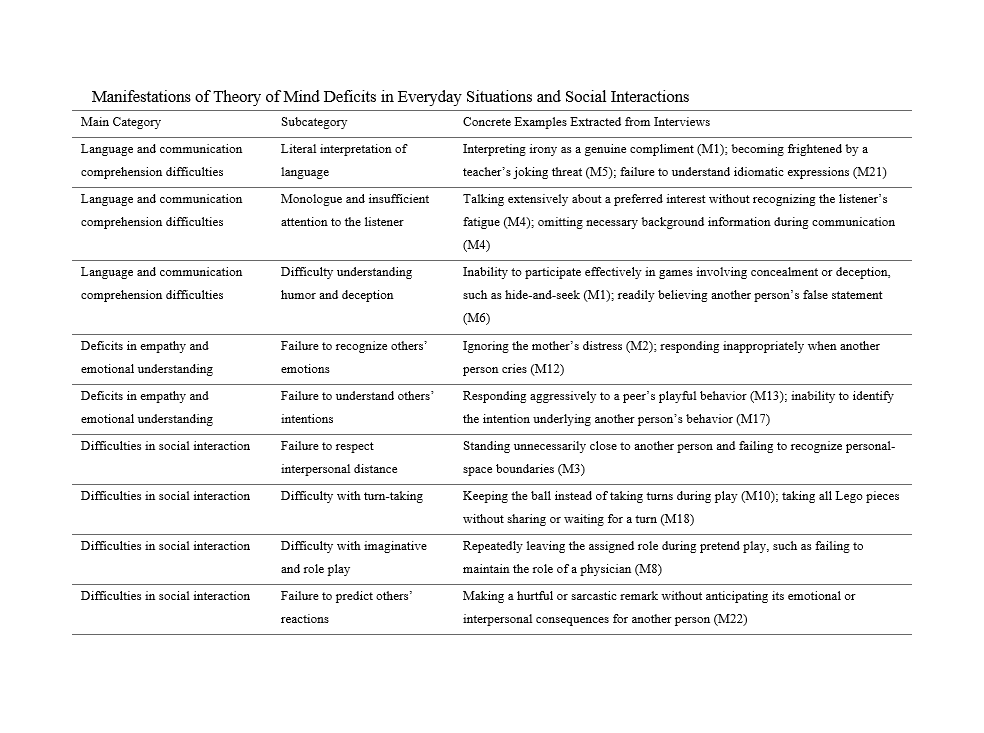
This study aimed to develop a culturally adapted skills-training educational package for children with autism spectrum disorder (ASD) based on Theory of Mind (ToM) components and Iranian cultural characteristics. This qualitative exploratory study employed systematic literature review, document analysis, field investigation, and semi-structured interviews with autism specialists selected through purposive and snowball sampling until theoretical saturation was achieved. The participants included clinical psychologists, child psychiatrists, occupational therapists, speech therapists, and educational instructors with relevant professional experience. Interview data were transcribed and analyzed in MAXQDA using qualitative content analysis and a three-stage grounded-theory coding procedure comprising open, axial, and selective coding. The resulting categories were integrated into a paradigmatic model encompassing causal conditions, the central phenomenon, contextual and intervening conditions, strategies, and consequences. Content and face validity of the proposed package were evaluated by experts. The final intervention was organized as a structured 40-session program progressing from concrete to increasingly abstract ToM skills. The analysis indicated that deficits in understanding nonliteral language, intentions, deception, perspectives, and pragmatic communication constituted major causal mechanisms underlying impaired social skills and stereotyped behaviors. Child-related cognitive and behavioral characteristics, family support, parental cooperation, and environmental stability emerged as important contextual conditions, whereas sensory difficulties, behavioral problems, resistance to routine changes, limited generalization, and inadequate school–family coordination acted as intervening barriers. The principal educational strategies comprised training in basic emotions, joint attention, desires, first- and second-order false beliefs, behavioral prediction, empathy, humor, and irony. Experts further emphasized visual and concrete materials, role-play, video modeling, personalization, parental participation, school coordination, and practice across natural settings. The model indicated that these strategies could improve social interaction, empathy, communication, and ToM-related functioning while reducing stereotyped behaviors through greater environmental predictability and behavioral flexibility. The developed 40-session ToM-based package provides a culturally responsive and developmentally sequenced framework for strengthening socio-cognitive and interpersonal skills in children with ASD and may enhance the ecological applicability of autism interventions within Iranian family, educational, and clinical contexts.
Downloads
References
American Psychiatric, A. (2013). Diagnostic and Statistical Manual of Mental Disorders (5th ed.). American Psychiatric Association. https://doi.org/10.1176/appi.books.9780890425596
Centers for Disease, C., & Prevention. (2023). Autism Spectrum Disorder (ASD). https://www.cdc.gov/ncbddd/autism/index.html
Durrleman, S., Bentea, A., & Prisecaru, A. (2023). Training Syntax to Enhance Theory of Mind in Children with Autism Spectrum Disorder. Journal of Autism and Developmental Disorders, 53, 2444-2457. https://doi.org/10.1007/s10803-022-05507-0
Eigsti, I., & Irvine, C. (2021). Verbal Mediation of Theory of Mind in Verbal Adolescents with Autism Spectrum Disorder. Language Acquisition, 28(2), 195-213. https://doi.org/10.1080/10489223.2021.1877705
Ghiglino, D., Floris, F., & De Tommaso, D. (2025). Enhancing Theory of Mind in Autism through Humanoid Robot Interaction in a Randomized Controlled Trial. Scientific reports, 15, 27650. https://doi.org/10.1038/s41598-025-12253-7
Jouy, L. (2025). The Effect of Resilience Skills Training on Improving Social Interactions in Children with Autism Spectrum Disorder. Neyshabur.
Kaltefleiter, L., Sodian, B., Kristen-Antonow, S., Grosse Wiesmann, C., & Schuwerk, T. (2021). Does Syntax Play a Role in Theory of Mind Development before the Age of 3 Years? Infant Behavior and Development, 64, 101575. https://doi.org/10.1016/j.infbeh.2021.101575
Li, L., Zhu, X., & Wan, S. (2025). Research on the Improvement of Daily Living Skills of Children with Autism in Virtual Campus Environments. Scientific reports, 15, 30102. https://doi.org/10.1038/s41598-025-08224-7
Martínez-González, A. E., Cervin, M., & Piqueras, J. A. (2022). Relationships between Emotion Regulation, Social Communication and Repetitive Behaviors in Autism Spectrum Disorder. Journal of Autism and Developmental Disorders, 52, 4519-4527. https://doi.org/10.1007/s10803-021-05340-x
Ozonoff, S., & South, M. (2001). Executive Functions in Autism. In (pp. 179-211). Oxford University Press.
Polyanskaya, I., Eigsti, I. M., & Brauner, T. (2021). Second-Order False Beliefs and Linguistic Recursion in Autism Spectrum Disorder. Journal of Autism and Developmental Disorders. https://doi.org/10.1007/s10803-021-05277-1
Pourhossein Mojarshin, R. (2023). A Comparative Review of Theory of Mind in Children with Autism Spectrum Disorder, Children with Intellectual Disability, and Typically Developing Children.
Rathi, E., Alishahi, M., Mahmoudi, M., & Nikandish, R. (2021). Life Skills Training for Children with Autism. Shirvan.
Salehi Kamroudi, M., Ahmadi, E., & Soleimani, M. (2022). The Effectiveness of Child-Centered Play Therapy on Theory of Mind in Children with Autism Spectrum Disorder. Health and Education in Early Childhood, 3(1), 129-141.
Schwartz Offek, E., & Segal, O. (2022). Comparing Theory of Mind Development in Children with Autism Spectrum Disorder, Developmental Language Disorder, and Typical Development. Neuropsychiatric Disease and Treatment, 18, 2349-2359.
Toker, M., & Acarlar, F. (2025). Theory of Mind and Executive Function: Children with Autism Spectrum Disorder and Typically Developing Children. e-Kafkas Journal of Educational Research, 12(2), 428-443. https://doi.org/10.30900/kafkasegt.1610389
World Health, O. (2023). Autism Spectrum Disorders. https://www.who.int/news-room/fact-sheets/detail/autism-spectrum-disorders
Zoccante, L., Sabaini, S., Rigotti, E., Bonatti, S. M., Lintas, C., & Zaffanello, M. (2025). Impact of a Structured Social Skills Training Program on Adolescents and Young Adults with Level 1 Autism. Pediatric Reports, 17(1), 6. https://doi.org/10.3390/pediatric17010006
Downloads
Additional Files
Publication Timeline
- Submitted
- Revised
- Accepted