The Mediating Role of Cognitive Avoidance in the Relationship Between Intolerance of Uncertainty and Chronic Pain in Multiple Sclerosis Patients: A Structural Equation Modeling Approach
Keywords:
Multiple Sclerosis, Cognitive Avoidance, Chronic Pain, Intolerance of UncertaintyAbstract
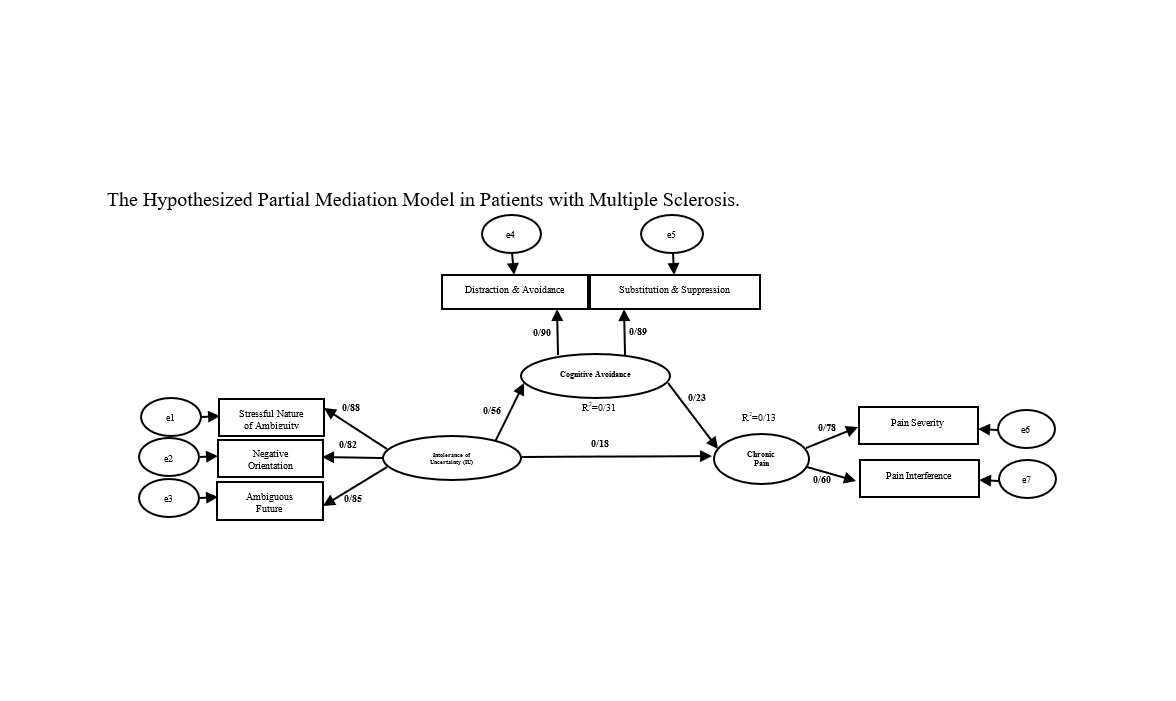
Chronic pain is a prevalent and debilitating symptom in multiple sclerosis (MS). While psychological factors, such as intolerance of uncertainty (IU), are known contributors, the specific mechanisms underlying them are underexplored. This study aimed to investigate whether cognitive avoidance (CA) mediates the relationship between IU and chronic pain severity in this population. In this cross-sectional study, 339 patients with MS (151 men, 178 women) were recruited via convenience sampling from medical centers in Tehran, Iran. Participants completed the Intolerance of Uncertainty Scale (IUS), the Cognitive Avoidance Questionnaire (CAQ), and the Brief Pain Inventory-Short Form (BPI-SF). Data were analyzed using structural equation modeling (SEM). A partial mediation model demonstrated an excellent fit to the data (CFI = 0.99, RMSEA = 0.055, χ2/df = 2.02). The analysis revealed both a significant direct effect of IU on chronic pain and a significant indirect effect mediated by CA, which was confirmed via bootstrapping. The final model accounted for 13% of the variance in chronic pain. Our findings highlight the crucial role of cognitive-behavioral mechanisms in MS-related chronic pain. Individuals with higher IU tend to engage in cognitive avoidance, which exacerbates their pain, identifying CA as a key therapeutic target. Psychological interventions aimed at reducing avoidance and enhancing tolerance to uncertainty may therefore provide a promising approach to improving pain management and well-being in individuals with MS.
Downloads
References
Abou El-Maaty, A. A., El Sherifi, S. S., El-Gilany, A. H., Zehry, H. I., Salim, A. A., Rohiem, M. F., & Ismael, A. F. (2024). Arabic translation, content validity and reliability of the Multiple Sclerosis Intimacy and Sexuality Questionnaire-19 (MSISQ-19). The Egyptian Journal of Neurology, Psychiatry and Neurosurgery, 60(1), 44. https://doi.org/10.1186/s41983-024-00817-9
Akbari Esfahani, A., Pourshahbaz, A., & Dolatshahi, B. (2024). Structural relations of illness perception, fatigue, locus of control, self-efficacy, and coping strategies in patients with multiple sclerosis: A cross-sectional study. BMC public health, 24(1), 1354. https://doi.org/10.1186/s12889-024-18807-0
Akboğa, Y. E., Türkel, N. N., Demirci, A., & Ertek, İ. E. (2025). Fear of relapse in multiple sclerosis: Examining the roles of perfectionism and intolerance of uncertainty. Neurological Sciences: Official Journal of the Italian Neurological Society and of the Italian Society of Clinical Neurophysiology. https://doi.org/10.1007/s10072-025-08507-x
Alaiti, R. K., Reis, F. J. J., Arruda-Sanchez, T., Caneiro, J., & Meulders, A. (2025). Unraveling the role of fear and avoidance behavior in chronic musculoskeletal pain: From theory to physical therapy clinical practice. Brazilian Journal of Physical Therapy, 29(3), 101197. https://doi.org/10.1016/j.bjpt.2025.101197
Allan, N. P., Gorka, S. M., Saulnier, K. G., & Bryan, C. J. (2023). Anxiety Sensitivity and Intolerance of Uncertainty: Transdiagnostic Risk Factors for Anxiety as Targets to Reduce Risk of Suicide. Current psychiatry reports, 25(4), 139-147. https://doi.org/10.1007/s11920-023-01413-z
Alschuler, K. N., Whibley, D., Kratz, A. L., Jensen, M. P., Wundes, A., von Geldern, G., Qian, P., Bombardier, C. H., & Ehde, D. M. (2022). Quality of life in individuals newly diagnosed with multiple sclerosis or clinically isolated syndrome. Journal of Neurology, 269(5), 2560-2572. https://doi.org/10.1007/s00415-021-10842-w
Bogosian, A., Day, F., Norton, S., Silber, E., Sakel, M., Sharrack, B., & Moss-Morris, R. (2022). Key demographics and psychological skills associated with adjustment to progressive Multiple Sclerosis early in the diagnosis. Frontiers in Rehabilitation Sciences, 3. https://doi.org/10.3389/fresc.2022.966133
Chang, E. C. (2024). Expectativas Oscuras: On the Added Burden of Concomitant Negative Problem Orientation and Pessimism in Predicting Depressive Symptoms and Suicidal Behaviors in Latinx Young Adults. Cognitive therapy and research, 48(6), 1139-1151. https://doi.org/10.1007/s10608-024-10509-6
Cohen, S. P., Vase, L., & Hooten, W. M. (2021). Chronic pain: An update on burden, best practices, and new advances. The lancet, 397(10289), 2082-2097. https://doi.org/10.1016/S0140-6736(21)00393-7
Guarnaccia, J. B., Njike, V. Y., Dutton, A., Ayettey, R. G., Treu, J. A., Comerford, B. P., & Sinha, R. (2023). A pilot, randomized, placebo-controlled study of mindfulness meditation in treating insomnia in multiple sclerosis. BMC Neurology, 23(1), 263. https://doi.org/10.1186/s12883-023-03309-0
Hanna, M., & Strober, L. B. (2020). Anxiety and depression in Multiple Sclerosis (MS): Antecedents, consequences, and differential impact on well-being and quality of life. Multiple Sclerosis and Related Disorders, 44. https://doi.org/10.1016/j.msard.2020.102261
Hebert, S. V., Green, M. A., Mashaw, S. A., Brouillette, W. D., Nguyen, A., Dufrene, K., Shelvan, A., Patil, S., Ahmadzadeh, S., Shekoohi, S., & Kaye, A. D. (2024). Assessing Risk Factors and Comorbidities in the Treatment of Chronic Pain: A Narrative Review. Current Pain and Headache Reports, 28(6), 525-534. https://doi.org/10.1007/s11916-024-01249-z
Jellinger, K. A. (2024). Depression and anxiety in multiple sclerosis. Review of a fatal combination. Journal of Neural Transmission, 131(8), 847-869. https://doi.org/10.1007/s00702-024-02792-0
Kodosaki, E., Watkins, W. J., Loveless, S., Kreft, K. L., Richards, A., Anderson, V., Hurler, L., Robertson, N. P., Zelek, W. M., & Tallantyre, E. C. (2024). Combination protein biomarkers predict multiple sclerosis diagnosis and outcomes. Journal of Neuroinflammation, 21(1), 52. https://doi.org/10.1186/s12974-024-03036-4
Kusec, A., Murphy, F. C., Peers, P. V., & Manly, T. (2024). Measuring Intolerance of Uncertainty After Acquired Brain Injury: Factor Structure, Reliability, and Validity of the Intolerance of Uncertainty Scale-12. Assessment, 31(4), 794-811. https://doi.org/10.1177/10731911231182693
Landmark, L., Sunde, H. F., Fors, E. A., Kennair, L. E. O., Sayadian, A., Backelin, C., & Reme, S. E. (2024). Associations between pain intensity, psychosocial factors, and pain-related disability in 4285 patients with chronic pain. Scientific reports, 14(1), 13477. https://doi.org/10.1038/s41598-024-64059-8
Llera, S. J., & Newman, M. G. (2023). Incremental validity of the contrast avoidance model: A comparison with intolerance of uncertainty and negative problem orientation. Journal of anxiety disorders, 95, 102699. https://doi.org/10.1016/j.janxdis.2023.102699
Margoni, M., Preziosa, P., Rocca, M. A., & Filippi, M. (2023). Depressive symptoms, anxiety and cognitive impairment: Emerging evidence in multiple sclerosis. Translational psychiatry, 13(1), 264. https://doi.org/10.1038/s41398-023-02555-7
McHugh, R. K., Kneeland, E. T., Edwards, R. R., Jamison, R., & Weiss, R. D. (2020). Pain catastrophizing and distress intolerance: Prediction of pain and emotional stress reactivity. Journal of Behavioral Medicine, 43(4), 623-629. https://doi.org/10.1007/s10865-019-00086-5
Mihailova, S., & Jobson, L. (2020). The impact of depression and culture on responses to intrusive autobiographical memories: Cognitive appraisals, cognitive avoidance, and brooding rumination. The British Journal of Clinical Psychology, 59(1), 66-79. https://doi.org/10.1111/bjc.12232
Nombela-Cabrera, R., Pérez-Nombela, S., Avendaño-Coy, J., Comino-Suárez, N., Arroyo-Fernández, R., Gómez-Soriano, J., & Serrano-Muñoz, D. (2023). Effectiveness of transcranial direct current stimulation on balance and gait in patients with multiple sclerosis: Systematic review and meta-analysis of randomized clinical trials. Journal of NeuroEngineering and Rehabilitation, 20(1), 142. https://doi.org/10.1186/s12984-023-01266-w
Panjwani, A. A., Applebaum, A. J., Revenson, T. A., Erblich, J., & Rosenfeld, B. (2024). Intolerance of uncertainty, experiential avoidance, and trust in physician: A moderated mediation analysis of emotional distress in advanced cancer. Journal of Behavioral Medicine, 47(1), 71-81. https://doi.org/10.1007/s10865-023-00419-5
Pennington, C. R., Oxtoby, M. C. S. Y., & Shaw, D. J. (2024). Social cognitive disruptions in multiple sclerosis: The role of executive (dys)function. Neuropsychology, 38(2), 157-168. https://doi.org/10.1037/neu0000917
Pourhaji, F., Jamali, J., Taraghdar, M. M., Peyman, N., & Tehrani, H. (2024). Design and validation of a Questionnaire on the factors influencing self-care behaviors in patients with Multiple sclerosis (QFASMS). BMC Neurology, 24(1), 20. https://doi.org/10.1186/s12883-023-03522-x
Racke, M. K., Frohman, E. M., & Frohman, T. (2022). Pain in Multiple Sclerosis: Understanding Pathophysiology, Diagnosis, and Management Through Clinical Vignettes. Frontiers in Neurology, 12. https://doi.org/10.3389/fneur.2021.799698
Rivel, M., Achiron, A., Stern, Y., Zeilig, G., & Defrin, R. (2024). Emotional burden among MS patients: Associations between specific chronic pain diagnoses and psychological features. Journal of Neurology, 271(2), 688-698. https://doi.org/10.1007/s00415-023-12048-8
Sparaco, M., Miele, G., Abbadessa, G., Ippolito, D., Trojsi, F., Lavorgna, L., & Bonavita, S. (2022). Pain, quality of life, and religiosity in people with multiple sclerosis. Neurological Sciences, 43(5), 3247-3254. https://doi.org/10.1007/s10072-021-05759-1
Sturgeon, J. A., Zubieta, C., Kaplan, C. M., Pierce, J., Arewasikporn, A., Slepian, P. M., Hassett, A. L., & Trost, Z. (2024). Broadening the Scope of Resilience in Chronic Pain: Methods, Social Context, and Development. Current Rheumatology Reports, 26(4), 112-123. https://doi.org/10.1007/s11926-024-01133-0
Taskin Yilmaz, F., Celik, S., & Ozcelik, E. E. (2025). Intolerance of Uncertainty, Symptom Severity, and Disease Self-management in Patients With Multiple Sclerosis. The Journal of Neuroscience Nursing: Journal of the American Association of Neuroscience Nurses, 57(5), 187-191. https://doi.org/10.1097/JNN.0000000000000844
Downloads
Additional Files
Publication Timeline
- Submitted
- Revised
- Accepted