Comparison of the Effectiveness of Aerobic Exercise Training and Neuro-Linguistic Programming (NLP) Strategies on Executive Functions in Students with Learning Disabilities
Keywords:
Aerobic Exercise, Neuro-Linguistic Programming, Executive Functions, Sustained Attention, Planning, Organization, Learning DisabilitiesAbstract
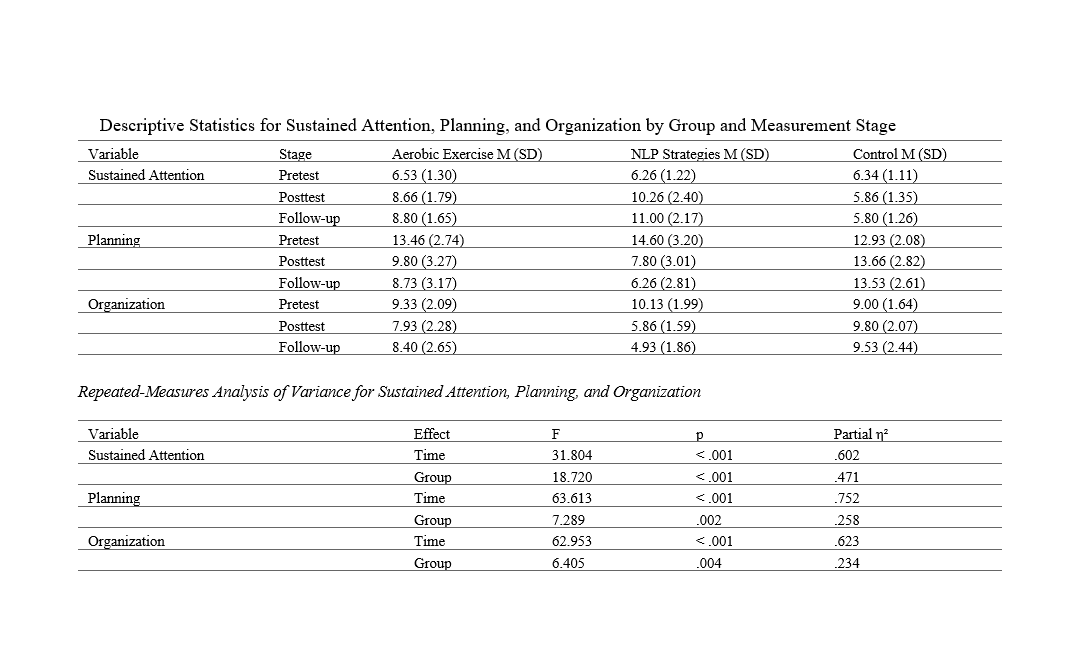
The present study aimed to compare the effectiveness of aerobic exercise training and neuro-linguistic programming (NLP) strategies on sustained attention, planning, and organization in students with learning disabilities. This quasi-experimental study employed a pretest–posttest design with a control group and a two-month follow-up. The statistical population consisted of students with learning disabilities attending educational and clinical centers in the Mehrshahr district of Karaj during the 2024–2025 academic year. Using convenience sampling, 45 eligible students aged 13–15 years were selected and randomly assigned to three groups: aerobic exercise training (n = 15), NLP strategies training (n = 15), and control (n = 15). The two experimental groups received their respective interventions over a two-month period, whereas the control group received no intervention. Executive functions were assessed using the Behavior Rating Inventory of Executive Function, Teacher Form (BRIEF), at pretest, posttest, and follow-up. Data were analyzed using repeated-measures analysis of variance and Bonferroni post-hoc comparisons in SPSS version 26. Repeated-measures analysis showed significant time and group effects for sustained attention (F = 31.804, p < .001, partial η² = .602; F = 18.720, p < .001, partial η² = .471), planning (F = 63.613, p < .001, partial η² = .752; F = 7.289, p = .002, partial η² = .258), and organization (F = 62.953, p < .001, partial η² = .623; F = 6.405, p = .004, partial η² = .234). Bonferroni comparisons indicated that both aerobic exercise and NLP significantly improved sustained attention and planning compared with the control group, while no significant difference was found between the two interventions. For organization, only the NLP group differed significantly from the control group (p = .003), whereas aerobic exercise did not (p = .630). Both aerobic exercise training and NLP strategies can improve sustained attention and planning in students with learning disabilities, while NLP strategies may offer a more specific benefit for organizational functioning.
Downloads
References
Amorós-Aguilar, L., Rodríguez-Quiroga, E., Sánchez-Santolaya, S., & Coll-Andreu, M. (2021). Effects of Combined Interventions With Aerobic Physical Exercise and Cognitive Training on Cognitive Function in Stroke Patients: A Systematic Review. Brain Sciences, 11(4), 473. https://doi.org/10.3390/brainsci11040473
Borji, R., Affes, S., Zarrouk, N., Sahli, S., & Rebai, H. (2022). Acute Effects of Aerobic Versus Resistance Exercises on Cognitive Function in Individuals With Intellectual Disability. Journal of Applied Research in Intellectual Disabilities, 36(1), 106-115. https://doi.org/10.1111/jar.13039
Cano-Sánchez, J., Carcelén‐Fraile, M. d. C., & Muñoz-Perete, J. M. (2026). Blood Flow Restriction Training Improves Cognition Performance and Sleep Quality in Middle-Aged Adults With Relapsing–Remitting Multiple Sclerosis. Physiologia, 6(1), 12. https://doi.org/10.3390/physiologia6010012
Carcelén‐Fraile, M. d. C., Hita‐Contreras, F., Mesas-Aróstegui, M. A., & Aibar‐Almazán, A. (2025). Effects of Physical Activity on Executive Function and Emotional Regulation in Children and Adolescents With Neurodevelopmental Disorders: A Systematic Review and Meta-Analysis. Healthcare, 13(19), 2415. https://doi.org/10.3390/healthcare13192415
Chang, H. W., Chiu, Y. H., Chou, C. C., Chen, J.-F., & Pan, C. C. (2025). Associations of Physical Fitness With Sustained Overt Attention and Academic Performance in Children With Learning Disabilities. Peerj, 13, e19549. https://doi.org/10.7717/peerj.19549
Dotson, V. M., Gradone, A. M., Bogoian, H. R., Minto, L. R., Taiwo, Z., & Salling, Z. (2021). Be Fit, Be Sharp, Be Well: The Case for Exercise as a Treatment for Cognitive Impairment in Late-Life Depression. Journal of the International Neuropsychological Society, 27(8), 776-789. https://doi.org/10.1017/s1355617721000710
Farì, G., Lunetti, P., Raele, M. V., Mintrone, G., Ranieri, M., Megna, M., & Capobianco, L. (2021). The Effect of Physical Exercise on Cognitive Impairment in Neurodegenerative Disease: From Pathophysiology to Clinical and Rehabilitative Aspects. International Journal of Molecular Sciences, 22(21), 11632. https://doi.org/10.3390/ijms222111632
Gharakhanlou, R., Wesselmann, L., Rademacher, A., Lampit, A., Negaresh, R., Kaviani, M., Oberste, M., Motl, R. W., Sandroff, B. M., Bansi, J., Baker, J. S., Heesen, C., Zimmer, P., & Javelle, F. (2020). Exercise Training and Cognitive Performance in Persons With Multiple Sclerosis: A Systematic Review and Multilevel Meta-Analysis of Clinical Trials. Multiple Sclerosis Journal, 27(13), 1977-1993. https://doi.org/10.1177/1352458520917935
Gitimoghaddam, M., Vanderloo, L. M., Hung, R., Ryce, A., McKellin, W. H., Miller, A. R., & Collet, J. P. (2021). Impacts of Participation in Community-Based Physical Activity Programs on Cognitive Functions of Children and Youth With Neurodevelopmental Disabilities: A Scoping Review. Brain Sciences, 11(2), 195. https://doi.org/10.3390/brainsci11020195
Gkora, V., & Driga, A. M. (2023). Virtual Reality, Digital Technologies and Brain Rewiring Techniques for Intervention in Attention-Deficit/Hyperactivity Disorder (Adhd). Journal Health and Technology - JHT, 2(2), e2237. https://doi.org/10.47820/jht.v2i2.37
Guzmán-Muñoz, E., Concha‐Cisternas, Y., Jofré‐Saldía, E., Castillo-Paredes, A., Molina-Márquez, I., & Sepulveda, R. A. Y. (2025). Physical Activity and Its Effects on Executive Functions and Brain Outcomes in Children: A Narrative Review. Brain Sciences, 15(11), 1238. https://doi.org/10.3390/brainsci15111238
Han, C. (2023). Effects of Aerobic Exercise on Cognitive Function in Different Populations. Frontiers in Sport Research, 5(4). https://doi.org/10.25236/fsr.2023.050407
He, Y., Wang, Q., Wu, H.-D., Dong, Y.-M., Guo, X., & Jiang, N. (2023). The Role of IGF-1 in Exercise to Improve Obesity-Related Cognitive Dysfunction. Frontiers in Neuroscience, 17. https://doi.org/10.3389/fnins.2023.1229165
Huang, Y., Ou, H., Lin, Q., Xue, Y., Xia, R., Tan, Z., Xiong, L., Yan, Z., & Wen, J. (2024). The Effects of Moderate-Intensity Aerobic Exercise on Cognitive Function in Individuals With Stroke-Induced Mild Cognitive Impairment: A Randomized Controlled Pilot Study. Journal of Rehabilitation Medicine, 56, jrm33001. https://doi.org/10.2340/jrm.v56.33001
Huszaini, S., & Shahril, M. I. (2023). The Development of Aerobic Dance (ADa) Modules and Its Effectiveness Towards Cognitive Development of Students With Learning Disabilities at Secondary School Putrajaya, Malaysia. International Journal of Academic Research in Business and Social Sciences, 13(5). https://doi.org/10.6007/ijarbss/v13-i5/17098
Koper, M., & Rękosiewicz, M. (2024). The Effect of the Bilateral Integration Exercise Program on the Cognitive Functioning of Pupils With Moderate Intellectual Disabilities. Frontiers in Psychiatry, 15. https://doi.org/10.3389/fpsyt.2024.1409061
Langeskov‐Christensen, M., Hvid, L. G., Jensen, H. B., Nielsen, H. H., Petersen, T., Stenager, E., Hämäläinen, P. I., & Dalgas, U. (2020). Efficacy of High-Intensity Aerobic Exercise on Cognitive Performance in People With Multiple Sclerosis: A Randomized Controlled Trial. Multiple Sclerosis Journal, 27(10), 1585-1596. https://doi.org/10.1177/1352458520973619
Liang, X., Chen, M., Chan, R. C., Chang, J. R., Yeung, M. K., Hsu, C. L., Liu, C., Chen, Y., Xu, R. H., Yang, B., Yan, C., Qiu, H., Tse, A. C. Y., Shum, D., Chan, R. C. K., & Li, S. X. (2026). Non-Pharmacological Executive Function Interventions for Children and Adolescents With Neurodevelopmental Disorders: A Systematic Review and Network Meta-Analysis. EClinicalMedicine, 100, 104228. https://doi.org/10.1016/j.eclinm.2026.104228
Liu, C., Liang, X., & Sit, C. H. P. (2024). Physical Activity and Mental Health in Children and Adolescents With Neurodevelopmental Disorders. JAMA Pediatrics, 178(3), 247. https://doi.org/10.1001/jamapediatrics.2023.6251
Liu, L., Xin, X., & Zhang, Y. (2025). The Effects of Physical Exercise on Cognitive Function in Adolescents: A Systematic Review and Meta-Analysis. Frontiers in psychology, 16. https://doi.org/10.3389/fpsyg.2025.1556721
Munn, E. E., Lang, D. M., Hynes, J., Northcutt, A., Patten, B., Wadsworth, D. D., & Pangelinan, M. M. (2023). The Effects of Virtual Zumba® on Functional Outcomes in Adults With Developmental Disabilities. Medicine & Science in Sports & Exercise, 55(7), 1151-1159. https://doi.org/10.1249/mss.0000000000003157
Nweke, M., Mshunqane, N., Govender, N., Akinpelu, A. O., Ukwuoma, M., & Ogunniyi, A. O. (2022). Aerobic Exercise for HIV-associated Neurocognitive Disorders in Individuals on Antiretroviral Therapy: A Randomised Controlled Trial. Clinical Rehabilitation, 36(12), 1601-1612. https://doi.org/10.1177/02692155221114587
Sánchez‐Arenas, R., Doubova, S. V., Bernabé-García, M., Gregory, M. A., Mejía-Alonso, L. A., Orihuela-Rodríguez, Ó., Paredes-Manjarréz, C., Colin‐Martínez, T., Mujica-Morales, I., Grijalva, I., Basurto-Acevedo, L., Manuel‐Apolinar, L., Cuadros‐Moreno, J., Bernal-Diaz, A., & Shigematsu, R. (2020). Double-Task Exercise Programmes to Strengthen Cognitive and Vascular Health in Older Adults at Risk of Cognitive Decline: Protocol for a Randomised Clinical Trial. BMJ open, 10(12), e039723. https://doi.org/10.1136/bmjopen-2020-039723
Sánchez‐Arenas, R., Grijalva, I., Manuel‐Apolinar, L., & Orihuela, O. (2024). Multi-Domain Intervention Program on Cognitive Function in Community-Dwelling Older Adults: Pilot Study. https://doi.org/10.5281/zenodo.14200027
Sandroff, B. M., Motl, R. W., Amato, M. P., Brichetto, G., Chataway, J., Chiaravalloti, N. D., Cutter, G., Dalgas, U., DeLuca, J., Farrell, R. A., Feys, P., Filippi, M., Freeman, J. A., Inglese, M., Meza, C., Rocca, M. A., Salter, A. R., & Feinstein, A. (2021). Cardiorespiratory Fitness and Free-Living Physical Activity Are Not Associated With Cognition in Persons With Progressive Multiple Sclerosis: Baseline Analyses From the CogEx Study. Multiple Sclerosis Journal, 28(7), 1091-1100. https://doi.org/10.1177/13524585211048397
Su, W.-C., Amonkar, N., Cleffi, C., Srinivasan, S. M., & Bhat, A. N. (2022). Neural Effects of Physical Activity and Movement Interventions in Individuals With Developmental Disabilities–A Systematic Review. Frontiers in Psychiatry, 13. https://doi.org/10.3389/fpsyt.2022.794652
Sun, R., Li, X., Zhu, Z., Li, T., Li, W., Huang, P., & Gong, W. (2021). Effects of Combined Cognitive and Exercise Interventions on Poststroke Cognitive Function: A Systematic Review and Meta‐Analysis. BioMed Research International, 2021(1). https://doi.org/10.1155/2021/4558279
Vandoni, M., Giuriato, M., Pirazzi, A., Zanelli, S., Gaboardi, F., Pellino, V. C., Gazzarri, A. A., Baldassarre, P., Zuccotti, G., & Calcaterra, V. (2023). Motor Skills and Executive Functions in Pediatric Patients With Down Syndrome: A Challenge for Tailoring Physical Activity Interventions. Pediatric Reports, 15(4), 691-706. https://doi.org/10.3390/pediatric15040062
Varalta, V., Righetti, A., Morone, G., Tamburin, S., Picelli, A., Fonte, C., Tinazzi, M., Vico, I. A. D., Waldner, A., Filippetti, M., & Smania, N. (2022). Effect of Upper Limb Motor Rehabilitation on Cognition in Parkinson’s Disease: An Observational Study. Brain Sciences, 12(12), 1684. https://doi.org/10.3390/brainsci12121684
Verrall, C. E., Tran, D., Yang, J. Y., Lubans, D. R., Winlaw, D. S., Ayer, J. G., Celermajer, D. S., & Cordina, R. (2023). Exercise as Therapy for Neurodevelopmental and Cognitive Dysfunction in People With a Fontan Circulation: A Narrative Review. Frontiers in Pediatrics, 11. https://doi.org/10.3389/fped.2023.1111785
Wang, Y., Yang, M., Li, W., Wang, L., & Fan, J. (2025). A Meta-Analysis of the Dose–response Relationship Between Aerobic Exercise and Executive Function in Children. Frontiers in Public Health, 13. https://doi.org/10.3389/fpubh.2025.1608937
Wong, A., Lam, B. Y. K., Mak, K. Y., Lam, L. C. W., Au, L. W. C., Yiu, B., Yeung, S. K., Chu, C. W. W., Shi, L., Leung, T. W. H., Soo, Y. O. Y., Lau, A. Y. L., Ip, B. Y. M., Kwok, T. C. Y., Ko, H., & Mok, V. (2021). Aerobic Exercise in Older People With Subclinical Sporadic Cerebral Small Vessel Disease: A Randomized Clinical Trial. Alzheimer S & Dementia Translational Research & Clinical Interventions, 7(1). https://doi.org/10.1002/trc2.12224
Yang, W., Liang, X., & Sit, C. H. P. (2022). Physical Activity and Mental Health in Children and Adolescents With Intellectual Disabilities: A Meta-Analysis Using the RE-AIM Framework. International Journal of Behavioral Nutrition and Physical Activity, 19(1). https://doi.org/10.1186/s12966-022-01312-1
Yao, X., Wang, Y., & Wang, Z. (2023). Aerobic Exercise Combined With Memory Strategy Training Improve the Cognitive Function. Brain and Behavior, 13(11). https://doi.org/10.1002/brb3.3234
Yates, B. A., Orkaby, A. R., Vingren, J. L., & Armstrong, L. E. (2025). Low Intrinsic Capacity Is Associated With a Blunted Exercise‐induced Cognitive Enhancement in Physically Active Middle‐aged and Older Adults. Alzheimer S & Dementia Translational Research & Clinical Interventions, 11(3). https://doi.org/10.1002/trc2.70141
Ye, Y., & Wang, Y. (2025). Benefits of Multi-Micronutrient Nutritional Formula Combined With Aerobic Exercise on Children With Attention Deficit Hyperactivity Disorder: Improvements in Symptoms, Cognition, Executive Function, and Sleep. Frontiers in Pediatrics, 13. https://doi.org/10.3389/fped.2025.1650588
Yu, F., Vock, D. M., Zhang, L., Salisbury, D. L., Nelson, N. W., Chow, L. S., Smith, G. E., Barclay, T. R., Dysken, M. W., & Wyman, J. F. (2021). Cognitive Effects of Aerobic Exercise in Alzheimer’s Disease: A Pilot Randomized Controlled Trial. Journal of Alzheimer’s Disease, 80(1), 233-244. https://doi.org/10.3233/jad-201100
Zheng, G., Zheng, Y., Xiong, Z., & Ye, B. (2020). Effect of Baduanjin Exercise on Cognitive Function in Patients With Post-Stroke Cognitive Impairment: A Randomized Controlled Trial. Clinical Rehabilitation, 34(8), 1028-1039. https://doi.org/10.1177/0269215520930256
Downloads
Additional Files
Publication Timeline
- Submitted
- Revised
- Accepted