Comparison of Attitudes Toward Disability, Resilience, and Sleep Quality Among Mothers of Children with High-Functioning Autism and Mothers of Children with Mild Intellectual Developmental Disabilities
Keywords:
Autism Spectrum Disorder; Intellectual Developmental Disability; Attitudes Toward Disability; Resilience; Sleep Quality; MothersAbstract
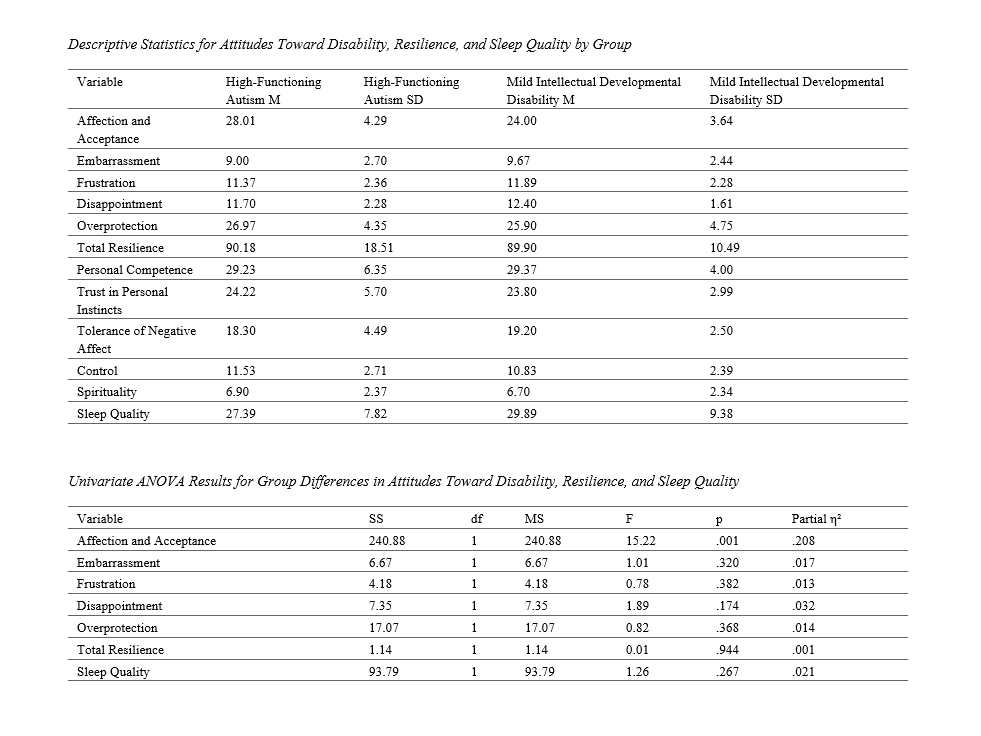
This study aimed to compare attitudes toward disability, resilience, and sleep quality among mothers of children with high-functioning autism spectrum disorder and mothers of children with mild intellectual developmental disabilities. This applied, quantitative, causal-comparative, and cross-sectional study was conducted among 60 mothers residing in District 13 of Tehran, Iran, including 30 mothers of children with high-functioning autism spectrum disorder and 30 mothers of children with mild intellectual developmental disabilities. Participants were selected through convenience and purposive sampling based on predefined inclusion and exclusion criteria and documented clinical diagnoses of their children. Data were collected using the Attitude Toward Disability Questionnaire, the Connor–Davidson Resilience Scale, and the Pittsburgh Sleep Quality Index. Statistical analyses were performed using SPSS version 27. Assumptions of parametric analysis were examined before inferential testing. Group differences were assessed using multivariate analysis of variance and follow-up univariate analyses of variance, with the significance level set at .05. The overall multivariate effect of group was statistically significant, Pillai’s Trace = .322, F(7, 52) = 3.53, p = .004, partial η² = .322. Follow-up analyses showed a significant difference only in the affection and acceptance component of attitudes toward disability, F(1, 58) = 15.22, p = .001, partial η² = .208, with mothers of children with high-functioning autism obtaining higher scores. No significant group differences were found for embarrassment, frustration, disappointment, overprotection, total resilience, or sleep quality (p > .05). The multivariate comparison of resilience dimensions was also nonsignificant, Pillai’s Trace = .107, F(5, 54) = 1.30, p = .279. Mothers of children with high-functioning autism and mothers of children with mild intellectual developmental disabilities showed broadly similar levels of resilience and sleep quality, while differing mainly in affection and acceptance toward disability.
Downloads
References
Abdi Garavandi, P., Soleimani, M., & Ghoreishi Rad, F. (2024). Attachment styles, parenting styles and sleep quality in predicting attention-deficit/hyperactivity symptoms through executive functions in girls aged 6 to 12 with ADHD Azarbaijan Shahid Madani University, Faculty of Education and Psychology].
Aghayar, F., & Kordmirza Nikouzadeh, A. A. (2024). Effectiveness of social skills training on mental health and social self-efficacy in girls with physical and motor disabilities Payame Noor University, South Tehran Center].
Amirizad, A., & Jamaldini, M. (2024). The relationship between community-based rehabilitation training and empowerment of people with disabilities in Jask County Islamic Azad University, Bandar Jask Branch, Department of Educational Management].
Arami, M., & Sharifi, A. A. (2024). The effect of sleep quality on behavioral inhibition, cognitive flexibility, self-concept and academic performance among lower secondary students Payame Noor University, Isfahan Center].
Babbar, N., Gupta, A., Bhalla, K., & Kharkongor, N. P. (2024). Is there any correlation of sleep quality with postpartum depression in mothers of neonatal intensive care unit admitted babies? Journal of Datta Meghe Institute of Medical Sciences University, 19(2), 300-303. https://doi.org/10.4103/jdmimsu.jdmimsu_199_22
Barani, A., & Jamaldini, M. (2024). The effect of social participation on self-confidence in people with physical and motor disabilities in Sirik County Islamic Azad University, Bandar Jask Branch, Department of Educational Management].
Beyaz, Ö., Akpınar, S., & Demirhan, G. (2024). Effect of 12-week traditional archery on motor performances and quality of life of adolescents with mild intellectual disability. International Journal of Developmental Disabilities, 1-16. https://doi.org/10.1080/20473869.2024.2436476
Beykverdi, R., & Mirzaei, P. (2024). Predicting internet addiction from ego strength, self-concept and problem-solving styles: The mediating role of resilience in adolescents Payame Noor University, Islamshahr Center].
Dehghan Manshadi, M., Arasteh Kani, A., & Akouchakian, M. (2025). The association between infertility and autism spectrum disorders in families. Journal Of Shahid Sadoughi University Of Medical Sciences, 33(1), 8567-8579.
Farsi, K., & Barghi Irani, Z. (2024). Effectiveness of quality of life improvement training on mental toughness and distress tolerance in secondary school students with physical disabilities Payame Noor University, South Tehran Center].
Ghadertalab, R., Talebian Sharif, J., & Karami, A. (2024). A model of academic achievement in people with disabilities based on parenting styles and self-efficacy with self-regulation as mediator Hekmat Razavi Higher Education Institute, Department of Psychology and Social Work].
Hojjatpanah, G. (2024). Effectiveness of resilience training on quality of life and reducing risky behaviors among elementary students in Tabadkan, Mashhad Hekmat Razavi Higher Education Institute, Department of Educational Management].
Hosseini Zavareh, S., & Shafiei, M. (2024). Cognitive functions of the nervous system according to sleep habits and quality in Tehran Islamic Azad University of Medical Sciences students during 1402–1403 Tehran Islamic Azad University of Medical Sciences, Faculty of Medicine].
Jahan Pourshirvan, H., & Naderi, M. (2024). Effectiveness of fluid awareness group therapy on marital satisfaction, happiness and life expectancy in mothers of children with intellectual disabilities Hakim Nezami Higher Education Institute, Faculty of Humanities].
Jalili, F. S., & Pourafrooz, A. (2025). Visual perception and spatial awareness in relation to brain lateral dominance in children with physical and motor disabilities Shandiz Higher Education Institute, Department of Psychology].
Karimi Pashaki, Z., Basharpour, S., & Narimani, M. (2024). Effectiveness of transcranial direct current stimulation on motor function and visual-motor perception in children with motor disabilities University of Mohaghegh Ardabili, Faculty of Education and Psychology].
Mardi Sarand, K., & Etesamipour, R. (2024). Comparison of social abilities, time perception and aggression in children with high- and low-functioning autism Payame Noor University, Ardabil Center].
Mazrouei, M., & Rezaei Dehnavi, S. (2024). The effect of an educational mathematics computer game on self-directed learning and academic achievement in students with high-functioning autism Payame Noor University, Mobarakeh Center].
Namdari Khalilabadi, S., & Saeidmanesh, M. (2024). Effectiveness of cognitive behavioral therapy on social adjustment and mental health in parents of children with physical disabilities University of Science and Art, Yazd, Faculty of Humanities].
Narzisi, A., Busuoli, E. M., Fabbri-Destro, M., Pinzino, M., Calderoni, S., Tancredi, R., Lombardo, M. V., & Masi, G. (2025). Exploring autistic traits in parents of autistic children: A pilot study on the broader autism phenotype. Frontiers in Psychiatry, 16. https://doi.org/10.3389/fpsyt.2025.1537487
Nediki, M., Karami, A., & Talebian Sharif, J. (2024). A model of optimal sleep quality in patients with hypothyroidism based on cognitive emotion regulation and perceived social support with perceived stress as mediator Hekmat Razavi Higher Education Institute, Department of Psychology and Social Work].
Nikjou, F., Vakili, S., & Mollanourozi, K. (2024). The effect of selected rowing exercises on motor skills and attention in children with high-functioning autism spectrum disorder. Family and Health, 14(4), 132-150.
Rahimi, S., & Roshandel, Z. (2024). Social support and childhood adversity in relation to suicidal ideation and self-perception: The mediating role of sleep quality Islamic Azad University, Ardabil Branch, Faculty of Humanities].
Rahmati, S., Pouretemad, H., & Sadeghi, S. (2024). The effect of figurative language training on social cognition in children with high-functioning autism Shahid Beheshti University, Faculty of Education and Psychology].
Rashidi, N., & Shirafkan, A. (2025). The mediating role of ego strength in the relationship of resilience with parenting stress and self-control in mothers of slow learners Payame Noor University, Semnan Center].
Saleh, G. A., & Ghamari Kivi, H. (2024). Problem-solving and communication skills training and emotional self-regulation in Iraqi students with disabilities University of Mohaghegh Ardabili, Faculty of Education and Psychology].
Shahbazi Gorjan, S., Basharpour, S., & Atadokht, A. (2024). Causal modeling of obsessive-compulsive symptoms based on emotional temperament and sleep quality: The mediating role of negative meta-emotion University of Mohaghegh Ardabili, Faculty of Education and Psychology].
Tavanaei Tamanaei, S., Khodabakhsh, M. R., & Ilbeigi, R. (2024). Effectiveness of continuous positive airway pressure therapy on depression, sleep-related behaviors and sleep quality in people with obstructive sleep apnea Hakim Tous Higher Education Institute, Department of Psychology].
Tayebli, M., & Jalali, Y. (2024). Designing a group game-based educational program and evaluating its effectiveness in improving theory of mind and self-esteem in children with mild intellectual disability. Psychology of Exceptional Individuals, 14(55), 247-276.
Yazdanipour, M., Fallah, A., & Farahmand Amin, S. (2025). Rumination as a mediator between sleep quality and anxiety symptoms in students of Islamic Azad University, Ardabil Branch Islamic Azad University, Ardabil Branch, Faculty of Medicine].
Downloads
Additional Files
Publication Timeline
- Submitted
- Revised
- Accepted