The Effectiveness of a Social-Emotional Learning Program on Social Acceptance and Perceived Competence in Adolescents with Specific Learning Disorder
Keywords:
social-emotional learning, social acceptance, perceived competence, specific learning disorderAbstract
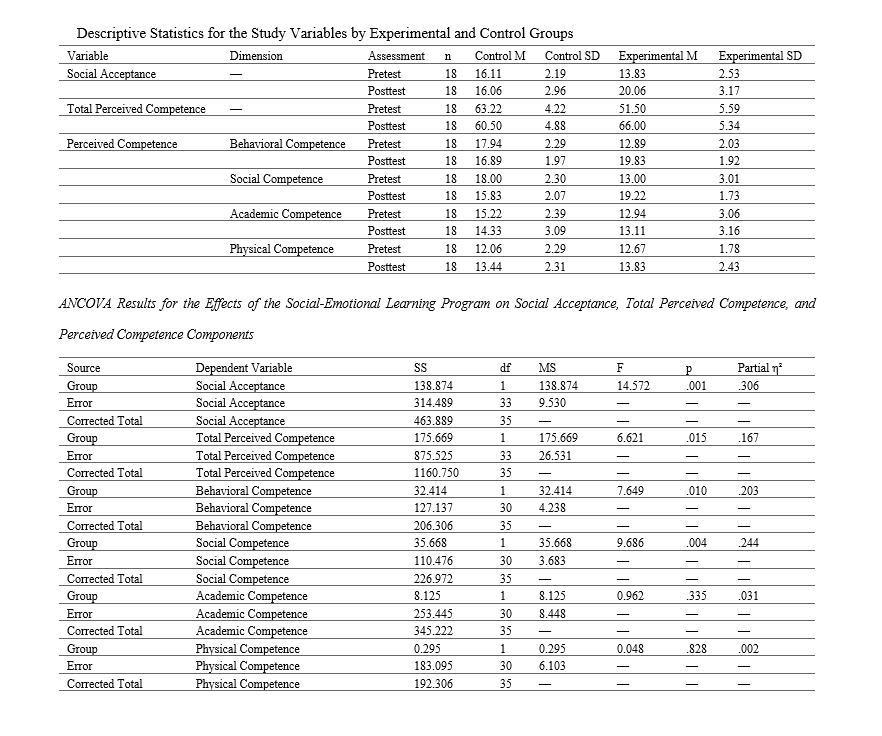
The present study aimed to investigate the effectiveness of a social-emotional learning program on social acceptance and perceived competence in adolescents with specific learning disorder. This study employed a quasi-experimental pretest–posttest design with a control group. The statistical population consisted of all students with specific learning disorder enrolled in the second stage of elementary education in West Azerbaijan Province during the first semester of the 2024–2025 academic year. The sample consisted of 36 participants, with 18 students assigned to the experimental group and 18 to the control group. Participants were selected through convenience sampling and were subsequently assigned to the groups using simple random assignment. Data were collected using the Marlowe–Crowne Social Desirability Scale (Marlowe & Crowne, 1960) and Harter’s Perceived Competence Scale (Harter, 1985). In this study, the social-emotional learning session protocol was developed based on the book Teaching Social-Emotional Skills by Sadri Demirchi (2010) and was implemented by Sadri Demirchi and Esmaeili Ghazi Valouei (2016) in 12 one-hour sessions. The results of the data analysis indicated that the social-emotional learning program had an effect size of 0.31 on social acceptance. In addition, the social-emotional learning program had an effect size of 0.17 on perceived competence. The findings demonstrated that the social-emotional learning program improved social acceptance and perceived competence among adolescents with specific learning disorder. These results indicate the effectiveness of this intervention in enhancing the social skills and self-perceptions of this group of students.
Downloads
References
Adiba, L., & Latip, A. (2021). Social emotional learning program for build responsible character of students in elementary school. Jmie (Journal of Madrasah Ibtidaiyah Education)(5), 67. https://doi.org/10.32934/jmie.v5i1.228
Almulla, A., & Khasawneh, M. (2024). Developing Social and Emotional Skills of Students with Learning Difficulties using a Digital Learning Program. Journal of Ecohumanism, 3(3), 1751-1763. https://doi.org/10.62754/joe.v3i3.3448
Azami, M., Safi, M., & Behjati Ardakani, F. (2023). Effectiveness of Positive Thinking Skills Training on Stress, Cognitive Flexibility, and Mental Strength in Mothers of Children with Learning Disorders. Journal of Learning Disabilities, 12(3), 22-37.
Bay, N., Hassanabadi, H., & Kavoosian, J. (2017). A Structural Model of Competence Beliefs and Classroom Perceptions with Students’ Academic Achievement: The Role of Achievement Behaviors and Beliefs. Applied Psychology Quarterly, 11(1), 67-83.
Brown, E. L., Valenti, M., Sweet, T., Mahatmya, D., Celedonia, K., & Bethea, C. (2020). How social and emotional competencies inform special educators’ social networks. Education & Treatment of Children, 43(3), 295-311. https://doi.org/10.1007/s43494-020-00022-2
Cuervo, H., Téllez, R., & Acevedo, V. (2022). The Socio-Emotional Competencies of High School and College Students in the National Polytechnic Institute (Mexico). Social Sciences, 11. https://doi.org/10.3390/socsci11070278
Dehghanizadeh, A., & Karamalian, H. (2023). Effectiveness of Discovery-Based Instruction of Social Studies Concepts and Themes on Social Skills, Social Adjustment, and Social Acceptance in Lower Secondary School Students [Master’s thesis, Payame Noor University, Isfahan Province, Natanz Center].
Drusch, C. (2021). Impacts of Social and Emotional Learning Interventions in Special Education Students [Master’s thesis, Bethel University]. Spark Repository.
Eva, N., & Tortop, H. S. (2026). Parental support as a mediator between teacher support and social-emotional competence among Indonesian gifted students. Open Education Studies, 8(1), 20250159. https://doi.org/10.1515/edu-2025-0159
Fallah, S., Abolmaali Alhosseini, K., & Sabet, M. (2021). Comparing the Effectiveness of Positive Parenting Training and Social-Emotional Learning Training for Parents of Preschool Children on Their Children’s Adaptive Behavior. Applied Family Therapy Journal, 2(3), 215-233.
Ferro, M. A., & Tang, J. (2017). Psychometric properties of the Self-Perception Profile for Children in children with chronic illness. Journal of the Canadian Academy of Child and Adolescent Psychiatry, 26(2), 119-124.
Franz, D. J., Lenhard, W., Marx, P., & Richter, T. (2021). Here I sit, making men in my own image: How learning disorder labels affect teacher student's expectancies. Current Psychology: A Journal for Diverse Perspectives on Diverse Psychological Issues. https://doi.org/10.1007/s12144-021-02250-0
Geva, E., & Kilpatrick, D. A. (2021). Diagnosing and providing interventions for students with learning disabilities: The case of dyslexia. In E. Cole & M. Kokai (Eds.), Consultation and mental health interventions in school settings: A scientist-practioner's guide (pp. 173-197). Hogrefe.
Hassani, S., & Schwab, S. (2021). Social-Emotional Learning Interventions for Students with Special Educational Needs: A Systematic Literature Review. https://doi.org/10.3389/feduc.2021.808566
Jahre, H., Grotle, M., Smedbråten, K., Richardsen, K. R., Côté, P., Steingrímsdóttir, Ó. A., Nielsen, C., Storheim, K., Småstuen, M., Stensland, S. Ø., & Øiestad, B. E. (2022). Low social acceptance among peers increases the risk of persistent musculoskeletal pain in adolescents. Prospective data from the Fit Futures Study. BMC Musculoskeletal Disorders, 23(1), 44. https://doi.org/10.1186/s12891-022-04995-6
Khanlou, N., Dasari, M., & Rahmani, M. (2023). Effectiveness of Social Skills Training in Improving Behavioral Problems of Students with Learning Disorders. Modern Advances in Psychology, Educational Sciences and Education, 6(11), 1-17.
Khojasteh Jalal, P., Manavipour, D., & Sedaghatifard, M. (2020). Psychometric Properties of Harter’s Self-Perception Profile for Children. Psychological Methods and Models, 11(40), 71-84.
Machinchi, A. (2022). The Role of Cultural Capital and Academic Self-Efficacy in High School Students’ Social Acceptance. Sociology of Education, 8(2), 344-351.
Martinsone, B., Supe, I., Stokenberga, I., & Damberga, I. (2022). Social Emotional Competence, Learning Outcomes, Emotional and Behavioral Difficulties of Preschool Children: Parent and Teacher Evaluations. Frontiers in psychology, 12. https://doi.org/10.3389/fpsyg.2021.760782
Pellegrino, G., Feraco, T., Meneghetti, C., & Carretti, B. (2026). Social, Emotional, and Behavioral Skills as Resources for Student Engagement: A One-Year Longitudinal Study in High School Students. Learning and Individual Differences, 131, 102988. https://doi.org/10.1016/j.lindif.2026.102988
Sadri Damirchi, E., & Esmaili Ghazivalouei, F. (2016). Effectiveness of Social-Emotional Skills Training on Cognitive Emotion Regulation and Social Skills in Children with Specific Learning Disorders. Learning Disabilities, 5(4), 59-86.
Sharafodin, H. (2010). The Relationship of Social Anxiety, Hope, and Social Support with Subjective Well-Being in Graduate Students at the Khuzestan Science and Research Branch [Master’s thesis in general psychology, Islamic Azad University, Ahvaz Branch].
Tavakoli Samarin, M., Khademi, H., & Aali, A. (2022). Effectiveness of Social Skills Training Based on a Discipline-Based Art Approach in Improving Social-Emotional Competence and Social Adjustment of Elementary School Children [Master’s thesis in educational psychology, Allameh Tabataba’i University, Faculty of Psychology and Educational Sciences].
Teglasi, H., Caputo, M. H., & Scott, A. L. (2022). Explicit and implicit theory of mind and social competence: A social information processing framework. New Ideas in Psychology, 64, 100915. https://doi.org/10.1016/j.newideapsych.2021.100915
Tinco Melchor, I. (2026). Systematic review: School climate in the academic and social-emotional experience of secondary school students. Revista InveCom, 6(3), e603022.
Wang, Y., & Zhao, Y. (2026). The Impact of Shyness on Social Anxiety among College Students: Mediating Role of Regulatory Emotional Self-Efficacy and Resilience. PLoS One, 21(3), e0344809. https://doi.org/10.1371/journal.pone.0344809
Wentzel, K. R., Jablansky, S., & Scalise, N. R. (2021). Peer social acceptance and academic achievement: A meta-analytic study. Journal of Educational Psychology, 113(1), 157-180. https://doi.org/10.1037/edu0000468
Woodcock, S., & Moore, B. (2021). Inclusion and students with specific learning difficulties: The double-edged sword of stigma and teacher attributions. Educational Psychology, 41(3), 338-357. https://doi.org/10.1080/01443410.2018.1536257
Downloads
Additional Files
Publication Timeline
- Submitted
- Revised
- Accepted