Comparison of the Effectiveness of Active and Passive Music Therapy on Echolalia and Pitch Frequency in Children with Level 1 Autism Spectrum Disorder
DOI:
https://doi.org/10.61838/kman.prien.3.2.9Keywords:
Autism Spectrum Disorder, Echolalia, Pitch Frequency, Active Music Therapy, Passive Music TherapyAbstract
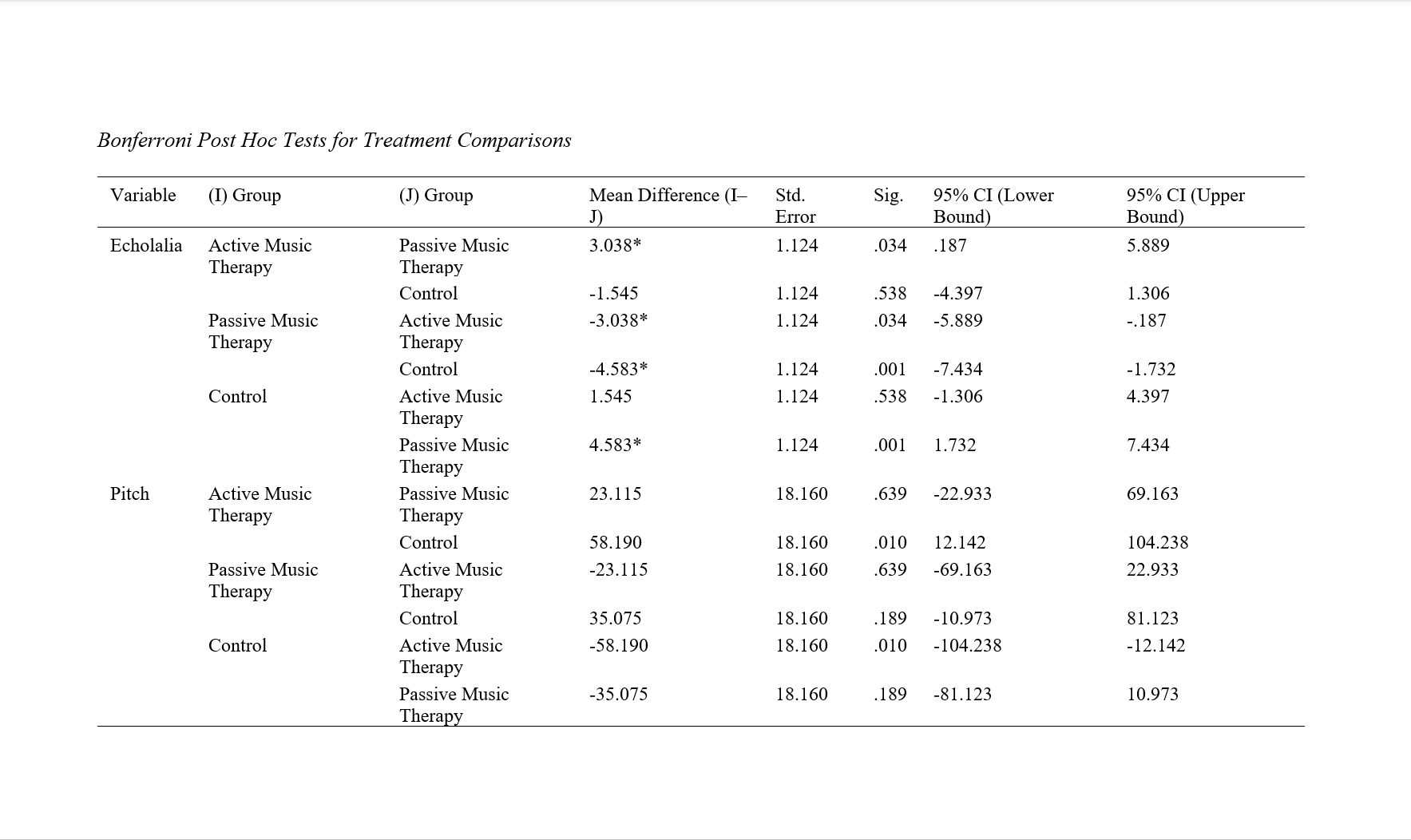
Music therapy is a complementary and innovative intervention for children with autism spectrum disorder (ASD), encompassing both active and passive approaches that differ in their implementation methods and potential outcomes. The present study aimed to examine and compare the effectiveness of active and passive music therapy on echolalia and pitch frequency in children with Level 1 ASD. This quasi-experimental study employed a pretest–posttest design with a control group and a two-month follow-up period. The study sample included 33 children aged 4 to 7 years diagnosed with Level 1 ASD, selected through convenience sampling. After meeting the inclusion criteria, participants were randomly assigned to two experimental groups and one control group. The research instruments consisted of the Praat acoustic phonetic software and the Abnormal Behavior Checklist. Data were analyzed using repeated-measures analysis of variance (ANOVA) with SPSS-27 to compare dependent variables across pretest, posttest, and follow-up phases. The results indicated that passive music therapy had the greatest effect in reducing echolalia. Pairwise comparisons with Bonferroni correction showed significant mean differences between the passive and active groups (3.038, p = 0.034) and between the passive and control groups (-4.583, p = 0.001), whereas the difference between the active and control groups was not significant (mean difference = -1.545, p = 0.538). These findings suggest that the passive method was more effective in decreasing echolalia compared to the other groups. Furthermore, the active music therapy group showed a significant improvement in pitch scores compared to the control group. The overall time effect on scores was significant in the multivariate analysis, and the trend of changes varied across groups, although the univariate analysis did not confirm a formal time effect. Passive music therapy showed no significant difference compared to the control condition. Therefore, incorporating music therapy into rehabilitation programs for children with ASD is recommended as a beneficial complementary intervention.
Downloads
References
Caponnetto, P., LaMattina, G., & Quattropani, M. C. (2022). Music therapy and psychological-clinical impact in surgery: a systematic review. Health Psychology Research, 10(4), 38615. https://doi.org/10.52965/001c.38615
Chenausky, K. V., Norton, A. C., & Schlaug, G. (2017). Auditory-Motor Mapping Training in a More Verbal Child with Autism. Frontiers in human neuroscience, 11, 426. https://doi.org/10.3389/fnhum.2017.00426
Farahani Sepehr, F., Hashemi, J., & Pezeshk Sh, S. (2014). The effectiveness of speech repetition on echolalia and challenging behaviors among autistic children. Journal of Exceptional Individuals, 4(15), 57-72. https://jpe.atu.ac.ir/article_297.html
Ferdosi, N., & Ashayeri, H. (2015). The effect of music on language disorders (Melodic intonation therapy in autism and aphasia). Tehran: Jungle, Javadaneh.
Ferdosi, N., Ashayeri, H., Modarresi, Y., & Rovshan, B. (2013). The Effects of Melodic Intonation Therapy on 7-10-year, Persian, Autistic, Male Children's Speech. Advances in Cognitive Sciences, 15(3), 12-23. https://ensani.ir/fa/article/321148/
Gao, X., Xu, G., Fu, N., Ben, Q., Wang, L., & Bu, X. (2025). The effectiveness of music therapy in improving behavioral symptoms among children with autism spectrum disorders: a systematic review and meta-analysis. https://doi.org/10.3389/fpsyt.2024.1511920
Geretsegger, M., Elefant, C., Mössler, K. A., & Gold, C. (2014). Music therapy for people with autism spectrum disorder. Cochrane Database Syst Rev(6), CD004381. https://doi.org/10.1002/14651858.CD004381.pub3
Hamidifard, S., DashtBozorgi, Z., & Hafezi, F. (2023). The Effectiveness of Music Therapy on Self-Harm Behaviors and Executive Functions in Children with Autism Disorder. ijrn, 10(1), 10-20. https://ijrn.ir/article-1-813-fa.html
Harbison, A. L., Woynaroski, T. G., & McDaniel, J. (2020). Speech prosody interventions for persons with autism spectrum disorders: A systematic review. American Journal of Speech-Language Pathology, 29(4), 1912-1928. https://doi.org/10.1044/2020_AJSLP-19-00127
Holbrook, S., & Israelsen, M. (2020). Speech Prosody Interventions for Persons With Autism Spectrum Disorders: A Systematic Review. Am J Speech Lang Pathol. https://doi.org/10.1044/2020-AJSLP-19-00127
Kaat, A. J., Lecavalier, L., & Aman, M. G. (2014). Validity of the aberrant behavior checklist in children with autism spectrum disorder. Journal of Autism and Developmental Disorders, 44(5), 1103-1116. https://doi.org/10.1007/s10803-013-1970-0
Kabuk, A., Şendir, M., & Filinte, G. (2022). The effect of reflexology massage and passive music therapy intervention before burn dressing on pain, anxiety level and sleep quality. Burns, 48(7), 1743-1752. https://doi.org/10.1016/j.burns.2021.10.012
Karami, J., Alikhani, M., Zakiei, A., & Khodadi, K. (2012). The effectiveness of art therapy (painting) in reducing the aggressive behavior of students with dyslexia. Journal of Learning Disabilities, 1(3), 105-117. https://journal.uma.ac.ir/article_106.html
Khaliulin, I., Hamoudi, W., & Amal, H. (2025). The multifaceted role of mitochondria in autism spectrum disorder. Molecular Psychiatry, 30(2), 629-650. https://doi.org/10.1038/s41380-024-02725-z
Khanjani, Z., & Khaknezhad, Z. (2016). The Effect of Inactive Music Therapy on Symptoms, Communication Deficit, and Social Interaction of Children with Autism Spectrum Disorder. J Child Ment Health, 3(3), 97-105. http://childmentalhealth.ir/browse.php?a_code=A-10-229-1&sid=1&slc_lang=fa
Lim, H. A. (2010). Effect of "developmental speech and language training through music" on speech production in children with autism spectrum disorders. Journal of Music Therapy, 47(1), 2-26. https://doi.org/10.1093/jmt/47.1.2
Shiri, E., Pouretemad, H., Fathabadi, J., & Narimani, M. (2018). Evaluation effectiveness of the family-based program of the management on Behavioral Excesses with children autism. Journal of Family Research, 15(2), 267-282. https://jfr.sbu.ac.ir/article_97754.html
Stekić, K. (2024). The role of active and passive music engagement in cognitive development: A systematic review. International Journal of Music Education. https://doi.org/10.1177/02557614241268049
Wang, M., Wu, J., & Yan, H. (2023). Effect of music therapy on older adults with depression: A systematic review and meta-analysis. Complementary Therapies in Clinical Practice, 53, 101809. https://doi.org/10.1016/j.ctcp.2023.101809
Yinger, O. S., & Gooding, L. F. (2014). Music therapy for preschool children with autism: A systematic review. Journal of Music Therapy, 51(2), 151-181.
Downloads
Additional Files
Publication Timeline
- Submitted
- Revised
- Accepted