Machine Learning–Based Prediction of Reading Comprehension Deficits from Attention Control, Processing Speed, Phonological Awareness, and Academic Anxiety in Children with Dyslexia
DOI:
https://doi.org/10.61838/kman.prien.5551Keywords:
Dyslexia, Reading Comprehension Deficits, Machine Learning, Attention Control, Processing Speed, Phonological Awareness, Academic Anxiety, Predictive Modeling, Executive Functions, Learning DisabilitiesAbstract
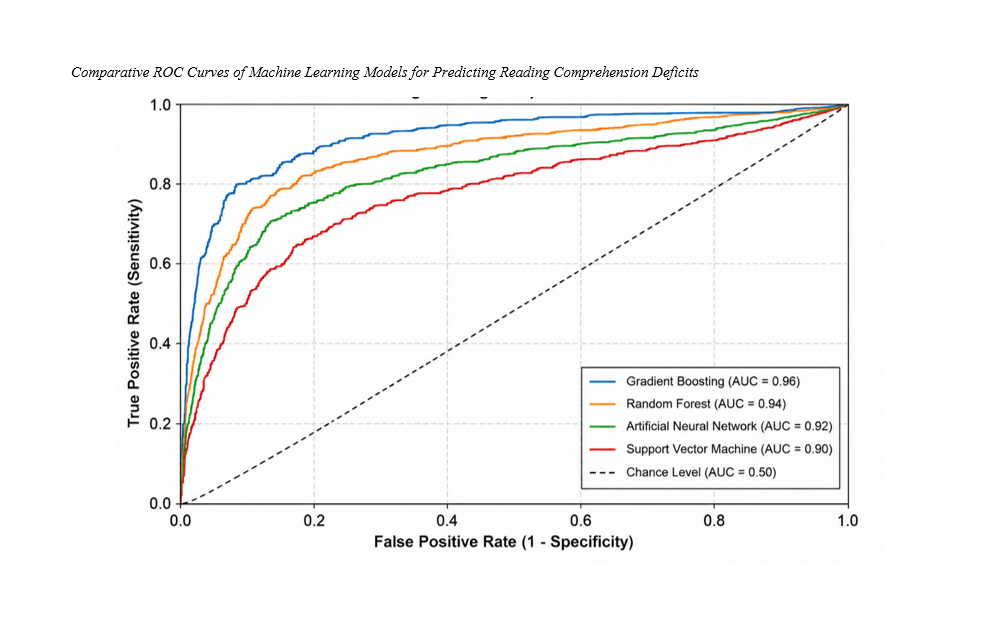
The present study aimed to predict reading comprehension deficits based on attention control, processing speed, phonological awareness, and academic anxiety using machine learning models in children with dyslexia. This study employed a correlational design with a machine learning predictive approach. The statistical population included children with dyslexia enrolled in elementary schools and learning disability centers in Tehran during the 2025–2026 academic year. A total of 240 children aged 8–12 years were selected using multistage cluster sampling and purposive screening procedures. Data collection instruments included the Reading Comprehension Subtest of the Gray Oral Reading Tests, the Attention Control Scale, the Processing Speed Index of the Wechsler Intelligence Scale for Children–Fifth Edition, the Comprehensive Test of Phonological Processing, and the Academic Anxiety Scale. Data were analyzed using SPSS-27 and Python machine learning libraries. Several algorithms including Random Forest, Support Vector Machine, Gradient Boosting, and Artificial Neural Network models were implemented. Model evaluation was conducted using accuracy, precision, recall, F1-score, root mean square error, and area under the receiver operating characteristic curve indices. The findings revealed significant relationships among all study variables. Reading comprehension deficits demonstrated significant negative correlations with attention control, processing speed, and phonological awareness, while academic anxiety showed a significant positive association with reading comprehension deficits. Among predictor variables, phonological awareness had the strongest relationship with reading comprehension deficits. The Gradient Boosting model demonstrated the highest predictive performance with 93% accuracy, 91% precision, 92% recall, an F1-score of 91%, and an area under the curve value of 0.96. The Random Forest model also showed high predictive performance with 91% accuracy and an area under the curve value of 0.94. Feature importance analysis indicated that phonological awareness was the strongest predictor, followed by attention control, academic anxiety, and processing speed. The findings support multifactorial neurocognitive models of dyslexia suggesting that reading comprehension deficits are influenced by integrated cognitive, executive, phonological, and emotional processes. Machine learning algorithms, particularly ensemble learning models, demonstrated high effectiveness in predicting reading comprehension deficits among children with dyslexia. These findings highlight the potential utility of machine learning approaches for early screening, individualized assessment, and targeted intervention planning in educational and clinical settings.
Downloads
References
Alrubaian, A. (2025). Exploring and Identifying Key Factors in Predicting Dyslexia in Children: Advanced Machine Learning Algorithms From Screening to Diagnosis. Clinical Psychology & Psychotherapy, 32(3). https://doi.org/10.1002/cpp.70077
Alves, R. J. R., Victória, R. d. A. G., Fonseca, B. G., Gabrielle, M. C. d. A., Duarte, J. L., & Crenitte, P. A. P. (2024). The Big Five Personality Traits in Dyslexic Adults: An Exploratory Study. Actas Esp Psiquiatr, 52(4), 428-436. https://doi.org/10.62641/aep.v52i4.1661
Basharpoor, S., Seif, E., & Daneshvar, S. (2024). Computerized Executive Functions Training: The Efficacy on Reading Performance of Children With Dyslexia. Dyslexia, 30(2). https://doi.org/10.1002/dys.1762
Bonti, E., Kamari, A., Sofologi, M., Giannoglou, S., Porfyri, G.-N., Tatsiopoulou, P., Kougioumtzis, G. Α., Efstratopoulou, M., & Diakogiannis, I. (2021). Similarities and Differences in the Learning Profiles of Adolescents With SLD and SLI in Mathematics. https://doi.org/10.20944/preprints202103.0606.v1
Cardoso-Pereira, N., Costa, A., & Guerreiro, M. (2024). Predictive Models of Reading Difficulties Considering Neuropsycholinguistic Profiles of Atypical and ADHD-inattentive Type Readers, and Eye-Tracking Measures. Journal of Eye Movement Research, 16(4). https://doi.org/10.16910/jemr.16.4.6
Chung, K. K. H., Lam, C. B., Chan, K. S., Lee, A., Liu, C., & Wang, L. C. (2023). Are General Anxiety, Reading Anxiety, and Reading Self-Concept Linked to Reading Skills Among Chinese Adolescents With and Without Dyslexia? Journal of Learning Disabilities, 57(2), 106-119. https://doi.org/10.1177/00222194231181914
Conant, L. L., & Miller, L. E. (2024). Intellectual Developmental Disorder, Autism Spectrum Disorder, Attention-Deficit/Hyperactivity Disorder, and Specific Learning Disorders Across the Lifespan. 587-617. https://doi.org/10.1037/0000383-022
Ferreira, T. F. L., Janaína Aparecida de Oliveira, A., Stella, P. R. F., Rita de Cássia Coutinho Vieira, F., Arduin, R. G., & Ciasca, S. M. (2023). Cognitive and Behavioral Profile in Dyslexia: Challenges in Interdisciplinary Assessment. Psychology, 14(06), 1038-1052. https://doi.org/10.4236/psych.2023.146056
Flores-Gallegos, R., Fernández, T. a., Alcauter, S., Pasaye, E. H., Albarrán-Cárdenas, L., Barrera-Díaz, B. E., & Rodríguez-Leis, P. (2024). Functional Connectivity Is Linked to Working Memory Differences in Children With Reading Learning Disability. BMC pediatrics, 24(1). https://doi.org/10.1186/s12887-024-04791-2
Gharaibeh, M. (2025). Examining the Level of Executive Functions in the Arabic Language Among Third-Grade Students With Typical Literacy Development and Dyslexia. https://doi.org/10.21203/rs.3.rs-7786621/v1
Khan, K., & Lal, P. (2023). Executive Dysfunctions in Different Learning Disabilities: A Review. Journal of Indian Association for Child and Adolescent Mental Health, 19(2), 126-142. https://doi.org/10.1177/09731342231179614
Kizilaslan, A., & TunagÜR, M. (2021). Dyslexia and Working Memory: Understanding Reading Comprehension and High Level Language Skills in Students With Dyslexia. Kastamonu Eğitim Dergisi, 29(5), 941-952. https://doi.org/10.24106/kefdergi.741028
Knight, R. E., Ritter, M. J., & Loeb, D. F. (2024). Strategies Used by University Students With Dyslexia: A Narrative Review. Communication Disorders Quarterly, 46(2), 103-117. https://doi.org/10.1177/15257401241275900
Kormos, J. (2025). The Role of First Language Skills, Working Memory, and Anxiety in Second Language Reading. Studies in Second Language Acquisition, 1-23. https://doi.org/10.1017/s0272263125101010
Kranz, A. E., Serry, T., & Snow, P. (2024). Twice‐exceptionality Unmasked: A Systematic Narrative Review of the Literature on Identifying Dyslexia in the Gifted Child. Dyslexia, 30(1). https://doi.org/10.1002/dys.1763
Landínez-Martínez, D., Londoño, D. M. M., Aldana, L. A., Lubert, C. D., Robledo-Castro, C., & Gutierrez, A. P. (2025). Neuropsychological and Academic Performance in Colombian Children With Attention-Deficit Hyperactivity Disorder: A Comparative Study With a Control Group. Children, 12(5), 561. https://doi.org/10.3390/children12050561
Larissa Mariane, M. A. M., Anna Irenne de Lima, A., Messias, B. L. C., Maria Elizabeth Job de, V., & Azoni, C. A. S. (2022). Are Dyslexia and Developmental Language Disorder Isolated or Comorbid Conditions? An Integrative Review. Revista Cefac, 24(3). https://doi.org/10.1590/1982-0216/202224312021
Li, Z., Al-Qadri, A. H., & Zhao, W. (2022). The Cognitive Ability of Chinese Students With Dyslexia and Mathematical Learning Disabilities. Children, 9(12), 1949. https://doi.org/10.3390/children9121949
López‐Zamora, M., Porcar‐Gozalbo, N., López‐Chicheri, I., & Cano‐Villagrasa, A. (2025). Linguistic and Cognitive Abilities in Children With Dyslexia: A Comparative Analysis. European Journal of Investigation in Health Psychology and Education, 15(3), 37. https://doi.org/10.3390/ejihpe15030037
Maresca, G., Corallo, F., Cola, M. C. D., Formica, C., Giliberto, S., Rao, G., Crupi, M. F., Quartarone, A., & Pidalà, A. (2024). Effectiveness of the Use of Virtual Reality Rehabilitation in Children With Dyslexia: Follow-Up After One Year. Brain Sciences, 14(7), 655. https://doi.org/10.3390/brainsci14070655
Maresca, G., Leonardi, S., Cola, M. C. D., Giliberto, S., Cara, M. D., Corallo, F., Quartarone, A., & Pidalà, A. (2022). Use of Virtual Reality in Children With Dyslexia. Children, 9(11), 1621. https://doi.org/10.3390/children9111621
Medina, G. B. K., & Guimarães, S. R. K. (2021). Reading in Developmental Dyslexia: The Role of Phonemic Awareness and Executive Functions. Estudos De Psicologia (Campinas), 38. https://doi.org/10.1590/1982-0275202138e180178
Misciagna, S. (2022). Neuropsychological Assessment of Children With Learning Disabilities. https://doi.org/10.5772/intechopen.102565
Nicolson, R. I., & Fawcett, A. J. (2021). Mathematics Disability vs. Learning Disability: A 360 Degree Analysis. Frontiers in psychology, 12. https://doi.org/10.3389/fpsyg.2021.725694
Pasqualotto, A., & Venuti, P. (2020). A Multifactorial Model of Dyslexia: Evidence From Executive Functions and Phonological‐based Treatments. Learning Disabilities Research and Practice, 35(3), 150-164. https://doi.org/10.1111/ldrp.12228
Pellegrino, M., Ben‐Soussan, T. D., & Paoletti, P. (2023). A Scoping Review on Movement, Neurobiology and Functional Deficits in Dyslexia: Suggestions for a Three-Fold Integrated Perspective. International journal of environmental research and public health, 20(4), 3315. https://doi.org/10.3390/ijerph20043315
Peng, P., Zhang, Z., Wang, W., Lee, K., Wang, T., Wang, C., Luo, J., & Lin, J. (2022). A Meta-Analytic Review of Cognition and Reading Difficulties: Individual Differences, Moderation, and Language Mediation Mechanisms. Psychological bulletin, 148(3-4), 227-272. https://doi.org/10.1037/bul0000361
Pinheiro-Chagas, P. (2025). Data-Driven Cognitive Clusters in Persistent Developmental Dyslexia. https://doi.org/10.1101/2025.11.24.690327
Renata Pires Sena de Assumpção, V., & Germano, G. D. (2025). Characterization of Reading Processes in Brazilian Adolescents: Development of Criteria for Identifying Students at Risk for Dyslexia. Frontiers in psychology, 16. https://doi.org/10.3389/fpsyg.2025.1477896
Saunders, K. V., Sun, S., Tibi, S., Dawson, K., & Lombardino, L. J. (2025). Staples of Screening for Dyslexia in University Students. Dyslexia, 31(4). https://doi.org/10.1002/dys.70011
Schneider, D., & Mather, N. (2025). A Postsecondary Case Study: Use of the WJ v Dyslexia Test Set and Other Tests to Inform Recommendations for Accommodations in Higher Education. Journal of Psychoeducational Assessment. https://doi.org/10.1177/07342829251355504
Snowling, M. J., & Hulme, C. (2020). Annual Research Review: Reading Disorders Revisited – The Critical Importance of Oral Language. Journal of Child Psychology and Psychiatry, 62(5), 635-653. https://doi.org/10.1111/jcpp.13324
Vágvölgyi, R., Sahlender, M., Schröter, H., Nagengast, B., Dresler, T., Schrader, J., & Nuerk, H. C. (2024). Low Literacy Skills in Adults Can Be Largely Explained by Basic Linguistic and Domain-General Predictors. Frontiers in psychology, 15. https://doi.org/10.3389/fpsyg.2024.1422896
Valenzuela, M. J. G., & Martín-Ruiz, I. (2022). Neuropsychological Perspective on Dyslexia. https://doi.org/10.5772/intechopen.99386
Wilcox, G., Galilee, A., Stamp, J., Makarenko, E., & MacMaster, F. P. (2020). The Importance of Research on Integrating Transcranial Direct Current Stimulation (TDCS) With Evidence-Based Reading Interventions. Journal of Pediatric Neuropsychology, 6(4), 218-228. https://doi.org/10.1007/s40817-020-00090-7
Wolf, M., Gotlieb, R., Kim, S. A., Pedroza, V., Rhinehart, L., Gorno‐Tempini, M. L., & Sears, S. (2024). Towards a Dynamic, Comprehensive Conceptualization of Dyslexia. Annals of Dyslexia, 74(3), 303-324. https://doi.org/10.1007/s11881-023-00297-1
Downloads
Additional Files
Publication Timeline
- Submitted
- Revised
- Accepted