Psychometric Properties of the Persian Version of the Autism Social Skills Profile
DOI:
https://doi.org/10.61838/kman.prien.5556Keywords:
Autism Spectrum Disorder, Social Skills, Psychometric Properties, Confirmatory Factor AnalysisAbstract
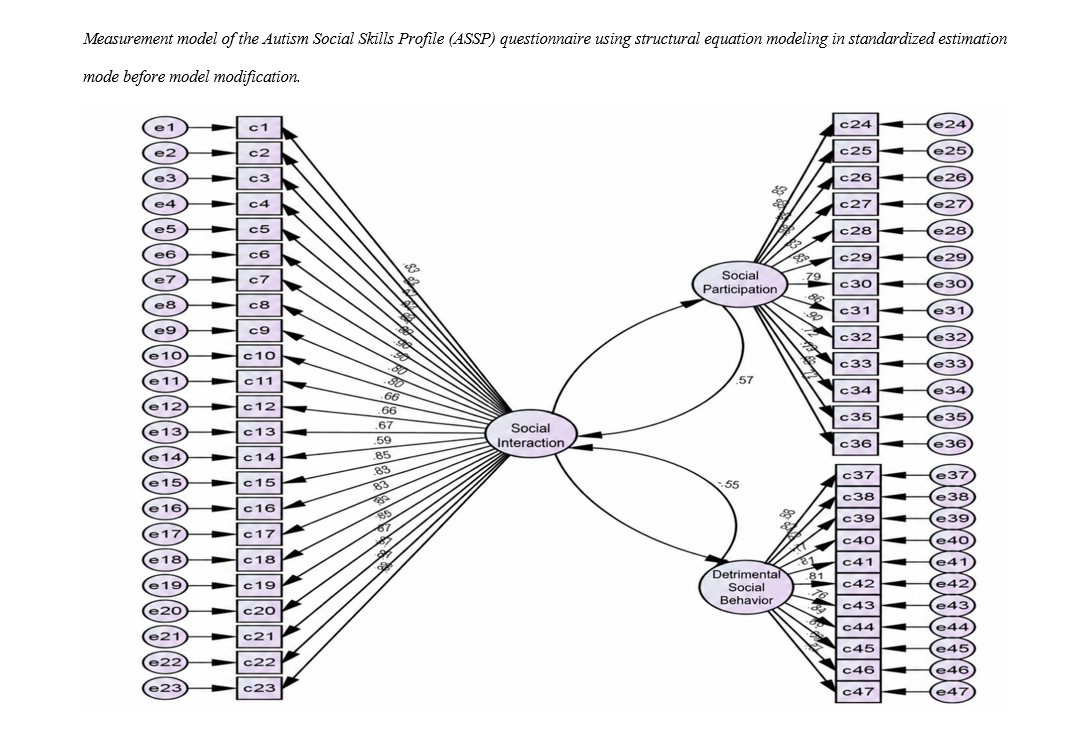
The present study was conducted to determine the psychometric properties and examine the factor structure of the Persian version of the Autism Social Skills Profile (ASSP) in children with Autism Spectrum Disorder (ASD). The current study was descriptive-analytical in nature and was conducted within the framework of psychometric research. The statistical population included all children with Autism Spectrum Disorder in the city of Tehran. From this population, a sample of 420 children and adolescents aged 6 to 17 years was selected, including two groups of 210 participants each: one group with typical development and the other consisting of individuals with autism spectrum disorder. Participants were randomly selected from regular schools, autism schools, and autism centers in Iran. Fifteen participants from each group also participated in the test–retest procedure. The instruments used in this study included the Autism Social Skills Profile (ASSP) and the Gilliam Autism Rating Scale-Second Edition (GARS-2). Data were analyzed using Confirmatory Factor Analysis (CFA), internal consistency indices (Cronbach’s alpha), temporal stability (test–retest reliability), and convergent validity analysis. The results of the confirmatory factor analysis indicated that the measurement models demonstrated satisfactory fit within the Iranian population. Reliability coefficients (Cronbach’s alpha and test–retest reliability) for both scales were calculated at a significant level (p < .001), indicating high stability and internal consistency of the instruments. Furthermore, the significant negative correlations between the scores of the studied instruments and the GARS-2 scale confirmed the convergent validity and clinical discriminative validity of the instruments. The Persian version of the Autism Social Skills Profile demonstrated strong psychometric properties and can be considered an effective instrument for clinical assessment and monitoring of educational interventions in children with Autism Spectrum Disorder within the Iranian cultural context. The application of these instruments in rehabilitation centers may substantially contribute to more accurate diagnosis and the development of individualized treatment programs.
Downloads
References
Bordini, D., Moya, A. C., Asevedo, G. R. D. C., Paula, C. S., Brunoni, D., Brentani, H., & Bagaiolo, L. (2024). Exploring the Acquisition of Social Communication Skills in Children with Autism: Preliminary Findings from Applied Behavior Analysis (ABA), Parent Training, and Video Modeling. Brain Sciences, 14(2), 172. https://doi.org/10.3390/brainsci14020172
Drüsedau, L. L., Götz, A., Kleine Büning, L., Conzelmann, A., Renner, T. J., & Barth, G. M. (2023). Tübinger Training for Autism Spectrum Disorders (TüTASS): a structured group intervention on self-perception and social skills of children with autism spectrum disorder (ASD). European Archives of Psychiatry and Clinical Neuroscience, 273(7), 1599-1613. https://doi.org/10.1007/s00406-022-01537-y
Heidarzadeh, F., Lotfi, L., & Afshari, V. (2023). A meta-analysis of the effectiveness of psychological interventions on social skills in children with autism. The Tenth National Conference on Recent Advances in Positive Psychology, Bandar Abbas.
Howard, J., Herold, B., Major, S., Leahy, C., Ramseur, K., Franz, L., Deaver, M., Vermeer, S., Carpenter, K. L. H., Murias, M., Huang, W. A., & Dawson, G. (2023). Associations between executive function and attention abilities and language and social communication skills in young autistic children. Autism, 13623613231154310. https://doi.org/10.1177/13623613231154310
Inci, R., & Saglam, M. (2025). Investigation of the effect of interactive art activity program on repetitive behaviors, social skills and parents' emotions in children with autism spectrum disorder. Advances in Autism, 11(1), 5-18. https://doi.org/10.1108/AIA-06-2024-0041
Karna, W., & Stefaniuk, I. (2024). The Influence of Peer Relationships on the Social Development of Children with Autism Spectrum Disorder. Iranian Journal of Neurodevelopmental Disorders, 2(4), 10-18. https://doi.org/10.61838/kman.jndd.2.4.2
Levante, A., Martis, C., Antonioli, G., Dima, M., Duma, L., Perrone, M., Russo, L., & Lecciso, F. (2023). The Effect of Sports Activities on Motor and Social Skills in Autistic Children and Adolescents: a Systematic Narrative Review. Current Developmental Disorders Reports, 10(3), 155-174. https://doi.org/10.1007/s40474-023-00277-5
Monahan, J., Freedman, B., & Pini, K. (2023). Autistic Input in Social Skills Interventions for Young Adults: a Systematic Review of the Literature. Review Journal of Autism and Developmental Disorders, 10, 1-21. https://doi.org/10.1007/s40489-021-00280-9
Morales, J., Pierantozzi, E., Fukuda, D. H., Garcia, V., Guerra-Balic, M., Sevilla-Sánchez, M., & Carballeira, E. (2022). Improving motor skills and psychosocial behaviors in children with autism spectrum disorder through an adapted judo program. Front Psychol, 13, 1067310. https://doi.org/10.3389/fpsyg.2022.1067310
O’Keeffe, C., & McNally, S. (2023). A systematic review of play-based interventions targeting the social communication skills of children with autism spectrum disorder in educational contexts. Review Journal of Autism and Developmental Disorders, 10(1), 51-81.
Ranjbar, S., Abui Mehrizi, S., & Ghasemi, M. (2023). Effectiveness of pishanskill enhancement package on promoting social adaptation in children with autism spectrum disorder. Research in Child and Adolescent Psychotherapy, 2(3), 40-31. https://doi.org/10.22098/rcap.2023.14060.1033
Reddy, P., & J, A. (2023). Diagnosis of Autism in Children Using Deep Learning Techniques by Analyzing Facial Features. Engineering Proceedings, 59(1).
Silveria- Zaldivar, T., Ozerk, G., & Ozerk, K. (2023). Developing Social Skills and Social Competence in Children with Autism. International Electronic Journal of Elementary Education, 13(3), 341-336. https://doi.org/10.26822/iejee.2021.195
Soares, E. E., Bausback, K., Beard, C. L., Higinbotham, M., Bunge, E. L., & Gengoux, G. W. (2021). Social skills training for autism spectrum disorder: A meta-analysis of in-person and technological interventions. Journal of Technology in Behavioral Science, 6(1), 166-180. https://doi.org/10.1007/s41347-020-00177-0
Wang, L. A., Petrulla, V., Zampella, C. J., Waller, R., & Schultz, R. T. (2022). Gross motor impairment and its relation to social skills in autism spectrum disorder: A systematic review and two meta-analyses. Psychological bulletin, 148(3-4), 273. https://doi.org/10.1037/bul0000358
Wattanawongwan, S., Ganz, J. B., Hong, E. R., Dunn, C., Yllades, V., Pierson, L. M., Baek, E., & Foster, M. (2023). Interventions for Improving Social-Communication Skills for Adolescents and Adults With ASD: A Meta-Analysis. Review Journal of Autism and Developmental Disorders, 10(3), 391-405. https://doi.org/10.1007/s40489-021-00300-8
Wen, L., & Wu, Z. (2025). The impact of sensory integration based sports training on motor and social skill development in children with autism spectrum disorder. Sci Rep, 15(1), 19974. https://doi.org/10.1038/s41598-025-05393-3
West, R., & Silverman, M. J. (2021). Social Skills Instruments for Children with Autism Spectrum Disorder: A Critical Interpretive Synthesis. Journal of Music Therapy, 58(2), 121-154.
Downloads
Additional Files
Publication Timeline
- Submitted
- Revised
- Accepted