Effectiveness of a Neuro-Play Therapy-Based Intervention on Working Memory, Self-Control, and Cognitive Flexibility in Children with Learning Disabilities
Keywords:
Neuro-Play Therapy, Working Memory, Self-Control, Cognitive Flexibility, Learning Disabilities, Executive FunctionsAbstract
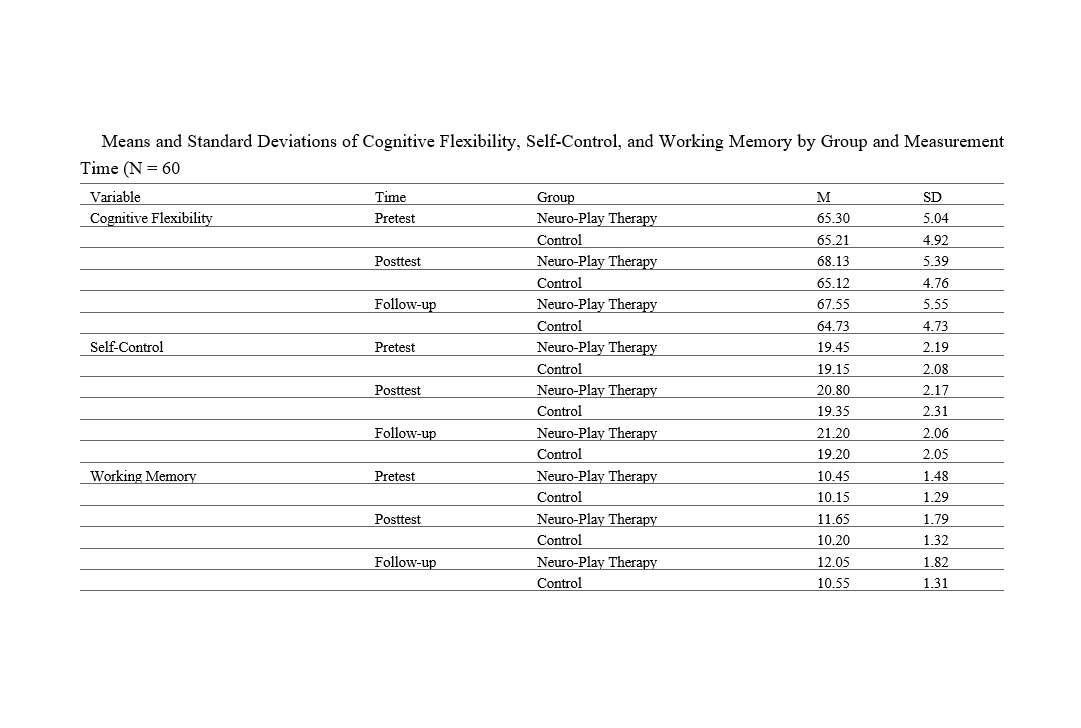
This study aimed to determine the effectiveness of a neuro-play therapy-based intervention in improving working memory, self-control, and cognitive flexibility among children with learning disabilities. This applied quasi-experimental study employed a pretest–posttest design with a one-month follow-up and a control group. The statistical population consisted of children aged 7–11 years with diagnosed learning disabilities who attended counseling centers in District 10 of Tehran during the first semester of the 2025–2026 academic year. Using purposive sampling, 60 eligible children were selected and assigned to an experimental group (n = 30) and a control group (n = 30). The experimental group received a structured neuro-play therapy intervention in 11 two-hour group sessions conducted twice weekly, whereas the control group received no intervention. Data were collected using the Daneman and Carpenter Working Memory Capacity Test, Tangney et al.’s Self-Control Scale, and Dennis and Vander Wal’s Cognitive Flexibility Inventory. Data were analyzed using mixed repeated-measures analysis of variance in SPSS version 26. Mixed ANOVA indicated significant time effects for cognitive flexibility, F(2,114) = 70.11, p < .001, η² = .55; self-control, F(2,114) = 35.32, p < .001, η² = .38; and working memory, F(2,114) = 107.42, p < .001, η² = .65. Significant time × group interactions were also found for cognitive flexibility, F(4,114) = 21.56, p < .001, η² = .43; self-control, F(4,114) = 7.61, p < .001, η² = .21; and working memory, F(4,114) = 14.67, p < .001, η² = .34. Between-group effects were significant for cognitive flexibility, F(2,57) = 3.03, p = .050, η² = .10; self-control, F(2,57) = 3.10, p = .050, η² = .10; and working memory, F(2,57) = 3.65, p = .032, η² = .12. Neuro-play therapy appears to be an effective intervention for enhancing executive functions in children with learning disabilities, particularly working memory, self-control, and cognitive flexibility. The persistence of improvement through the follow-up assessment suggests that structured, neuroscience-informed play activities may produce relatively stable cognitive and behavioral benefits. Accordingly, neuro-play therapy may be incorporated into psychological, counseling, and educational rehabilitation programs designed for children with learning disabilities.
Downloads
References
Allen, G., Milne, B., Velija, P., & Radley, R. (2024). 'Hearing Their Voice': The Experiences of Physical Education with Pupils Diagnosed with Severe Learning Disabilities. Sport, Education and Society, 29(3), 342-357. https://doi.org/10.1080/13573322.2022.2141704
Baddeley, A. D., Hitch, G. J., & Allen, R. J. (2021). Working Memory and Binding in Sentence Recall. Journal of Memory and Language, 120, 104238.
Beaudoin, E. S., Blackburn, S., Hove, I. E., & Sladeczek, I. E. (2025). Interventions Targeting Anxiety in Individuals with Learning Disabilities: A Scoping Review. Learning disabilities Research & Practice, 40(2), 96-111. https://doi.org/10.1177/09388982241295772
Blom, E., Berke, R., Shaya, N., & Adi-Japha, E. (2021). Cognitive Flexibility in Children with Developmental Language Disorder: Drawing of Nonexistent Objects. Journal of Communication Disorders, 93, 106137. https://doi.org/10.1016/j.jcomdis.2021.106137
Diamond, A. (2013). Executive Functions. Annual review of psychology, 64(1), 135-168. https://doi.org/10.1146/annurev-psych-113011-143750
Ghanbari, Z., & Talebi, D. (2025). Effectiveness of Neuropsychological Play Therapy on Executive Functions and Working Memory in Children with Learning Disorders. Rooyesh-e-Ravanshenasi, 14(1), 195-204.
Guo, L., & Keles, S. (2025). A Systematic Review of Studies with Parent-Involved Interventions for Children with Specific Learning Disabilities. European Journal of Special Needs Education, 40(4), 755-772. https://doi.org/10.1080/08856257.2024.2421112
Hassanvand, M., & Arjmandnia, A. (2019). Examining the Effect of Cognitive Games on Cognitive Flexibility in Children with Mathematics Disorder. Cognitive Psychology and Psychiatry, 6(2), 134-148.
Li, S., Wang, Z., Wang, J., & He, J. (2024). Metacognition Predicts Critical Thinking Ability Beyond Working Memory: Evidence from Middle School and University Students. Thinking Skills and Creativity, 53, 101572. https://doi.org/10.1016/j.tsc.2024.101572
Okur, M., & Aksoy, V. (2025). The Effect of a Working Memory Intervention Package on the Working Memory Performance of Primary School Students with Specific Learning Disabilities. Journal of Intelligence, 13(2), 16. https://doi.org/10.3390/jintelligence13020016
Rodríguez, J., Marín-López, I., & Espejo-Siles, R. (2025). Is Artificial Intelligence Use Related to Self-Control, Self-Esteem and Self-Efficacy Among University Students? Education and Information Technologies, 30(2), 2507-2524. https://doi.org/10.1007/s10639-024-12906-6
Romero, C., Goodman, Z. T., Kupis, L., Dirks, B., Parlade, M. V., Beaumont, A. L., & Uddin, L. Q. (2025). Multilingualism Impacts Children's Executive Function and Core Autism Symptoms. Autism Research, 17(12), 2645-2661. https://doi.org/10.1002/aur.3260
Schäfer, J., Reuter, T., Leuchter, M., & Karbach, J. (2024). Executive Functions and Problem-Solving-The Contribution of Inhibition, Working Memory, and Cognitive Flexibility to Science Problem-Solving Performance in Elementary School Students. Journal of Experimental Child Psychology, 244, 105962. https://doi.org/10.1016/j.jecp.2024.105962
Soltani, M., Pasha, G., Ehteshamzadeh, P., & Nejati, V. (2023). Effectiveness of Cognitive Non-Motor Rehabilitation on Working Memory and Cognitive Flexibility in Children with Reading Learning Disabilities. Quarterly Journal of New Psychological Research, 18(70), 123-134.
Zahrai, K., Veer, E., Ballantine, P. W., de Vries, H. P., & Prayag, G. (2022). Either You Control Social Media or Social Media Controls You: Understanding the Impact of Self-Control on Excessive Social Media Use from the Dual-System Perspective. Journal of Consumer Affairs, 56(2), 806-848. https://doi.org/10.1111/joca.12449
Zhang, J., Peng, C., & Chen, C. (2024). Mental Health and Academic Performance of College Students: Knowledge in the Field of Mental Health, Self-Control, and Learning in College. Acta Psychologica, 248, 104351. https://doi.org/10.1016/j.actpsy.2024.104351
Downloads
Additional Files
Publication Timeline
- Submitted
- Revised
- Accepted