Presenting a Model for Improving Customer Relationship Management with Sustainable Development Using a Meta-Synthesis Approach
DOI:
https://doi.org/10.61838/kman.ijimob.3291Keywords:
Customer relationship management, sustainable development, hybridizationAbstract
Objective: The primary objective of this research is to develop a comprehensive model for improving Customer Relationship Management (CRM) with sustainable development using a meta-synthesis approach.
Methodology: This study employs a qualitative meta-synthesis method, utilizing the seven-step model proposed by Sandelowski and Barroso (2007). A systematic literature review was conducted, analyzing both Persian and English academic articles published between 2010 and 2023. A total of 602 articles were initially reviewed, with 54 high-quality studies selected for further analysis. Key data were extracted, coded, and synthesized using Atlas.ti software, leading to the identification of critical dimensions and indicators.
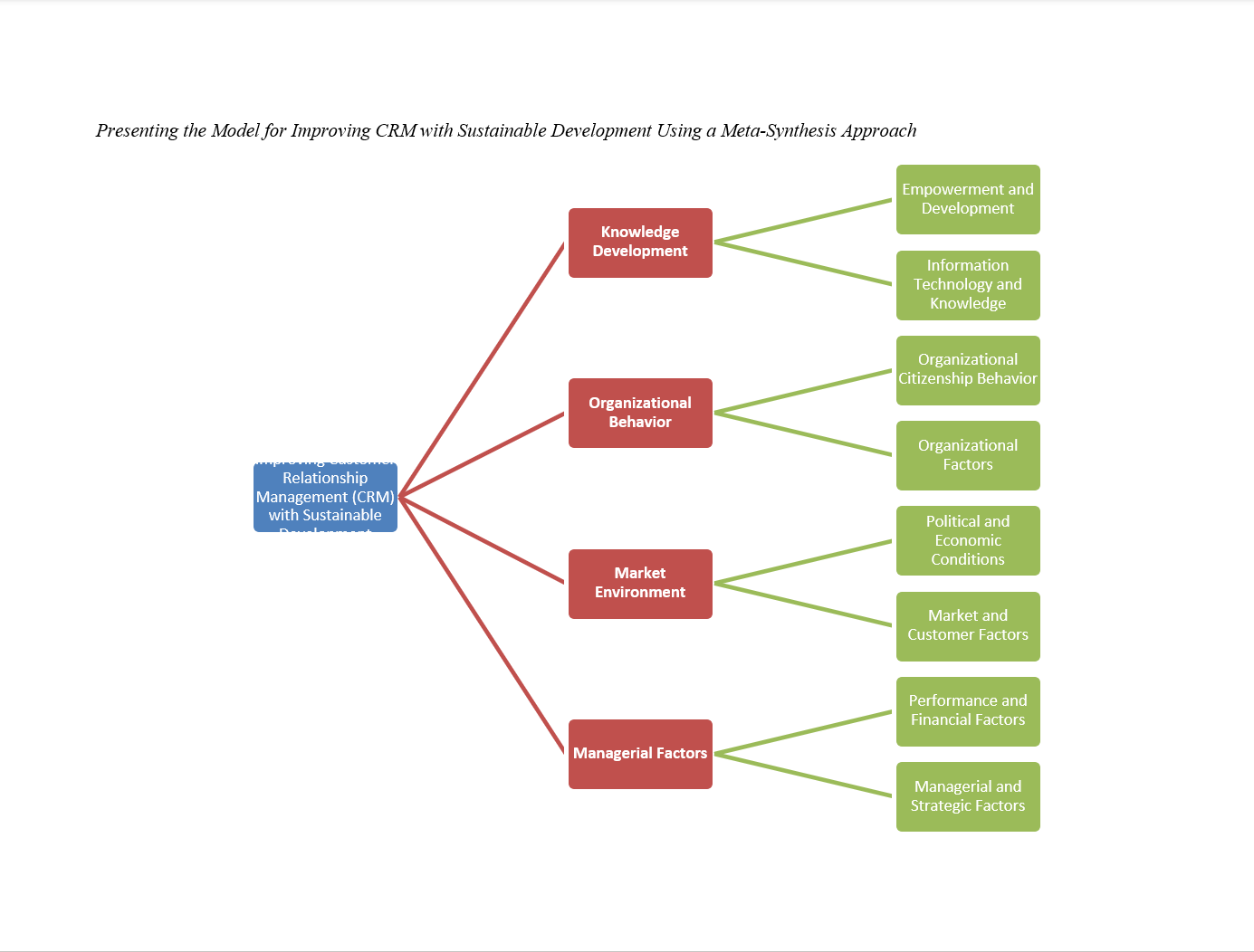
Findings: The research identified four key dimensions, eight components, and 53 indicators critical for improving CRM with sustainable development. The identified dimensions include: (1) Knowledge Development (empowerment and development, information technology and knowledge); (2) Organizational Behavior (organizational citizenship behavior, organizational factors); (3) Market Environment (political and economic conditions, market and customer factors); and (4) Managerial Factors (performance and financial factors, managerial and strategic factors). These findings align with several previous studies, confirming the importance of integrating sustainability into CRM practices.
Conclusion: The study presents a comprehensive model that integrates CRM with sustainability, providing a roadmap for organizations to enhance customer relationships while promoting long-term sustainability. The findings underscore the importance of knowledge development, organizational behavior, market adaptability, and effective managerial strategies in fostering sustainable CRM practices. The model serves as a strategic guide for businesses aiming to balance customer satisfaction, profitability, and sustainability goals.
Downloads
References
Acheampong, S., Pimonenko, T., & Lyulyov, O. (2023). Sustainable Marketing Performance of Banks in the Digital Economy: The Role of Customer Relationship Management. Virtual Economics, 6(1), 19-37. https://doi.org/10.34021/ve.2023.06.01(2)
Agbedahin, A. V. (2019). Sustainable development, Education for Sustainable Development, and the 2030 Agenda for Sustainable Development: Emergence, efficacy, eminence, and future. Sustainable Development, 27(4), 669-680. https://doi.org/10.1002/sd.1931
Baashar, Y., Alhussian, H., Patel, A., Alkawsi, G., Alzahrani, A. I., Alfarraj, O., & Hayder, G. (2020). Customer relationship management systems (CRMS) in the healthcare environment: A systematic literature review. Computer Standards & Interfaces, 71, 103442. https://doi.org/10.1016/j.csi.2020.103442
Bahri-Ammari, N. (2014). The Role of Loyalty Program (LP) and Brand Attachment in Establishing Word-of-Mouth Intentions. International Journal of Customer Relationship Marketing and Management, 5(3), 49-68. https://doi.org/10.4018/ijcrmm.2014070104
Baran, R. J., & Galka, R. J. (2016). Customer Relationship Management: the foundation of contemporary marketing strategy. Routledge. https://doi.org/10.4324/9781315687834
Del Vecchio, P., Mele, G., Siachou, E., & Schito, G. (2021). A structured literature review on Big Data for customer relationship management (CRM): toward a future agenda in international marketing. International Marketing Review, 39(5), 1069-1092. https://doi.org/10.1108/IMR-01-2021-0036
Diem, P. T., Vu, N. T., Nhan, V. K., & Vang, V. T. (2021). The strategy of CRM system development at Mega Market Vietnam. International Journal Multidisciplinary Research and Growth Evaluation, 2(4), 802-806. https://www.researchgate.net/publication/354035682_The_strategy_of_CRM_system_development_at_Mega_Market_Vietnam
Ferrer-Estévez, M., & Chalmeta, R. (2023). Sustainable customer relationship management. Marketing Intelligence & Planning, 41(2), 244-262. https://doi.org/10.1108/MIP-06-2022-0266
Ghiasabadi Farahani, M., & Ghafari Ashtiani, P. (2018). Eco-friendly export marketing strategy with the mediating role of Porter's competitive advantages. Business Studies(88-89), 53-61. https://barresybazargani.itsr.ir/article_34478.html
Golabchi, H., Kiaee, M., & Kameli, M. J. (2024). Designing a Superior Service Delivery Model in Education to Enhance Public Satisfaction [Research Article]. Iranian Journal of Educational Sociology, 7(1), 189-197. https://doi.org/10.61838/kman.ijes.7.1.18
Hajian, M., & Kashani, S. J. (2021). Evolution of the concept of sustainability. From Brundtland Report to sustainable development goals. In Sustainable Resource Management (pp. 1-24). Elsevier. https://doi.org/10.1016/B978-0-12-824342-8.00018-3
Haudi, H., Rahadjeng, E., Santamoko, R., Putra, R., Purwoko, D., & Purwanto, A. (2022). The Role of E-Marketing and E-CRM on E-Loyalty of Indonesian Companies During Covid Pandemic and Digital Era. Uncertain Supply Chain Management, 10(1), 217-224. https://doi.org/10.5267/j.uscm.2021.9.006
Javid, M. R., & Ne'matizadeh, G. B. (2021). Presenting a model for developing customer relationship management (CRM) systems with an emphasis on digital marketing strategies (Case study: Shahr Bank). Financial Economy, 17(63), 313-334. http://ensani.ir/fa/article/459495/%D8%A7%D8%B1%D8%A7%D8%A6%D9%87-%D9%85%D8%AF%D9%84-%D8%AA%D9%88%D8%B3%D8%B9%D9%87-%D8%B3%DB%8C%D8%B3%D8%AA%D9%85-%D9%85%D8%AF%DB%8C%D8%B1%DB%8C%D8%AA-%D8%A7%D8%B1%D8%AA%D8%A8%D8%A7%D8%B7-%D8%A8%D8%A7-%D9%85%D8%B4%D8%AA%D8%B1%DB%8C-%D8%A8%D8%A7-%D8%AA%D8%A3%DA%A9%DB%8C%D8%AF-%D8%A8%D8%B1-%D8%A7%D8%B3%D8%AA%D8%B1%D8%A7%D8%AA%DA%98%DB%8C-%D9%87%D8%A7%DB%8C-%D8%A8%D8%A7%D8%B2%D8%A7%D8%B1%DB%8C%D8%A7%D8%A8%DB%8C-%D8%AF%DB%8C%D8%AC%DB%8C%D8%AA%D8%A7%D9%84-%D9%85%D9%88%D8%B1%D8%AF%D9%85%D8%B7%D8%A7%D9%84%D8%B9%D9%87-%D8%A8%D8%A7%D9%86%DA%A9-%D8%B4%D9%87%D8%B1-
Khantimirov, D., Karande, K., & Ford, J. (2020). Dissatisfaction after service failures as a realized transaction risk: Customer opportunism as a function of external and internal rewards. Journal of Retailing and Consumer Services, 52, 101896. https://doi.org/10.1016/j.jretconser.2019.101896
Khattak, K. N., Hassan, Z., Shehryar Ali Naqvi, S., Khan, M. A., Qayyum, F., & Ullah, I. (2024). A Conceptual Framework Based on PLS-SEM Approach for Sustainable Customer Relationship Management in Enterprise Software Development: Insights from Developers. Sustainability, 16(6), 2507. https://doi.org/10.3390/su16062507
Klimecka-Tatar, D., Ingaldi, M., & Obrecht, M. (2021). Sustainable development in logistics-a strategy for management in terms of green transport. Management Systems in Production Engineering, 29(2), 91-96. https://doi.org/10.2478/mspe-2021-0012
Muhammad Abubakar, F., & Mohammed, I. (2020). Mediating effect of customer satisfaction on the relationship between E-CRM adoption and customer loyalty in Nigerian banks. Sahel Analyst, African Journal of Management, 5(4). https://www.researchgate.net/publication/359506761_MEDIATING_EFFECT_OF_CUSTOMER_SATISFACTION_ON_THE_RELATIONSHIP_BETWEEN_E-CRM_ADOPTION_AND_CUSTOMER_LOYALTY_IN_NIGERIAN_BANKS
Naibol-Asl, R. (2020). Providing an optimal CRM model in Agriculture Bank to improve financial status and profitability using the AHP hierarchical analysis method. Accounting and Management Perspective, 3(25), 33-45. https://www.jamv.ir/article_108303.html
Ngelyaratan, D., & Soediantono, D. (2022). Customer relationship management (CRM) and recommendation for implementation in the defense industry: a literature review. Journal of Industrial Engineering & Management Research, 3(3), 17-34. https://jiemar.org/index.php/jiemar/citationstylelanguage/get/apa?submissionId=279
Pansari, A., & Kumar, V. (2017). Customer engagement: the construct, antecedents, and consequences. Journal of the Academy of Marketing Science, 45, 294-311. https://doi.org/10.1007/s11747-016-0485-6
Racbhini, W., Wulandjani, H., Thalib, S., Setiyowati, H., & Sasmito, T. (2021). Effect of e-crm and e-servqual on e-loyalty through e-satisfaction in Millennial Generation, study of online shopping behavior in Indonesia. International Journal of Economic and Business Applied, 2(2). http://ijeba.makarioz.org/
Rahman, S. U., & Nguyen‐Viet, B. (2023). Towards sustainable development: Coupling green marketing strategies and consumer perceptions in addressing greenwashing. Business Strategy and the Environment, 32(4), 2420-2433. https://doi.org/10.1002/bse.3256
Sanguino, R., Barroso, A., Fernández-Rodríguez, S., & Sánchez-Hernández, M. I. (2020). Current trends in economy, sustainable development, and energy: a circular economy view. Environmental Science and Pollution Research, 27, 1-7. https://doi.org/10.1007/s11356-019-07074-x
Sen, A. (2013). A survey of sustainable development: social and economic dimensions (Vol. 6). Island Press. https://books.google.com/books/about/A_Survey_of_Sustainable_Development.html?id=1z1QIdZCHpoC
Sivesan, S. (2012). The Impact of Customer Relationship Marketing on Customer Loyalty: Evidence From the Banking Sector. South Asian Journal of Marketing & Management Research, 2, 179-191. https://ideas.repec.org/a/igg/jcrmm0/v14y2023i1p1-17.html
Son, T. H., Weedon, Z., Yigitcanlar, T., Sanchez, T., Corchado, J. M., & Mehmood, R. (2023). Algorithmic urban planning for smart and sustainable development: Systematic review of the literature. Sustainable Cities and Society, 104562. https://doi.org/10.1016/j.scs.2023.104562
Downloads
Additional Files
Publication Timeline
- Submitted
- Revised
- Accepted
Issue
Section
License
Copyright (c) 2024 Hossein Yazdani (Author); Shahrbanoo Gholipour Freydouni (Corresponding Author); Mehdi Rouholamini (Author)

This work is licensed under a Creative Commons Attribution-NonCommercial 4.0 International License.