Developing a Model for Identifying and Exploiting Entrepreneurial Opportunities in the Health Sector: A Qualitative Approach
DOI:
https://doi.org/10.61838/kman.ijimob.5.3.5Keywords:
Identifying entrepreneurial opportunities, exploiting entrepreneurial opportunities, health sector, grounded theoryAbstract
Objective: This study aimed to develop a comprehensive model for identifying and exploiting entrepreneurial opportunities within the healthcare sector, emphasizing the roles of contextual, structural, and behavioral factors.
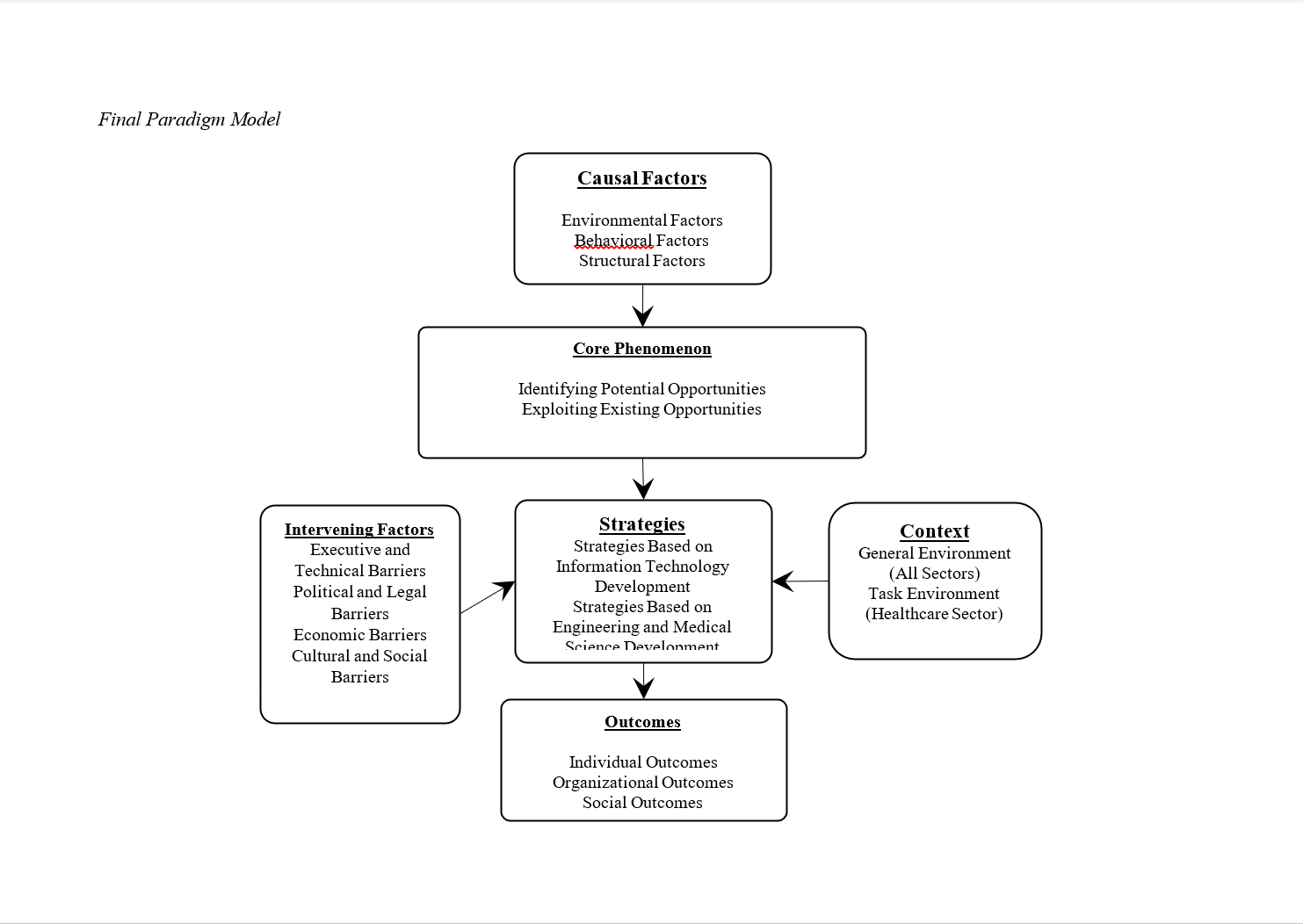
Methodology: A qualitative, process-oriented approach was employed using grounded theory methodology to explore the dynamics of healthcare entrepreneurship. Data were collected through semi-structured interviews with healthcare experts and academic professionals in Tehran, totaling 20 interviews (10 experts and 10 academics), with analysis achieved through open, axial, and selective coding. The resulting model encompasses causal, contextual, and intervening conditions along with actionable strategies and anticipated outcomes.
Findings: The proposed model highlights the critical role of contextual conditions, such as technological infrastructure, structural organizational support, and behavioral factors like public engagement, in enabling healthcare entrepreneurship. Key strategies identified include leveraging advancements in information technology, engineering, and medical sciences to foster innovation in healthcare. Findings underscore the importance of regulatory and economic considerations as intervening conditions that either facilitate or limit entrepreneurial opportunities. Organizational and social outcomes include improved healthcare access, cost reductions, and increased public satisfaction, while individual outcomes reflect enhanced patient care and engagement.
Conclusion: The study’s model provides a comprehensive framework for understanding and facilitating healthcare entrepreneurship by integrating environmental, structural, and individual factors.
Downloads
References
Abdi Jammaran, A., Hosseini, E., Moghaddam, A., & Ghasemloo, M. (2017). Individual Factors Affecting the Identification of Entrepreneurial Opportunities. Shbank Journal, 3(2), 105-115. https://www.sid.ir/paper/514958/fa
Ardichvili, A., Cardozo, R., & Ray, S. (2003). A theory of entrepreneurial opportunity identification and development. Journal of Business Venturing, 18(1), 105-123. https://doi.org/10.1016/S0883-9026(01)00068-4
Asgharinezhad, S., Rezghi Shirsavar, H., & Khanzadi, K. (2024). Identifying the Dimensions and Components of Internet of Things (IoT) Development in Schools Based on Futurology [Research Article]. Iranian Journal of Educational Sociology, 7(2), 98-105. https://doi.org/10.61838/kman.ijes.7.2.12
Bhagavatula, S., Elfring, T., Van Tilburg, A., & Van De Bunt, G. G. (2010). How social and human capital influence opportunity recognition and resource mobilization in India's handloom industry. Journal of Business Venturing, 25(3), 245-260. https://doi.org/10.1016/j.jbusvent.2008.10.006
Bhatia, D., Bagyaraj, S., Karthick, S. A., Mishra, A., & Malviya, A. (2021). Role of the Internet of Things and deep learning for the growth of healthcare technology. Trends in Deep Learning Methodologies, 113-127. https://doi.org/10.1016/B978-0-12-822226-3.00005-2
Dianati, M., Karimi, A., & Akbari, M. (2018). The Effect of Entrepreneurial Self-Efficacy on Opportunities for Recognition: Considering the Entrepreneurial Role of Entrepreneurial Knowledge-Based Companies Based in Science and Technology Parks in Tehran. Journal of Entrepreneurship Development, 11(1), 61-81. https://www.sid.ir/fa/journal/ViewPaper.aspx?id=467717
Diepolder, C. S. (2024). Exploring the Impact of Sustainable Entrepreneurial Role Models on Students’ Opportunity Recognition for Sustainable Development in Sustainable Entrepreneurship Education. Sustainability, 16(4), 1484. https://doi.org/10.3390/su16041484
Dudek, K. A., Dion-Albert, L., Kaufmann, F. N., Tuck, E., Lebel, M., & Menard, C. (2021). Neurobiology of resilience in depression: immune and vascular insights from human and animal studies. European Journal of Neuroscience, 53(1), 183-221. https://doi.org/10.1111/ejn.14547
Garov, A. K., & Awasthi, A. K. (2022). Case Study-Based Big Data and IoT in Healthcare. In Machine Learning, Deep Learning, Big Data, and Internet of Things for Healthcare (pp. 13-35). Chapman and Hall/CRC. https://doi.org/10.1201/9781003227595-2
Gholipour, R., Aghajani, H., & Karimi, M. (2009). Investigating Factors Influencing on Entrepreneurial Opportunity Recognition in the Field of Information Technology. Information Technology Studies, 1(3), 123-158. https://jead.gau.ac.ir/article_3500.html
Goss, D., & Sadler-Smith, E. (2018). Opportunity creation: Entrepreneurial agency, interaction, and affect. Strategic Entrepreneurship Journal, 12(2), 219-239. https://doi.org/10.1002/sej.1273
Khoshmaram, M., Zarafshani, K., & Mirkzadeh, A. (2017). Designing and Explaining a Model for Identifying Entrepreneurial Opportunities in Agriculture in Kermanshah Province: Application of NVivo Software. Journal of Rural Research, 8(3), 391-402. https://www.sid.ir/fa/journal/ViewPaper.aspx?id=317341
Lim, W. L., & Xavier, S. R. (2015). Opportunity Recognition Framework: Exploring the Technology Entrepreneurs. American Journal of Economics, 5(2), 105-111. http://article.sapub.org/10.5923.c.economics.201501.10.html
Mah-Najafabadi, A., Ghasemi, A. H., Papi, A., & Zare-Farashbandi, F. (2022). Identifying the Opportunities and Challenges of Establishing an Information Therapy Center. Journal of Health Administration, 25(2), 116-133. https://www.sid.ir/fileserver/je/114220220207.pdf
Mechanick, J. I., Apovian, C., Brethauer, S., Timothy Garvey, W., Joffe, A. M., Kim, J., Kushner, R. F., Lindquist, R., Pessah-Pollack, R., Seger, J., Urman, R. D., Adams, S., Cleek, J. B., Correa, R., Figaro, M. K., Flanders, K., Grams, J., Hurley, D. L., Kothari, S., . . . Still, C. D. (2020). Clinical Practice Guidelines for the Perioperative Nutrition, Metabolic, and Nonsurgical Support of Patients Undergoing Bariatric Procedures – 2019 Update: Cosponsored by American Association of Clinical Endocrinologists/American College of Endocrinology, The Obesity Society, American Society for Metabolic and Bariatric Surgery, Obesity Medicine Association, and American Society of Anesthesiologists. Obesity, 28(4), O1-O58. https://doi.org/10.1002/oby.22719
Nayak, S., Mantri, S., Nayak, M., & Rai, A. (2022). Introduction to e-monitoring for healthcare. In Machine Learning, Deep Learning, Big Data, and Internet of Things for Healthcare (pp. 1-11). Chapman and Hall/CRC. https://doi.org/10.1201/9781003227595-1
Rao, A. R., & Elias-Medina, A. (2024). Designing an internet of things laboratory to improve student understanding of secure IoT systems. Internet of Things and Cyber-Physical Systems, 4, 154-166. https://doi.org/10.1016/j.iotcps.2023.10.002
Sheeba, P. S. (2021). An overview of IoT in health sectors. In Emerging Technologies for Healthcare: Internet of Things and Deep Learning Models (pp. 1-24). https://doi.org/10.1002/9781119792345.ch1
Wang, Y., Ellinger, A. D., & JimWu, Y. (2013). Entrepreneurial opportunity recognition: an empirical study of R&D personnel. Management Decision, 51(2), 248-266. https://doi.org/10.1108/00251741311301803
Zehri, A. W., Bhatti, M. K., & Baloch, M. S. (2023). Career Decisions and Opportunity Recognition as the Predictors of Entrepreneurial Intention. Research Journal for Societal Issues, 5(1), 138-149. https://doi.org/10.56976/rjsi.v5i1.72
Downloads
Additional Files
Publication Timeline
- Submitted
- Revised
- Accepted
Issue
Section
License
Copyright (c) 2025 Mahdi Mohammadi (Author); Seyyed Mahdi Etamad (Corresponding Author)

This work is licensed under a Creative Commons Attribution-NonCommercial 4.0 International License.