Proposing a Paradigmatic Model of Organizational Culture in Iraqi Schools
DOI:
https://doi.org/10.61838/kman.ijimob.5.5.3Keywords:
organizational culture, schools, grounded theory, educational qualityAbstract
Objective: The objective of the present study is to propose a localized model of organizational culture in the schools of Wasit County, Iraq, emphasizing the identification of cultural dimensions and components relevant to these schools.
Methodology: The research methodology is qualitative, applied in terms of purpose, and exploratory in terms of data type. The statistical population for the qualitative section of the study consists of 30 educational experts and school administrators from Wasit County, Iraq. These individuals were selected as the target population due to their profound experience and knowledge in organizational culture and educational management. Purposeful sampling was employed to select 30 participants from this expert community. Data collection was conducted through semi-structured interviews in the qualitative phase, and data analysis was carried out using Maxqda software.
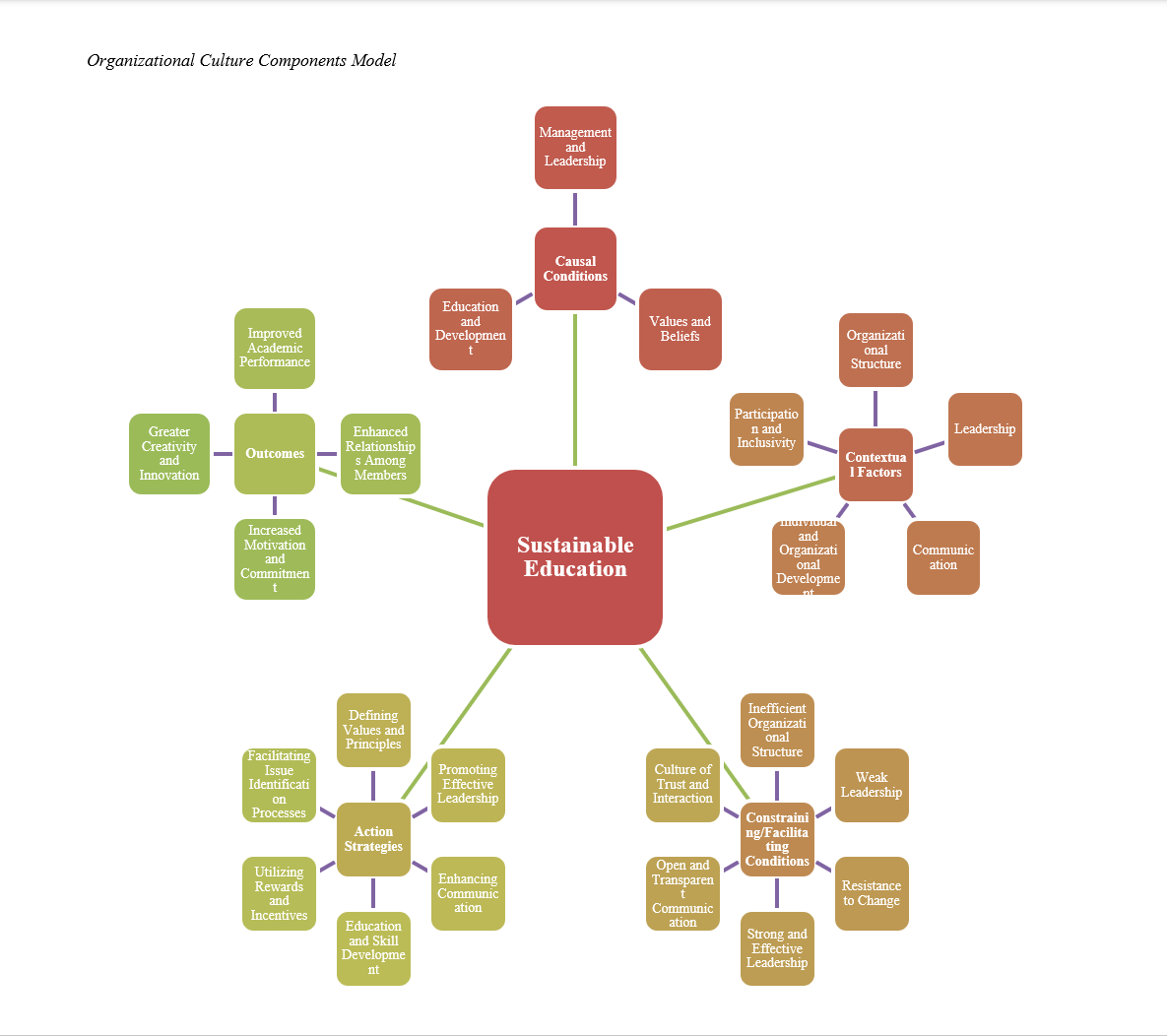
Findings: The findings indicate that organizational culture in the schools of Wasit County encompasses multiple dimensions, the most significant of which include "educational values," "organizational cohesion and interactions," "commitment and responsibility," and "educational leadership." Ultimately, based on the findings, a paradigmatic model was developed grounded in the Strauss and Corbin model. It can be concluded that the organizational culture in Iraqi schools requires several components to enhance and promote its development.
Conclusion: Therefore, planners can utilize the findings of this study to design organizational culture programs for schools, enabling a deeper understanding of organizational culture.
Downloads
References
Akpa, V. O., Asikhia, O. U., & Nneji, N. E. (2021). Organizational culture and organizational performance: A review of literature. International Journal of Advances in Engineering and Management, 3(1), 361-372. https://www.researchgate.net/publication/356105838_Organizational_Culture_and_Organizational_Performance_A_Review_of_Literature
Alaei, F., Ahghar, G., & Fathi Vernosfaderani, L. (2024). Identification and Explanation of Organizational Health Dimensions and Components among Middle School Teachers in Tehran. iase-idje, 7(2), 36-42. https://doi.org/10.61838/kman.ijes.7.2.5
Assoratgoon, W., & Kantabutra, S. (2023). Toward a sustainability organizational culture model. Journal of Cleaner Production, 400. https://doi.org/10.1016/j.jclepro.2023.136666
Bockius, H., & Gatzert, N. (2023). Organizational risk culture: A literature review on dimensions, assessment, value relevance, and improvement levers. European Management Journal. https://doi.org/10.1016/j.emj.2023.02.002
Ebrahimzadeh, B., & Nazem, F. (2019). Identifying and formulating components affecting the competency model of elementary school principals in Tehran. Journal of Leadership and Educational Management, 12(4), 9-23. https://sanad.iau.ir/en/Journal/edu/Article/855754
Farasatkhah, M., & Taslimi, M. (2016). Examination of privatization and the culture of non-profit schools in Tehran. First International Conference on Educational Management in Iran, Tehran.
Jamali, A., Bhutto, A., Khaskhely, M., & Sethar, W. (2022). Impact of leadership styles on faculty performance: Moderating role of organizational culture in higher education. Management Science Letters, 12(1), 1-20. https://doi.org/10.5267/j.msl.2021.8.005
Kumar, S. K. R. (2025). Influence of Sustainable Human Resource Practices on ITES Organizational Culture. Journal of Information Systems Engineering & Management, 10(13s), 522-530. https://doi.org/10.52783/jisem.v10i13s.2107
Mahmoudi Sardareh, F., Ahmadi, E., Salehi, M., & Shahamat, N. (2022). Organizational culture of effective high schools in Bandar Abbas: Comparing current and desired states. Journal of Leadership and Educational Management, 16(2), 255-271. https://journals.iau.ir/article_694320.html
Mikusova, M., Klabusayova, N., & Meier, V. (2023). Evaluation of organisational culture dimensions and their change due to the pandemic. Evaluation and Program Planning, 97, 1-13. https://doi.org/10.1016/j.evalprogplan.2023.102246
Mosadeghrad, A. M., Parsaeian, M., & Hedayati, P. (2023). Organizational culture of hospitals affiliated to Tehran University of Medical Sciences. payeshj, 22(4), 375-385. https://doi.org/10.61186/payesh.22.4.375
Pavlidou, C. T., & Efstathiades, A. (2021). The effects of internal marketing strategies on the organizational culture of secondary public schools. Evaluation and Program Planning, 84. https://doi.org/10.1016/j.evalprogplan.2020.101894
Pedraza-Rodríguez, J. A., Ruiz-Vélez, A., Sánchez-Rodríguez, M. I., & Fernández-Esquinas, M. (2023). Management skills and organizational culture as sources of innovation for firms in peripheral regions. Technological Forecasting and Social Change, 191. https://doi.org/10.1016/j.techfore.2023.122518
Rahimi, M., Bahmaee, L., & Barekat, G. H. (2023). Designing A Paradigmatic Model of Barriers to Innovation Management in Ahvaz Primary Schools. International Journal of Innovation Management and Organizational Behavior (IJIMOB), 3(4), 19-27. https://doi.org/10.61838/kman.ijimob.3.4.3
Schein, E. (2010). Organizational Culture. Farah Publications. https://www.google.de/books/edition/Organizational_Culture_and_Leadership/l2jpCgAAQBAJ?hl=en&gbpv=1&dq=Organizational+Culture+schein+e&printsec=frontcover
Taslimi, M., & Farasatkhah, M. (2021). Analyzing the components of organizational culture in public schools. Behavioral Studies in Management, 12(26), 21-32. https://www.researchgate.net/publication/354202747_wakawy_mwlfh_hay_frhng_sazmany_mdars_dwlty_Analysis_of_Organizational_Culture_Components_in_Public_Schools
Vatan, E., Raissi Ardali, G. A., & Shahin, A. (2024). Selecting information systems development models based on organizational culture: an integrated approach of DEMATEL and ANP. VINE Journal of Information and Knowledge Management Systems, 54(3), 531-560. https://doi.org/10.1108/VJIKMS-08-2021-0164
Winata, L. R. W. (2024). The Influence of Organizational Culture, Situational Leadership and Emotional Intelligence on Organizational Commitment Through Job Satisfaction at PDAM Tirta Ardhia Rinjani, Central Lombok Regency. Journal of Economics Finance and Management Studies, 07(05). https://doi.org/10.47191/jefms/v7-i5-17
Downloads
Additional Files
Publication Timeline
- Submitted
- Revised
- Accepted
Issue
Section
License
Copyright (c) 2025 Aziz Abdullah Mazloum Al-Jawda, Negin Jabbari, Thaer Mohammed Ali Mohammed Ibrahim Al-Suwaidi, Nasrolah Ghashghaeizadeh (Author)

This work is licensed under a Creative Commons Attribution-NonCommercial 4.0 International License.