Explaining and Modeling Strategic Alignment with Environmental Performance and Green Innovation Approach in the Food Industry
DOI:
https://doi.org/10.61838/kman.ijimob.5.4.10Keywords:
Green human resource management, strategic alignment, environmental performance, green strategyAbstract
Objective: To investigate the relationship between strategic alignment and environmental performance.
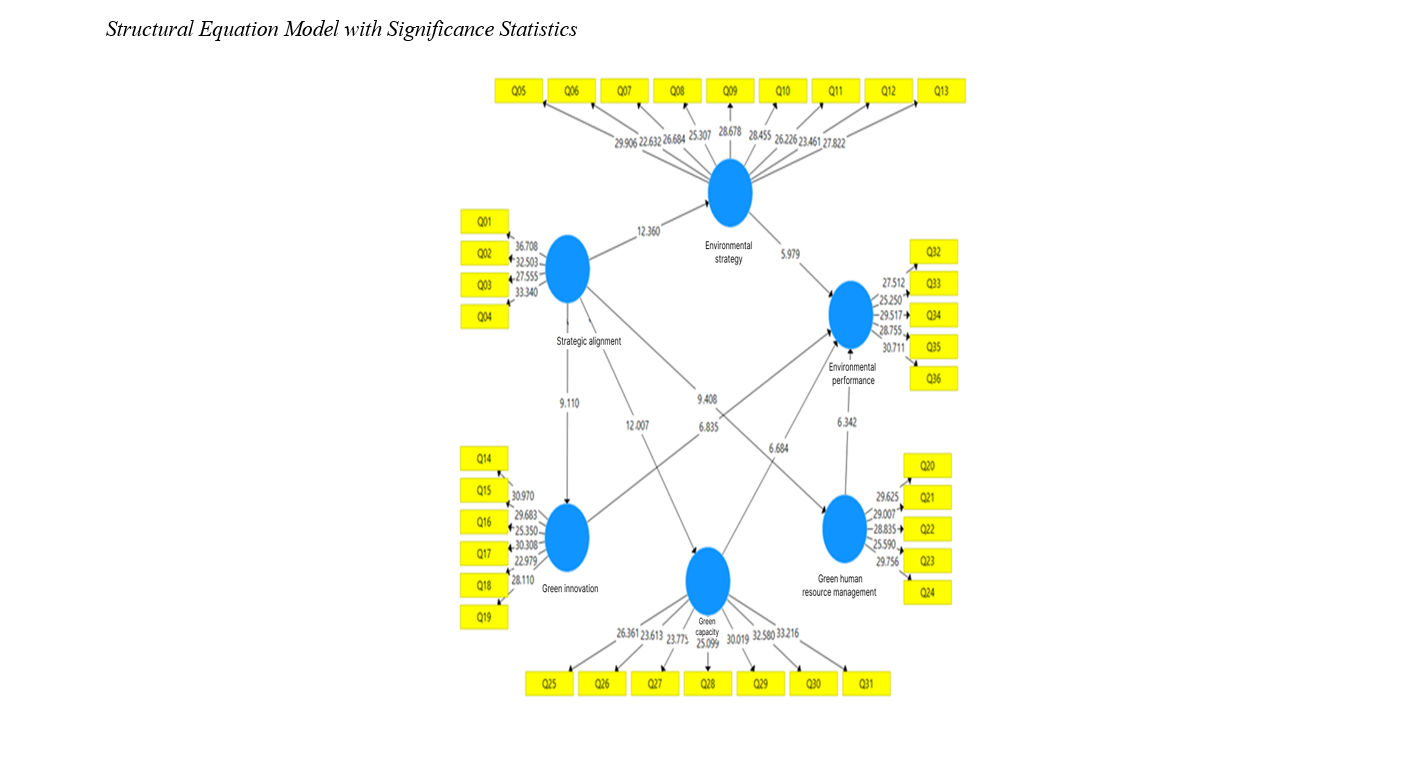
Methodology: This study employed a descriptive-correlational research design. Data were collected from senior and middle managers of publicly traded companies in the food industry using adapted questionnaires. Hypotheses were tested using the partial least squares (PLS) method and analyzed through SPSS 23 and Smart PLS software.
Findings: The results demonstrated that strategic alignment positively and significantly impacts green capacity, environmental strategy, green innovation, and green human resource management. Furthermore, green capacity, environmental strategy, green innovation, and green human resource management each positively and significantly influence environmental performance. The overall model fit was found to be excellent, with a calculated GOF value of 0.741.
Conclusion: Strategic alignment plays a critical role in enhancing environmental performance by fostering green capacity, promoting innovative environmental practices, and integrating green strategies within organizational processes. This study provides a foundational framework for understanding how strategic alignment can be leveraged as a powerful tool for improving organizational sustainability and competitiveness.
Downloads
References
Adama, H. E., Popoola, O. A., Okeke, C. D., & Akinoso, A. E. (2024). Theoretical frameworks supporting IT and business strategy alignment for sustained competitive advantage. International Journal of Management & Entrepreneurship Research, 6(4), 1273-1287. https://doi.org/10.51594/ijmer.v6i4.1058
Andriopoulos, C. (2001). Determinants of organisational creativity: a literature review. Management Decision, 39(10), 834-841. https://doi.org/10.1108/00251740110402328
Bhat, A. A., Mir, A. A., Allie, A. H., Lone, M. A., Al-Adwan, A. S., Jamali, D., & Riyaz, I. (2024). Unlocking corporate social responsibility and environmental performance: Mediating role of green strategy, innovation, and leadership. Innovation and Green Development, 3(2), 100112. https://doi.org/10.1016/j.igd.2023.100112
Chen, A., & Roberts, N. (2024). Joint drivers of different shades of green IT/IS practices: a strategic cognition perspective. Information Technology & People, 37(3), 1103-1125. https://doi.org/10.1108/ITP-07-2022-0562
Coreynen, W., Matthyssens, P., Struyf, B., & Vanhaverbeke, W. (2024). Spiraling between learning and alignment toward digital service innovation. Journal of Service Management, 35(2), 306-331. https://doi.org/10.1108/JOSM-12-2022-0400
Dahinine, B., Laghouag, A., Bensahel, W., Alsolami, M., & Guendouz, T. (2024). Modelling the Combined Effect of Green Leadership and Human Resource Management in Moving to Green Supply Chain Performance Enhancement in Saudi Arabia. Sustainability, 16(10), 3953. https://doi.org/10.3390/su16103953
Dias, G. P., & Silva, M. (2022). Revealing performance factors for supply chain sustainability: a systematic literature review from a social capital perspective. Brazilian Journal of Operations & Production Management, 19(1), 1-18. https://doi.org/10.14488/BJOPM.2021.037
Ferreira, J. J., Fernandes, C. I., & Ferreira, F. A. (2020). Technology transfer, climate change mitigation, and environmental patent impact on sustainability and economic growth: A comparison of European countries. Technological Forecasting and Social Change, 150, 119770. https://doi.org/10.1016/j.techfore.2019.119770
Gluch, P., Gustafsson, M., & Thuvander, L. (2009). An absorptive capacity model for green innovation and performance in the construction industry. Construction Management and Economics, 27(5), 451-464. https://doi.org/10.1080/01446190902896645
Huo, B., Wang, K., & Zhang, Y. (2021). The impact of leadership on supply chain green strategy alignment and operational performance. Operations Management Research, 14, 152-165. https://doi.org/10.1007/s12063-020-00175-8
Nagy, R. L., Hagspiel, V., & Kort, P. M. (2021). Green capacity investment under subsidy withdrawal risk. Energy Economics, 98, 105259. https://doi.org/10.1016/j.eneco.2021.105259
Nassani, A. A., & Aldakhil, A. M. (2023). Tackling organizational innovativeness through strategic orientation: strategic alignment and moderating role of strategic flexibility. European Journal of Innovation Management, 26(3), 847-861. https://doi.org/10.1108/EJIM-04-2021-0198
Novitasari, M., & Agustia, D. (2023). Competitive advantage as a mediating effect in the impact of green innovation and firm performance. Business: Theory and Practice, 24(1), 216-226. https://doi.org/10.3846/btp.2023.15865
Pesce, D., & Neirotti, P. (2023). The impact of IT-business strategic alignment on firm performance: The evolving role of IT in industries. Information & Management, 60(5), 103800. https://doi.org/10.1016/j.im.2023.103800
Shah, N., & Soomro, B. A. (2023). Effects of green human resource management practices on green innovation and behavior. Management Decision, 61(1), 290-312. https://doi.org/10.1108/MD-07-2021-0869
Shang, Y., Zhou, S., Zhuang, D., Żywiołek, J., & Dincer, H. (2024). The impact of artificial intelligence application on enterprise environmental performance: Evidence from microenterprises. Gondwana Research, 131, 181-195. https://doi.org/10.1016/j.gr.2024.02.012
Simmou, W., Govindan, K., Sameer, I., Hussainey, K., & Simmou, S. (2023). Doing good to be green and live clean!-Linking corporate social responsibility strategy, green innovation, and environmental performance: Evidence from Maldivian and Moroccan small and medium-sized enterprises. Journal of Cleaner Production, 384, 135265. https://doi.org/10.1016/j.jclepro.2022.135265
Sun, Y., Gao, P., Tian, W., & Guan, W. (2023). Green innovation for resource efficiency and sustainability: empirical analysis and policy. Resources Policy, 81, 103369. https://doi.org/10.1016/j.resourpol.2023.103369
Tjahjadi, B., Agastya, I. B. G. A., Soewarno, N., & Adyantari, A. (2023). Green human capital readiness and business performance: do green market orientation and green supply chain management matter? Benchmarking: An International Journal, 30(10), 3884-3905. https://doi.org/10.1108/BIJ-10-2021-0622
Tolliver, C., Fujii, H., Keeley, A. R., & Managi, S. (2021). Green innovation and finance in Asia. Asian Economic Policy Review, 16(1), 67-87. https://doi.org/10.1111/aepr.12320
Wang, Y., Ali, Z., Mehreen, A., & Hussain, K. (2023). The trickle-down effect of big data use to predict organization innovation: the roles of business strategy alignment and information sharing. Journal of Enterprise Information Management, 36(1), 323-346. https://doi.org/10.1108/JEIM-10-2021-0439
Downloads
Additional Files
Publication Timeline
- Submitted
- Revised
- Accepted
Issue
Section
License
Copyright (c) 2024 Leila Meshkinghalam (Author); Ali Rajabzadeh Ghatari (Corresponding Author); Nazanin Pilehvari (Author)

This work is licensed under a Creative Commons Attribution-NonCommercial 4.0 International License.