Identification and Prioritization of Indicators for the Annual Performance Evaluation of the President
DOI:
https://doi.org/10.61838/kman.ijimob.3620Keywords:
Annual Performance, President Performance, Performance EvaluationAbstract
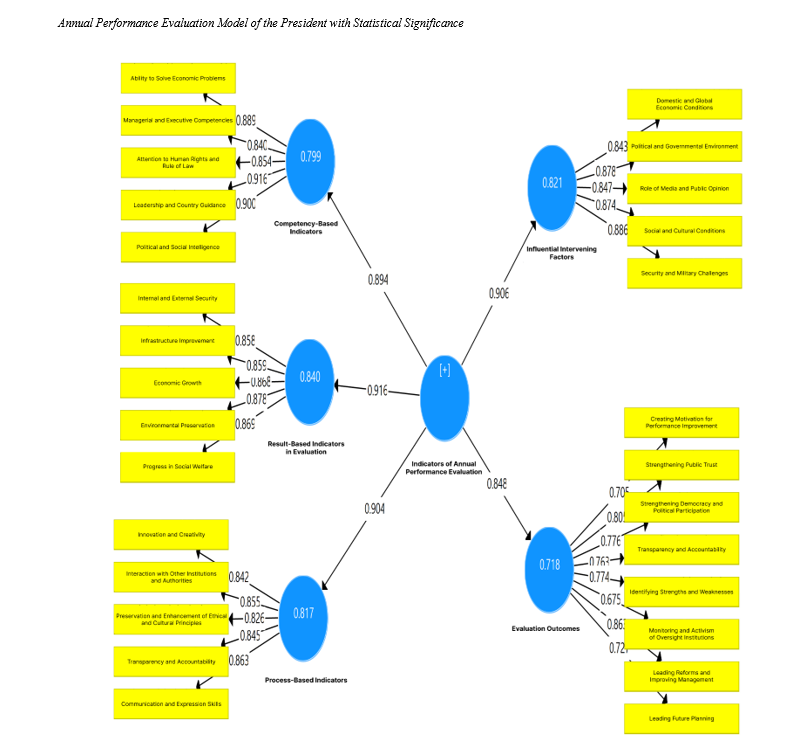
Objective: The objective of this study is to design and evaluate an annual performance evaluation model for the president
Methodology: The study employs a Delphi research process consisting of three rounds to reach a consensus among expert panel members on the relevant performance indicators. Structural Equation Modeling (SEM) is used to validate the measurement model, and confirmatory factor analysis (CFA) is conducted to assess the reliability and validity of the model.
Findings: The Cronbach's alpha coefficient and composite reliability for all constructs in the model exceed 0.7, indicating good and acceptable reliability for the measurement instruments. This implies that the various constructs of the model were measured consistently and accurately, and the resulting data can be reliably used to analyze and interpret the President’s performance. These results collectively show that the annual performance evaluation model for the President is statistically valid and can serve as an effective tool for performance analysis.
Conclusion: Overall, the findings of this evaluation suggest that higher priority was given to indicators that refer to tangible and measurable outcomes and impacts of the President's performance. In contrast, indicators related to individual competencies and external and intervening factors ranked lower. This pattern may indicate a tendency toward evaluations that focus more on objective and observable results than on more relative or indirect assessments.
Downloads
References
Alipour, A., & Nasri, F. (2017). Study and Analysis of Educational Performance Indicators of the University of Marine Sciences Using the BSC-TOPSIS Method. Journal of Marine Sciences Education, 4(9), 45-60. https://www.magiran.com/paper/1744150/investigation-and-analysis-of-educational-performance-indices-of-imam-khomeini-naval-academy-by-bsc-topsis?lang=en
Azari, A., & Zamani Mazdeh, M. (2015). Strategic Model for Organizational Performance Management. Educational and Research Institute of Defense Industries.
Bavos, H., & Vank, L. (2019). A Study of the Performance of Major Brazilian Banks Using the Two-Stage DEA Technique. Journal of Intellectual Capital, 6(2), 159-176.
Chang, H., & Shui, P. (2018). Measuring the True Performance of Taiwanese Bank Management with a Three-Tier DEA. Economic Policy Review, 9(5), 10-31.
Didehgah, S. A. A., & Sohrabi, T. (2023). A Model for Managing the Development of Emerging Technologies Based on Stabilizing Supply Chains in the Agricultural Industry. Technology Development Management, 11(4). https://jtdm.irost.ir/article_1425.html?lang=en
Fan, L., Fei, J., Schriever, U., & Fan, S. (2021). An Empirical Study on the Communicative Competence of Chinese Seafarers. Marine Policy, 87, 65-71. https://doi.org/10.1016/j.marpol.2017.10.010
Harrison, T. (2017). NGOs and Personal Politics: The Relationship Between NGOs and Political Leaders in West Bengal, India. World Development, 98, 485-496. https://doi.org/10.1016/j.worlddev.2017.05.008
Hossein Zadeh, A., Yaghoubi, N., & Pourshahabi, V. (2022). Review and Presentation of Performance Audit Policies for Management and Evaluation of Existing Factors in Public Organizations. Public Policy in Management, 13(46), 77-96. https://en.civilica.com/doc/1569095/
Kabanda, S., & Abdin, A. (2017). Survey of the Performance of 23 Indonesian Non-Life Insurance Companies from 2015 to 2017 Using Data Envelopment Analysis Method. Processes for Performance Evaluation, 10, 90-116.
Karimi, R., Naveh Ebrahim, A., Hasanpour, A., & Mousapour, N. (2020). Designing a Model for Evaluating the Performance of Faculty Members of Farhangian University. Educational and School Studies, 9(3), 253-284. https://pma.cfu.ac.ir/article_1422.html?lang=en
Khaled, Y., & Shaut, A. (2018). Investigation of a Fuzzy Computational Model Based on Hierarchical Analysis and TOPSIS to Evaluate the Performance of Staff and the University of Sudan Corporate Performance. Decision Support System, 23-45.
Koo, H. (2018). A Study Using the DEA Network Communication Model to Examine the Performance of Non-Life Insurance Companies in Taiwan. Management Accounting Research, 11, 230-261.
Koo, H., & Wang, W. (2017). A Review of the Two-Stage DEA Method of Performance of Insurance Companies in Taiwan. Management Accounting Research, 8, 118-129.
Koronokous, M., & Despoti, S. (2018). Investigating the New Approach of Network DEA in Two-Step Processes for Performance Evaluation. 15, 99-113.
Malek Hosseini, H. R., Arab Salehi, M., & Foroughi, D. (2025). The impact of board characteristics through modern management accounting techniques on firms' financial performance. Management Accounting and Auditing Knowledge, 14(54), 17-36.
Marsidin, S., & Mudjiran, R. (2020). The Practicality of Principal's Performance Appraisal Model In - 2nd International Conference Innovation in Education (ICoIE 2020).
Momeni Mofrad, M., Sepahvand, R., Mousavi Seyyed, N., & Vahdati, H. (2021). Identifying and Prioritizing Dimensions of Performance Evaluation for Governors of the Islamic Republic Government. Quarterly Journal of the Iranian Management Sciences Association, 16(64), 123-144. https://journal.iams.ir/article_367.html
Neely, A., Marr, B., Roos, G., Pike, S., & Gupta, O. (2003). Towards the Third Generation of Performance Measurement. Controlling, 15(3/4), 129-135. https://doi.org/10.15358/0935-0381-2003-3-4-129
Neustroev, S., Gordashnikova, O., & Zibrov, V. (2020). Designing a Regional Performance Appraisal Model for Administrators of Educational Institutions. Quality-Access to Success, 21(179). https://openurl.ebsco.com/EPDB%3Agcd%3A16%3A28406528/detailv2?sid=ebsco%3Aplink%3Ascholar&id=ebsco%3Agcd%3A147008546&crl=c&link_origin=www.google.com
Niroomand, H., & Rzayat, G. H. (2020). Employee Performance Appraisal Pattern of Military Organizations. Strategic Defense Studies, 18(82), 289-312. https://sds.sndu.ac.ir/article_1184.html?lang=en
Saho, S., & Tun, Y. (2018). Performance of Indian Life Insurance Companies Using DEA. Processes for Performance Evaluation, 8, 155-170.
Selvarajan, T. T., Singh, B., & Solansky, S. (2018). Performance Appraisal Fairness, Leader Member Exchange and Motivation to Improve Performance: A Study of US and Mexican Employees. Journal of Business Research, 85, 142-154. https://doi.org/10.1016/j.jbusres.2017.11.043
Sepahvand, F., Mohammadipour, F., Parvizy, S., Zagheri Tafreshi, M., Skerrett, V., & Atashzadeh-Shoorideh, F. (2020). Improving Nurses' Organizational Commitment by Participating in Their Performance Appraisal Process. Journal of nursing management, 28(3), 595-605. https://doi.org/10.1111/jonm.12961
Seyedi, P., Borhani, S. A., Maleki, M. H., & Adeli, O. (2025). Investigating the impact of intra-organizational factors on the quality of performance-based budgeting implementation in project-oriented organizations in Iran's housing sector. Studies in Ethics and Behavior in Accounting and Auditing, 4(1), 115-134.
Suvedi, M., Ghimire, R., & Channa, T. (2021). Examination of Core Competencies of Agricultural Development Professionals in Cambodia. Evaluation and Program Planning, 67, 89-96. https://doi.org/10.1016/j.evalprogplan.2017.12.003
Wang, X., Translated by Mehdi, K., & Alireza Naqavi, H. (2014). Performance Analysis in Public and Nonprofit Organizations. Safar Publications. https://scholars.cityu.edu.hk/en/publications/performance-analysisfor-public-and-nonprofit-organizations(6c93e462-1ba2-4487-b0f0-2fc17c0b95af).html
Downloads
Additional Files
Publication Timeline
- Submitted
- Revised
- Accepted
Issue
Section
License
Copyright (c) 2025 Soroosh Sotoodeh (Author); Aliasghar Pourezzat (Corresponding Author); Marjan Fayyazi, NourMohammad Yaghoubi, Bahareh Mahbanooei (Author)

This work is licensed under a Creative Commons Attribution-NonCommercial 4.0 International License.