Presenting a Model of Managers’ Psychological Capability in Public Organizations
DOI:
https://doi.org/10.61838/kman.ijimob.4975Keywords:
Psychological capability, public managers, public organizations, qualitative research, thematic analysisAbstract
Objective: This study aimed to identify and develop a comprehensive model of managers’ psychological capability in public organizations.
Methods and Materials: This study employed a qualitative research design using thematic analysis with an inductive approach. Data were collected through semi-structured interviews with managers and employees working in public organizations. Sampling was conducted purposively and continued until theoretical saturation was achieved, which occurred after 22 interviews. The interview data were transcribed verbatim and analyzed systematically through open coding, categorization of basic themes, abstraction into organizing themes, and integration into global themes, following established procedures for inductive thematic analysis to ensure analytical rigor and conceptual coherence.
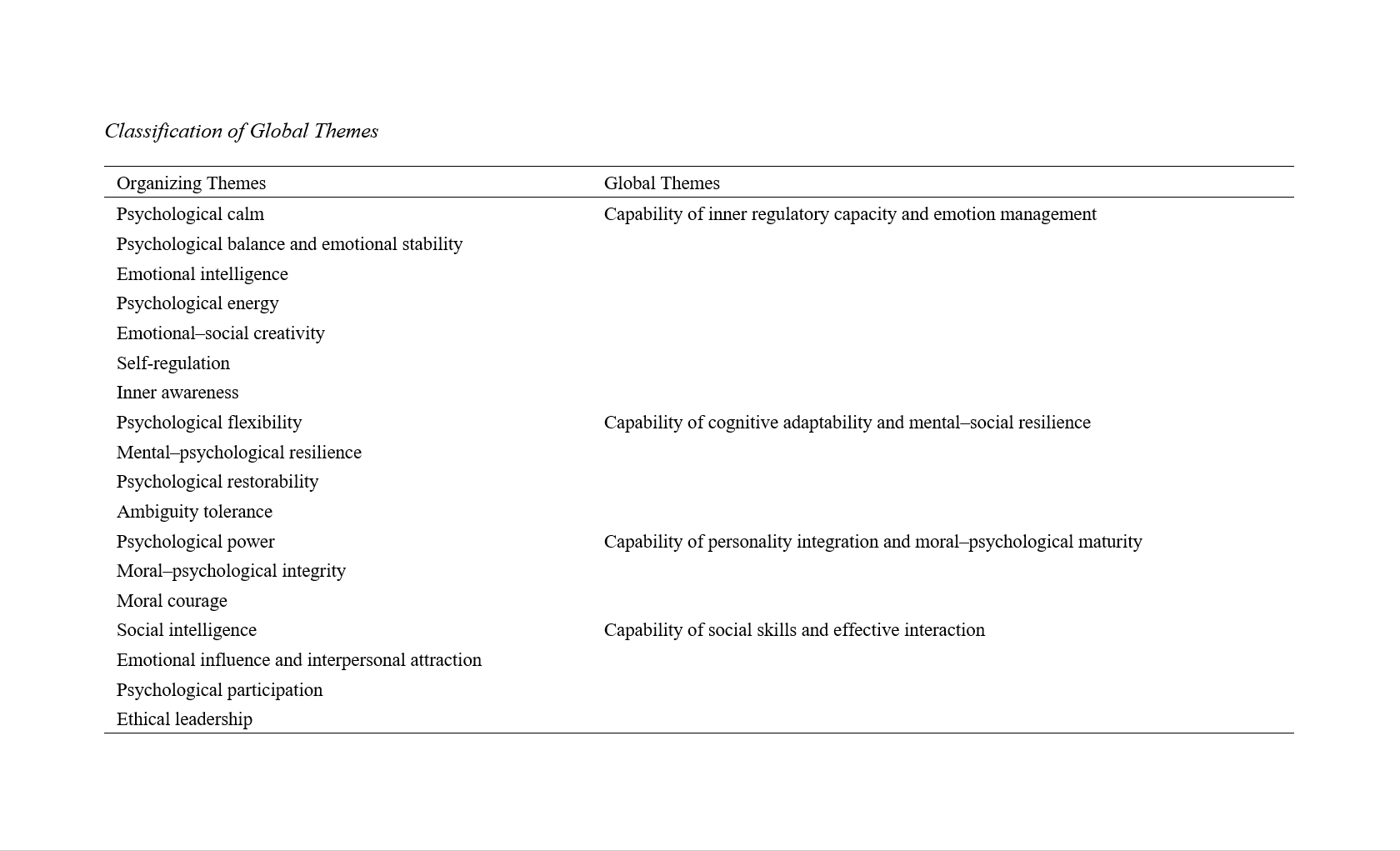
Findings: The analysis resulted in the identification of 94 basic themes, which were clustered into 17 organizing themes and ultimately integrated into four global dimensions of managers’ psychological capability. These dimensions included: (1) the capability of inner regulatory capacity and emotion management, (2) the capability of cognitive adaptability and mental–social resilience, (3) the capability of personality integration and moral–psychological maturity, and (4) the capability of social skills and effective interaction. The findings indicate that managers’ psychological capability is a multidimensional and integrative construct that encompasses emotional regulation, cognitive flexibility, ethical coherence, resilience, and relational effectiveness, all of which jointly shape managerial functioning in public organizations.
Conclusion: The study concludes that managers’ psychological capability represents a holistic psychological framework that underpins effective leadership in public organizations and extends beyond isolated constructs such as empowerment or psychological safety. By offering an empirically grounded and context-sensitive model, the findings provide a robust foundation for leadership development, managerial selection, and organizational policy aimed at enhancing psychological effectiveness and sustainable performance in the public sector.
Downloads
References
Abas, B., Bukhari, S. A., Farrukh, M., & Iqbal, S. (2024). Examining the Socio-Psychological Dynamics of Interpersonal and Organizational Deviances: The Moderating Influence of Interpersonal Justice and Perceived Organizational Support. Leadership & Organization Development Journal, 45(6), 935-953. https://doi.org/10.1108/lodj-07-2023-0350
Adekanmbi, F. P., Ilesanmi, O. A., & Ogunyemi, K. (2023). The impacts of perceived leadership integrity, psychological safety, and organizational culture in sustaining employee voice. Journal of Management Development, 42(5), 345-362. https://ujcontent.uj.ac.za/esploro/outputs/journalArticle/The-impacts-of-perceived-leadership-integrity/9933410007691
Ahmed, S., & Khan, M. A. (2023). Leader-member exchange and employee voice behavior: The mediating role of psychological safety. Public Organization Review, 23(3), 987-1004.
Al Otaibi, S. M., Amin, M., Winterton, J., Bolt, E. E. T., & Cafferkey, K. (2023). The role of empowering leadership and psychological empowerment on nurses' work engagement and affective commitment. International Journal of Organizational Analysis, 31(6), 2536-2560. https://doi.org/10.1108/IJOA-11-2021-3049
Alwali, J. (2024). Innovative work behavior and psychological empowerment: the importance of inclusive leadership on faculty members in Iraqi higher education institutions. Journal of Organizational Change Management, 37(2), 374-390. https://doi.org/10.1108/JOCM-03-2023-0084
Dai, X.-X., & Fang, Y. (2023). Does Inclusive Leadership Affect the Organizational Socialization of Newcomers From Diverse Backgrounds? The Mediating Role of Psychological Capital. Frontiers in psychology, 14. https://doi.org/10.3389/fpsyg.2023.1138101
Huyghebaert-Zouaghi, T., Gillet, N., Fernet, C., Thomas, J., & Ntoumanis, N. (2023). Managerial predictors and motivational outcomes of workers' psychological need states profiles: A two-wave examination. European Journal of work and organizational psychology, 32(2), 216-233. https://doi.org/10.1080/1359432X.2022.2127354
Ibnis Shaid Bin Abdul, R., Singh, S. S. B., Taat, M. S., & Mosin, M. B. (2024). Exploring the Effect of Inclusive Leadership on Psychological Distress Through Organizational Climate Mediation and Moderation. Humanities and Social Sciences Letters, 12(2), 425-442. https://doi.org/10.18488/73.v12i2.3787
Joshy, L., & Varghese, R. (2024). Unveiling the mechanisms by which inclusive leadership influences the good soldier syndrome among health-care employees. Leadersh Health Serv (Bradf Engl), ahead-of-print(ahead-of-print). https://doi.org/10.1108/lhs-11-2023-0089
Khomideh, K., Rangriz, H., Khastar, H., & Kheirandish, M. (2022). Redesigning the Selection and Appointment Model for Social Security Organization Managers Based on Competency Models Using a Grounded Theory Approach. Psychological Science Quarterly, 21(118), 1943-1956. https://doi.org/10.52547/JPS.21.118.1943
Kim, S. Y., & Kwak, W. J. (2022). Effect of Inclusive Leadership on Organizational Citizenship Behavior in the Military Organization: The Mediating Effect of Psychological Safety and Moderating Effect of Tenure. Korean Academy of Leadership, 13(3), 69-104. https://doi.org/10.22243/tklq.2022.13.3.69
Kranthi, A. K., Rai, A., & Showry, M. (2024). Linking resonant leadership and learning organizations: The role of psychological empowerment as a mediator in faculty members among higher educational institutions in India. Acta Psychologica, 248, 104365. https://doi.org/10.1016/j.actpsy.2024.104365
Mehdizadeh, I., Rajaeepor, S., & Siadat, S. A. (2023). Organizational Silence and Positive Leadership Strategies: The Mediating Role of Psychological Empowerment. Journal of Public Administration, 15(1), 67-93. https://www.sid.ir/paper/1093221/fa
Peymannia, B. (2022). Matrix Model Effectiveness in Job Burnout and Organizational Commitment of Managers of Ahvaz electric Power Distribution Company. Psychological Achievements, 29(2), 171-188. https://doi.org/10.22055/psy.2022.40620.2837
Pourdavood, M. R., & Aghighi, A. (2023). The Effect of Humble Leadership on Organizational Performance with the Mediating Role of Psychological Empowerment and Innovative Work Behavior. Proceedings of the Seventeenth International Conference on Management, Economics, and Development, Tehran.
Rahmani, I., & Ghanbari, S. (2024). The effect of toxic leadership on the creation of organizational trauma with the mediating role of organizational cynicism among middle and high school teachers. Psychological Achievements, 31(1), 231-252.
Rastgar, A. A., & Hasani, H. (2023). Investigating the Mediating Role of Benevolent Rule-Breaking and Leader-Follower Exchange in the Impact of Ethical Leadership on Employees' Intent to Leave (Case Study: Social Security Organization of Tehran). Psychological Research in Management, 9(2), 203-223. https://www.google.com/url?sa=t&source=web&rct=j&opi=89978449&url=https://civilica.com/doc/1900306/&ved=2ahUKEwjCrIWIktaOAxWLcKQEHbuxKNoQFnoECBgQAQ&usg=AOvVaw34lr73u9p7L42W_QQNzmVO
Rezazadeh Taloukolaei, F., Zameni, F., & Enayati, T. (2024). Identifying the Dimensions and Components of Good Governance and Organizational Development at Mazandaran University of Medical Sciences [Research Article]. Iranian Journal of Educational Sociology, 7(1), 113-123. https://doi.org/10.61838/kman.ijes.7.1.11
Sepahvand, R., Fathi Chegeni, F., & Azimi, H. (2022). The Effect of Positive Leadership on Organizational Whistleblowing Via the Mediation of Psychological Intimidation. Journal of Development of Logistics and Human Resource Management, 17(63), 1-26. https://www.noormags.ir/view/fa/articlepage/1866037
Shams, A., Jannesar Ahmadi, H., & Rajabi, M. (2023). Investigating the impact of organizational health on job satisfaction with the mediating role of organizational commitment in the National Petroleum Products Distribution Company of Mashhad. Psychological Researches in Management, 9(1), 119-138. https://doi.org/10.22034/jom.2023.703856
Siyal, S. (2023). Inclusive Leadership and Work Engagement: Exploring the Role of Psychological Safety and Trust in Leader in Multiple Organizational Context. Business Ethics the Environment & Responsibility, 32(4), 1170-1184. https://doi.org/10.1111/beer.12556
Xing-gui, Z., Lin, Z., Chen, X., Zhang, Z., & Liu, D. M. (2023). Leader–follower Congruence In psychological Capital: Effects on LMX and Turnover Intention. Leadership & Organization Development Journal, 44(4), 489-502. https://doi.org/10.1108/lodj-09-2020-0419
Zafar, H., Cheah, J. H., Ho, J. A., Suseno, Y., & Tian, F. (2025). How green servant leadership influences organizational green performance? The roles of employee green creativity, voluntary pro-environmental behavior and green psychological climate. Personnel Review, 54(4), 971-995. https://doi.org/10.1108/PR-10-2023-0843
Zahed Babolan, A., Abdolahzadeh, M., & Esmaeili, M. (2023). A Meta-analysis of the Antecedents and Consequences of Organizational Socialization in Iranian Educational Organizations. Sociology of Education, 10(1), 214-223. https://doi.org/10.22034/ijes.2023.2006997.1439
Downloads
Additional Files
Publication Timeline
- Submitted
- Revised
- Accepted