
Predicting Purchase Intention Based on Salesperson Behavior, Social Utility, Psychological Utility, and Economic Utility
DOI:
https://doi.org/10.61838/kman.ijimob.5058Keywords:
Purchase intention, salesperson behavior, social utility, psychological utility, economic utilityAbstract
Objective: The objective of this study was to predict consumers’ purchase intention based on salesperson behavior, economic utility, social utility, and psychological utility.
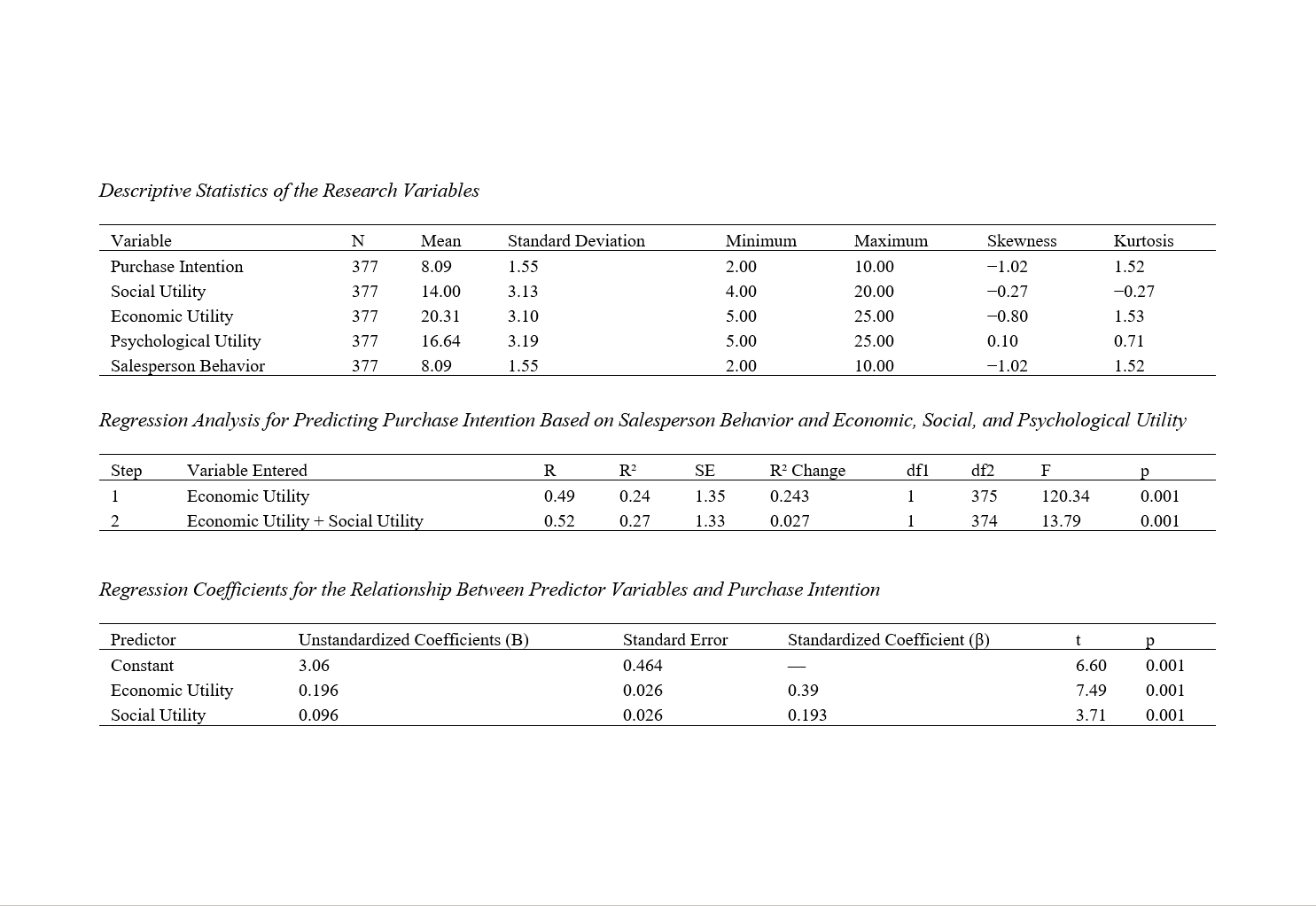
Methods and Materials: This applied study employed a descriptive–correlational design and was conducted using a cross-sectional survey method. The statistical population consisted of consumers who completed online questionnaires during May and June 2025. A total of 377 valid questionnaires were analyzed after excluding incomplete responses. Data collection instruments included researcher-developed questionnaires measuring purchase intention, salesperson behavior, economic utility, social utility, and psychological utility, all assessed on five-point Likert scales. Content validity was confirmed by subject-matter experts, and reliability was evaluated using Cronbach’s alpha. Data analysis was carried out using SPSS version 26, applying Pearson correlation analysis and stepwise multiple regression to examine the predictive relationships among variables.
Findings: Inferential analyses indicated that purchase intention was positively and significantly correlated with salesperson behavior, economic utility, social utility, and psychological utility (p ≤ .01). Stepwise multiple regression analysis showed that economic utility entered the regression model in the first step and explained 24% of the variance in purchase intention (p = .001). In the second step, social utility entered the model and, together with economic utility, explained 27% of the variance in purchase intention (p = .001). Psychological utility and salesperson behavior did not retain significant predictive power in the final regression model.
Conclusion: The findings demonstrate that consumers’ purchase intention is primarily driven by economic utility and, to a lesser extent, social utility, highlighting the dominant role of cost–benefit evaluations and social value considerations in purchase decision-making. These results suggest that while psychological benefits and salesperson behavior are important correlates, their influence on purchase intention may be indirect and mediated through perceived value dimensions.
Downloads
References
Aly, A. S., & Al-Salfiti, A. (2025). Linking Consumption Values to Green Purchase Intention: Evidence from Emerging Economies. Sustainability, 17(22), 10109-10109. https://doi.org/10.3390/su172210109
Azizi, S., & Azmayesh Fard, H. (2023). A Review of the Analysis and Evolution of Consumer Behavior Theories. Commercial Surveys, 20(117), 119-137. https://doi.org/10.22034/bs.2022.548580.249
Carvalho, J. M. S., & Sousa, C. A. A. (2018). Is Psychological Value a Missing Building Block in Societal Sustainability? Sustainability, 10(12), 4550-4550. https://doi.org/10.3390/su10124550
Dehghanizadeh, M., & Akbari pour, Z. (2021). The Impact of Identity and Social Influence on Perceived Value and Intention of Purchasing Organic Products and Moderating Effect of Consumer Innovative; Case study: Consumers of Organic Products in Karaj. Consumer Behavior Studies Journal, 8(2), 156-175. https://doi.org/10.34785/J018.2021.359
Escalas, J. E., & Bettman, J. R. (2005). Self-construal, reference groups, and brand meaning. Journal of Consumer Research, 32(3), 378-389. https://doi.org/10.1086/497549
Firlyani, R., & Millanyani, H. (2025). The impact of utilitarian, hedonic, and social value on purchase intention through customer trust in live streaming: A study of Wardah beauty products on TikTok. International Journal of Science, Technology & Management, 6(4), 636-643. https://doi.org/10.46729/ijstm.v6i4.1319
Gaur, H., Singhal, H., & Batra, A. (2025). The role of psychological, technological, and societal drivers in shaping consumer buying behaviour: Insights into social media influence and cultural trends. International Journal of Advanced Research, 13(7), 112-120. https://doi.org/10.21474/IJAR01/21316
Ghorbanimehr, M. (2024). The Impact of Emotional Intelligence on Salesman Behavior and Perceived Service Quality. Journal of Resource Management and Decision Engineering, 3(4), 47-56. https://doi.org/10.61838/kman.jrmde.3.4.6
Hosseini, M. H. (2013). The Explain of Evaluation of Customers Willing and Loyalty to Buy in Online Shops. Journal of Strategic Management Studies, 3(12), 167-188. https://www.smsjournal.ir/article_88834.html?lang=en
Kazemi, F., & Yazdani, N. (2022). Willingness to Purchase Domestic Household Appliance Brands in Iran and the Impact of Global Identity on Perceived Quality, with a Focus on the Role of Consumers. Commercial Strategies, 19(19), 62-82. https://doi.org/10.22070/CS.2023.17413.1287
Kim, H. M., Lee, I. H., Joo, K., Lee, J., & Hwang, J. (2022). Psychological Benefits of Purchasing Home Meal Replacement in the Context of Eco-Friendly TV Home Shopping Broadcast: The Moderating Role of Personal Norm. International journal of environmental research and public health, 19(13), 7759. https://doi.org/10.3390/ijerph19137759
Lei, T. (2023). A Study of the Influence of Consumer Perceived Value on the Purchase Intention of New Energy Vehicle Consumers by Taking the Degree of Involvement as the Moderating Variable. International Journal of Sociologies and Anthropologies Science Reviews, 3(2), 197-208. https://doi.org/10.14456/jsasr.2023.28
Li, Y., & Sun, M. (2025). The impact of perceived interactivity on purchase intention in interactive video: A CAB-based chain mediation model of empathy, immersion, and arousal. Frontiers in Communication, 10(?), 1615509-1615509. https://doi.org/10.3389/fcomm.2025.1615509
Liu, H. (2021). Perceived value dimension, product involvement and purchase intention for intangible cultural heritage souvenir. American Journal of Industrial and Business Management, 11(1), 76-91. https://doi.org/10.4236/ajibm.2021.111006
Liu, X., Kim, T. H., & Lee, M. J. (2025). The Impact of Green Perceived Value Through Green New Products on Purchase Intention: Brand Attitudes, Brand Trust, and Digital Customer Engagement. Sustainability, 17(9), 4106-4106. https://doi.org/10.3390/su17094106
Luo, B., Li, L., & Sun, Y. (2021). Understanding the influence of consumers' perceived value on energy-saving products purchase intention. Frontiers in psychology, 12(1), 640376-640376. https://doi.org/10.3389/fpsyg.2021.640376
Miryousefi, S. J., Nejad sajadi, S. A., & Zarkuipour, Y. (2024). Investigating the Role of Cultural-Social Factors on Experiential Marketing and the Purchase Intention of Athletes. Applied Research of Sport Management, 13(3), 65-80. https://doi.org/10.30473/ARSM.2024.68463.3783
Napitupulu, S. A., Setiawan, B., Rayesa, N., Haryati, N., & Rohman, A. A. (2025). Decoding Organic Food Buying Intention: The Interplay of Health Consciousness and Perceived Value Among Urban Consumers in Malang. HABITAT, 36(2), 166-180. https://doi.org/10.21776/ub.habitat.2025.036.2.14
Ong, A. K. S., Prasetyo, Y. T., Vallespin, B. E., Persada, S. F., & Nadlifatin, R. (2022). Evaluating the influence of service quality, hedonic, and utilitarian value on shopper's behavioral intentions in urban shopping malls during the COVID-19 pandemic. Heliyon, 8(12), e12542. https://doi.org/10.1016/j.heliyon.2022.e12542
Othman, N. A. (2025). Does frontline employee friendliness during service delivery still matter in the current era? Revisiting its dimensionality effects on brand outcome. Journal of Brand Management, 32(?), 315-327. https://doi.org/10.1057/s41262-025-00384-1
Pak, P., & Khosravipour, B. (2024). Investigating the economic, social, environmental and technical usefulness of pressurized irrigation patterns compared to common irrigation from the point of view of users (case study: farmers of Behbahan city). Geography and Human Relationships, 7(2), 158-178. https://doi.org/10.22034/gahr.2024.478112.2268
Reisch, L. A., & Zhao, M. (2017). Behavioural economics, consumer behaviour and consumer policy: state of the art. Behavioural Public Policy, 1(2), 190-206. https://doi.org/10.1017/bpp.2017.1
Rohman, A. A., Asmara, R., & Andriani, D. R. (2023). The effect of multidimensional consumer perceived value on customer satisfaction and purchase intention of organic food. HABITAT, 34(2), 213-224. https://doi.org/10.21776/ub.habitat.2023.034.2.19
Salah, P., Asfahani, A. M., & AlRajhi, F. H. (2024). The Effect of Perceived Value on Intention to Purchase Pre-Loved Luxury Fashion Products. Sustainability, 16(23), 10426-10426. https://doi.org/10.3390/su162310426
Wang, P., Kuah, A. T. H., Lu, Q., Wong, C. Y., Persaud, A., & Kendall, W. (2021). The impact of value perceptions on purchase intention of sustainable luxury brands in China and the UK. Journal of Brand Management, 28(3), 325-346. https://doi.org/10.1057/s41262-020-00228-0
Zauner, A., Koller, M., & Hatak, I. (2015). Customer perceived value-Conceptualization and avenues for future research. Cogent Psychology, 2(1), 1-1. https://doi.org/10.1080/23311908.2015.1061782
Downloads
Additional Files
Publication Timeline
- Submitted
- Revised
- Accepted