A Deep Learning Framework for Modeling the Impact of Transformational Leadership and Organizational Climate on Continuous Innovation Capability
DOI:
https://doi.org/10.61838/kman.ijimob.5065Keywords:
Transformational Leadership, Organizational Climate, Continuous Innovation Capability, Deep Learning, Organizational Innovation, Artificial Intelligence in ManagementAbstract
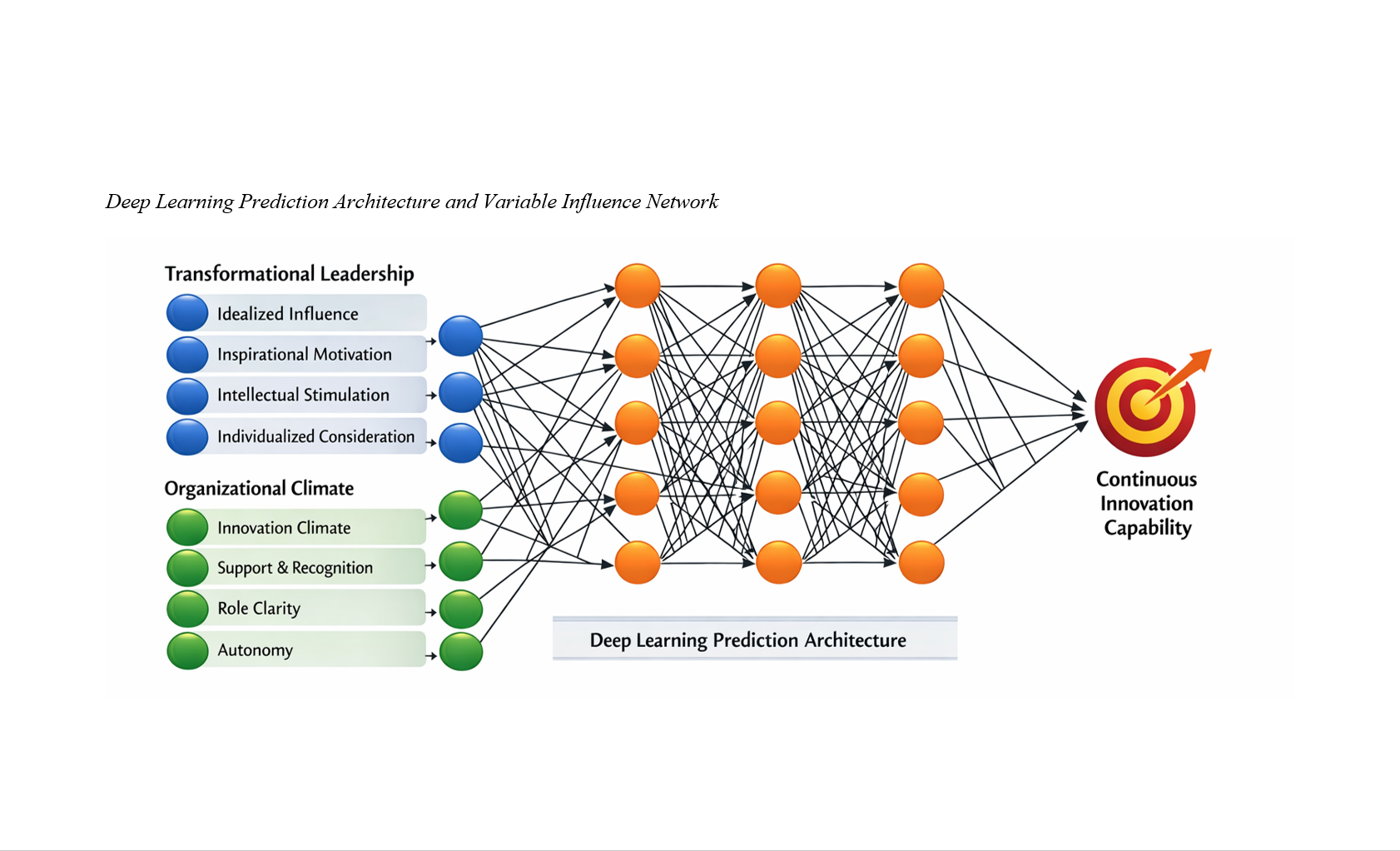
Objective: The objective of this study was to develop and validate a deep learning model capable of explaining and predicting the combined effects of transformational leadership and organizational climate on continuous innovation capability within organizational settings.
Methods and Materials: The study employed a quantitative cross-sectional design using data collected from 684 full-time employees and managers working in medium-to-large organizations in Germany. Transformational leadership was measured using the Multifactor Leadership Questionnaire, organizational climate was assessed through a standardized organizational climate scale, and continuous innovation capability was captured using a multidimensional innovation capability instrument. After establishing construct validity and reliability through confirmatory factor analysis, the dataset was analyzed using a deep neural network implemented with TensorFlow and Keras. Data were split into training, validation, and test sets (70–15–15). Model optimization employed Bayesian hyperparameter tuning, and performance was evaluated using mean squared error, root mean squared error, coefficient of determination, and prediction accuracy. Model interpretability was enhanced using SHAP analysis and permutation feature importance techniques.
Findings: Inferential results demonstrated strong predictive performance of the deep learning model (R² = .89 training, .87 validation, .86 test; prediction accuracy = 90.4% on test set). Transformational leadership and organizational climate jointly explained a substantial proportion of variance in continuous innovation capability. Feature importance analysis revealed inspirational motivation and innovation-oriented climate as the most influential predictors, followed by intellectual stimulation and supportive climate. The deep neural network significantly outperformed random forest, gradient boosting, and multiple regression models.
Conclusion: The findings confirm that continuous innovation capability is governed by complex, non-linear interactions between transformational leadership and organizational climate and that deep learning provides a superior analytical framework for modeling these dynamics, offering substantial theoretical and practical implications for innovation management.
Downloads
References
Afrianda, R., Zainal, V. R., Siswanti, I., & Nawangsari, L. C. (2023). Strategic Organizational Performance in Electric Power Company in Indonesia. Al Qalam Jurnal Ilmiah Keagamaan Dan Kemasyarakatan, 17(3), 2172. https://doi.org/10.35931/aq.v17i3.2153
Amelia, U. (2025). Transformational Leadership, Self-Efficacy, Organizational Climate on Innovative Behavior in Indonesia. Cana, 32(8s), 709-723. https://doi.org/10.52783/cana.v32.3768
Amin, N. U., & Khan, M. A. (2024). Driving Competitive Advantage in the Digital Era: The Role of Dynamic Capabilities, Innovation, and Leadership. Dinasti International Journal of Economics Finance & Accounting, 5(5), 5500-5514. https://doi.org/10.38035/dijefa.v5i5.3873
Bornay‐Barrachina, M., Cabrales, Á. L., & Salas‐Vallina, A. (2023). Sensing, Seizing, and Reconfiguring Dynamic Capabilities in Innovative Firms: Why Does Strategic Leadership Make a Difference? BRQ Business Research Quarterly, 28(2), 399-420. https://doi.org/10.1177/23409444231185790
Calen, C., Tarigan, S. A., Rosita, R., Susanto, S., & Alimin, E. (2021). The Role of Transformational Leadership, Leader Member Exchange, Digital Transformation on Organizational Citizenship Behaviour and Work Innovation Capabilities in During Covid-19 Pandemic. Jppi (Jurnal Penelitian Pendidikan Indonesia), 7(2), 203-216. https://doi.org/10.29210/020211163
Chen, C., & Ali, K. S. (2025). Advancing Sustainable Innovation: The Role of Transformational Leadership and Organizational Innovation Climate in Shaping the Innovative Behavior of Knowledge-Based Employees in High-Tech Enterprises in China. Sustainability, 17(17), 7931. https://doi.org/10.3390/su17177931
Farlina, S., Wonua, A. R., & Ismanto, I. (2023). Pengaruh Gaya Kepemimpinan Transformasional Dan Iklim Organisasi Terhadap Kapabilitas Inovasi Organisasi PDAM Tirta Dharma Kabupaten Kolaka. Jimak, 3(3), 40-50. https://doi.org/10.55606/jimak.v3i3.2138
Gui, L., Lei, H., & Le, P. B. (2021). Determinants of Radical and Incremental Innovation: The Influence of Transformational Leadership, Knowledge Sharing and Knowledge-Centered Culture. European Journal of Innovation Management, 25(5), 1221-1241. https://doi.org/10.1108/ejim-12-2020-0478
Gui, L., Lei, H., & Le, P. B. (2022). Fostering Product and Process Innovation Through Transformational Leadership And knowledge Management Capability: The Moderating Role Of innovation Culture. European Journal of Innovation Management, 27(1), 214-232. https://doi.org/10.1108/ejim-02-2022-0063
Hamidah, O. D., & Antonio, T. (2025). The Influence of Transformational Leadership and Shared Leadership on Innovative Work Behavior Among Generation Z Employees in the Creative Industry in Surabaya: The Role of Organizational Climate as a Mediating Variable. Dinasti International Journal of Education Management and Social Science, 6(4), 3223-3234. https://doi.org/10.38035/dijemss.v6i4.4415
Harsono, T. W., Hidayat, K., Iqbal, M., & Abdillah, Y. (2024). Exploring the Effect of Transformational Leadership and Knowledge Management in Enhancing Innovative Performance: A Mediating Role of Innovation Capability. Journal of Manufacturing Technology Management, 36(1), 227-250. https://doi.org/10.1108/jmtm-03-2024-0125
Indriani, E., Widhianingrum, W., & Setiawan, F. (2024). The Role of Transformational Leadership Style, Work Motivation and Organizational Climate in Its Influence on Innovative Work Productivity. Sentralisasi, 13(2), 202-219. https://doi.org/10.33506/sl.v13i2.3200
Kyeong, K. (2025). Do Transformational Leadership and Innovative Climate Always Enhance Employees’ Innovative Behavior? Focusing on the Moderated Mediating Role of Innovative Climate on Change-Oriented Organizational Citizenship Behavior. Public Personnel Management. https://doi.org/10.1177/00910260251325269
Liaqat, M. M., Rehman, S.-U., & Ullah, H. A. (2024). The Impact of Transformational Leadership and Digital Literacy on Innovation Capability: Mediating Role of Organizational Culture for Innovation. Gomal University Journal of Research, 42(2), 134-145. https://doi.org/10.51380/gujr-40-02-0
Loeis, M., Hubeis, M., Suroso, A. I., & Dirdjosaputro, S. (2023). Leadership Types in Support of Creativity and Innovation Within Video Game Studios in Indonesia. Jurnal Aplikasi Bisnis Dan Manajemen, 9(2), 455. https://doi.org/10.17358/jabm.9.2.455
Noveriansyah, M., Rustandi, T., & Suadma, U. (2024). Enhancing Product Innovation: The Impact of Transformational Leadership Mediated by Organizational Climate and Knowledge Sharing. Journal of Tourism Economics and Policy, 4(4), 418-429. https://doi.org/10.38142/jtep.v4i4.1151
Paijan. (2025). Exploring the Existence of Innovative Work Behavior Among Government Employees in Meruya Selatan Sub-District. Dinasti International Journal of Economics Finance & Accounting, 6(4), 3245-3257. https://doi.org/10.38035/dijefa.v6i4.5012
Puni, A., Hilton, S. K., Mohammed, I., & Korankye, E. S. (2022). The Mediating Role of Innovative Climate on the Relationship Between Transformational Leadership and Firm Performance in Developing Countries: The Case of Ghana. Leadership & Organization Development Journal, 43(3), 404-421. https://doi.org/10.1108/lodj-10-2020-0443
Rahman, S. H. W., Asmony, T., & Nurmayanti, S. (2023). The Influence of Transformational Leadership and Organizational Climate on Work Motivation and Innovative Work Behavior at the Department of Population and Civil Registration of East Lombok Regency. Jurnal Sosial Ekonomi Dan Humaniora, 9(2), 181-190. https://doi.org/10.29303/jseh.v9i2.365
Sandhu, M., & Naqbi, A. A. (2022). Leadership Behavior and Innovation Performance in the UAE's Telecom and ICT Industries. Benchmarking an International Journal, 30(5), 1695-1712. https://doi.org/10.1108/bij-10-2021-0599
Sauda Salim Hamdun Al, M., Makhbul, Z. K. M., & Sinniah, S. (2025). The Role of Digital Leadership Capability and Organizational Culture on Innovation Ecosystems in Omani E-Commerce Stores. 249-280. https://doi.org/10.4018/979-8-3693-8171-7.ch009
Shahzad, M. A., Chen, S., Wang, X., Li, Z., & Iqbal, T. (2025). Impact of GHRM and Innovation Capabilities on Organizational Performance: The Role of Digital Transformation and Green Leadership. Journal of Manufacturing Technology Management, 1-28. https://doi.org/10.1108/jmtm-11-2024-0639
Sim, H., & Oh, S. (2023). The Effect of Digital Transformation Leadership on Innovative Behaviors: The Mediating Effect of Organizational Dynamic Capabilities and Moderation Effect of Manager's Coaching Behaviors. Korean Academy of Leadership, 14(4), 105-134. https://doi.org/10.22243/tklq.2023.14.4.105
Sơn, T. T., Le, P. B., & Loan, B. T. T. (2020). Transformational Leadership and Knowledge Sharing: Determinants of Firm’s Operational and Financial Performance. Sage Open, 10(2). https://doi.org/10.1177/2158244020927426
Theng, B. P., Wijaya, E., Juliana, J., Eddy, E., & Putra, A. S. (2021). The Role of Transformational Leadership, Servant Leadership, Digital Transformation on Organizational Performance and Work Innovation Capabilities in Digital Era. Jppi (Jurnal Penelitian Pendidikan Indonesia), 7(2), 225-238. https://doi.org/10.29210/020211164
Tran, M. N. (2025). Fostering Organizational Innovation Capability Through Transformational Leadership and Creativity in Public Educational Institutions: Moderating Roles of AI-enabled Job Complexity and Innovation Climate. International Journal of Educational Management, 1-17. https://doi.org/10.1108/ijem-12-2024-0851
XiaoYan, Z. (2023). Study on the Impact Mechanism of Transformational Leadership on Employee Innovative Behavior. Ijisss, 1(1), 12-20. https://doi.org/10.62309/7p8rme49
Yu, J., & Xiang, K. (2024). Transformational Leadership, Organizational Resilience, and Team Innovation Performance: A Model for Testing Moderation and Mediation Effects. Behavioral Sciences, 15(1), 10. https://doi.org/10.3390/bs15010010
Downloads
Additional Files
Publication Timeline
- Submitted
- Revised
- Accepted