Predicting Open Innovation Success from Trust Networks, Communication Density, and Collaborative Behaviors Using Graph Neural Networks
DOI:
https://doi.org/10.61838/kman.ijimob.5068Keywords:
Open innovation, trust networks, communication density, collaborative behaviors, graph neural networks, organizational networksAbstract
Objective: The objective of this study was to develop and validate a graph neural network model for predicting open innovation success based on trust networks, communication density, and collaborative behaviors in Nigerian organizations.
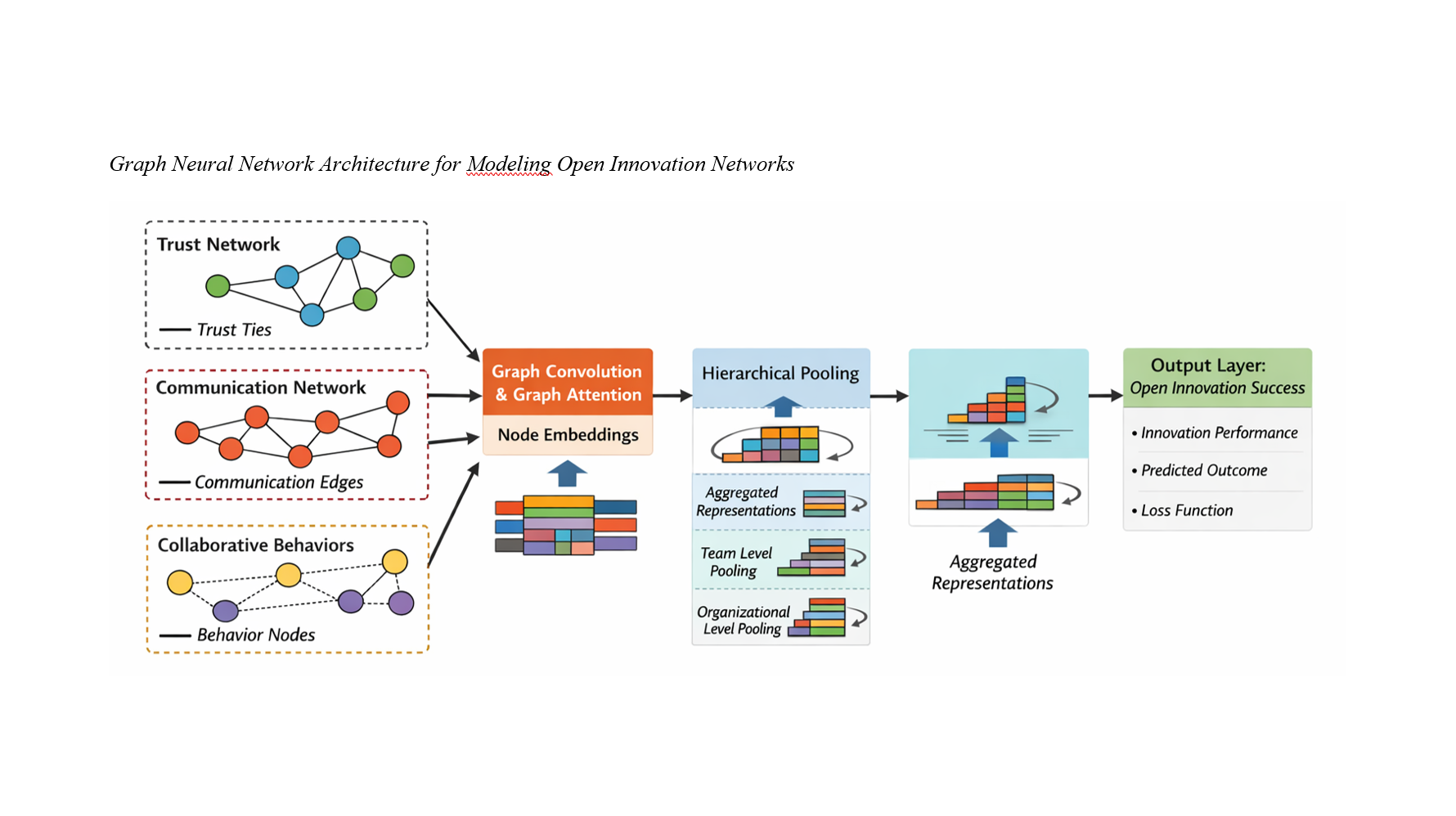
Methods and Materials: This study employed a quantitative, cross-sectional research design involving 487 professionals from innovation-intensive organizations in Nigeria across the technology, manufacturing, finance, telecommunications, and energy sectors. Data were collected using validated instruments measuring inter-organizational trust, communication density, and collaborative behaviors, combined with objective network data extracted from organizational collaboration platforms. Multilayer networks were constructed in which nodes represented individuals and edges represented trust relations, communication ties, and collaborative interactions. A graph neural network architecture integrating graph convolutional and attention mechanisms was trained to predict open innovation success. Model performance was evaluated using root mean squared error, mean absolute error, and explained variance, and results were compared against baseline machine learning models.
Findings: The graph neural network demonstrated strong predictive performance (R² = 0.82, RMSE = 0.31, MAE = 0.24), significantly outperforming gradient boosting (R² = 0.64), random forest (R² = 0.61), and support vector regression (R² = 0.58). Explainability analysis revealed that trust networks exerted the strongest influence on innovation success (importance weight = 0.41), followed by collaborative behaviors (0.30) and communication density (0.29). Multilevel network analysis showed that team-level structures had the largest standardized effect on innovation success (β = 0.44, p < 0.001), followed by individual-level (β = 0.36, p < 0.001) and organizational-level networks (β = 0.28, p < 0.001).
Conclusion: The findings demonstrate that open innovation success is primarily driven by the structure and quality of relational networks, and that graph neural networks provide a powerful and superior framework for modeling innovation outcomes within complex organizational ecosystems.
Downloads
References
Andrade, B. B. (2025). Givers and Takers in Science: Thriving Through Genuine Collaboration and Lasting Success. Journal of Evidence-Based Healthcare, 7, e6098. https://doi.org/10.17267/2675-021xevidence.2025.e6098
Arfita, S., Valentina, T. R., & Putera, R. E. (2024). Collaborative Governance in Nagari Development in Nagari Tigo Balai, Matur District. Jakpp (Jurnal Analisis Kebijakan & Pelayanan Publik), 133-149. https://doi.org/10.31947/jakpp.v9i2.26374
Burrell, D. N., Mullins, C. D., & Enobun, B. (2025). Beyond Transactional Relationships in Community-Based Participatory Healthcare Research. Hem, 6(2), 17-31. https://doi.org/10.61093/hem.2025.2-02
Carvalho, M. A., & Ivanoski, C. G. (2023). Sustainable Innovative Cities: Reflections on the Structuring Aspects of Urban Management. 298-307. https://doi.org/10.29183/2596-237x.ensus2023.v11.n1.p298-307
Cassanego, P., & Cristiane Ferreira de Souza, A. (2024). Social Networks Analysis: A Study on the Linkage of Relations and the Hierarchy in the Public Sector. https://doi.org/10.56238/sevened2024.014-013
Chen, L., Teirlinck, P., Niu, R., & Xie, G. (2025). Benefiting From Social Groups: Managerial Network Communities and Corporate Collaborative Innovation. Entrepreneurship Research Journal, 15(3), 487-517. https://doi.org/10.1515/erj-2023-0457
Cunningham, F., Potts, B. A., Ramanathan, S., Bailie, J., Bainbridge, R., Searles, A., Laycock, A., & Bailie, R. (2022). Network Evaluation of an Innovation Platform in Continuous Quality Improvement in Australian Indigenous Primary Health Care. https://doi.org/10.21203/rs.3.rs-1698571/v1
Gondal, N. (2023). Diffusion of Innovations Through Social Networks: Determinants and Implications. Sociology Compass, 17(5). https://doi.org/10.1111/soc4.13084
Grant, O. (2024). The Role of Trust and Communication in Supplier Relationship Management Within the E-Commerce Sector. https://doi.org/10.20944/preprints202407.1199.v1
Ibeku, S., & Nwagwu, W. E. (2024). Innovative Culture, Innovative Behaviour, Social Capital and Performance of Small and Medium ICT Enterprises in Lagos, Nigeria. Information Development. https://doi.org/10.1177/02666669241266819
Ivanoski, C. G., & Carvalho, M. (2023). Uma Estrutura De Gestão Urbana Para Cidades Inovadoras Sustentáveis. Impact, 2(1), 221-230. https://doi.org/10.59279/impact.v2i1.2275
K, K. (2025). Structural and Functional Dynamics of Virtual Organizational Networks - Insights From Network Theory. Journal of Computer and Communication Networks, 084-095. https://doi.org/10.64026/jccn/2025009
Liang, L., & Li, Y. (2023). The Impact of Digital Empowerment on Open Innovation Performance of Enterprises From the Perspective of SOR. Frontiers in psychology, 14. https://doi.org/10.3389/fpsyg.2023.1109149
Liu, Y., Liu, D., Wang, W., & Yu, C. (2024). Situational Awareness and Intelligence Mining in National Security Research Based on Complex Network Models. International Journal of Modern Physics C, 36(10). https://doi.org/10.1142/s0129183124420099
Mariam, S. (2025). Exploring Collaboration and Partnerships: A Qualitative Study on Strategic Alliances and Business Networking for Value Creation. Golden Ratio of Marketing and Applied Psychology of Business, 5(2), 386-399. https://doi.org/10.52970/grmapb.v5i2.1170
McPhillips, M., Ņikitina, T., Tegtmeier, S., & Wójcik, M. (2022). What Skills for Multi-Partner Open Innovation Projects? Open Innovation Competence Profile in a Cluster Ecosystem Context. Sustainability, 14(20), 13330. https://doi.org/10.3390/su142013330
Mehmood, S. (2025). Influence of Leadership Styles (Transformational/ Paradoxical Leadership) on Supply Chain Collaboration; Mediating Role of Trust. ACADEMIA International Journal for Social Sciences, 4(4), 3413-3423. https://doi.org/10.63056/acad.004.04.1191
Munawaroh, M. S. A., Rugaiyah, R., & Susanto, T. T. D. (2025). Collaboration and Creativity: How Interpersonal Communication and Knowledge Sharing Shape Innovative Work Behavior. Multidisciplinary Science Journal, 8(1), 2026019. https://doi.org/10.31893/multiscience.2026019
Niwagaba, T. (2025). Building Trust and Transparency in Educational Management. Roje, 5(1), 9-13. https://doi.org/10.59298/roje/2025/51913
Nunes, M., Abreu, A., Bagnjuk, J., Nunes, E., & Saraiva, C. (2022). A Strategic Process to Manage Collaborative Risks in Supply Chain Networks (SCN) to Improve Resilience and Sustainability. Sustainability, 14(9), 5237. https://doi.org/10.3390/su14095237
Rakhmaniar, A. (2023). Dinamika Komunikasi Nonverbal Dalam Interaksi Sosial Di Lingkungan Kerja. Tuturan Jurnal Ilmu Komunikasi Sosial Dan Humaniora, 1(3), 285-297. https://doi.org/10.47861/tuturan.v1i3.1121
Reynolds, S. (2024). Exploring the Role of Trust in Supplier-Buyer Relationships. https://doi.org/10.20944/preprints202406.1113.v1
Roy, V., Nobis, E., Abhari, K., Dagoc, F., & Parsons, M. (2022). Open Innovation Platform Design: The Case of Social Product Development. https://doi.org/10.24251/hicss.2022.059
Runiewicz-Wardyn, M., & Winogradska, B. (2023). The Role of Trust in Open Innovation Collaboration: The Experience of Polish Medium-High-Tech SMEs. Socioeconomic Challenges, 7(4), 133-151. https://doi.org/10.61093/sec.7(4).133-151.2023
Siriwong, C., Pongsakornrungsilp, S., Pongsakornrungsilp, P., & Kumar, V. (2024). Mapping the Terrain of Open Innovation in Consumer Research: Insights and Directions From Bibliometrics. Sustainability, 16(15), 6283. https://doi.org/10.3390/su16156283
Wang, J., Liu, H., Wang, Y., & Liang, X. (2023). Research on Collaborative Knowledge Innovation Mode Mining Based on User Behavior in Open Source Community. https://doi.org/10.1117/12.2667729
Xu, B., Xu, K., Yuning, Z., Zhou, Y., & Liu, X. (2025). Driving Innovation: When Design Collaboration Becomes Open Source, How Do Reward Mechanisms and in-Process Feedback Act as Catalysts. PLoS One, 20(7), e0327482. https://doi.org/10.1371/journal.pone.0327482
Yılmaz, A. A. (2023). Intercultural Communication in Multinational Organizations. 208-225. https://doi.org/10.4018/978-1-6684-5436-7.ch009
Zuo, X. (2025). Communication Transparency in School Management and Teachers’ Organizational Trust in a University in Beijing, China. Pacific International Journal, 8(5), 97-104. https://doi.org/10.55014/pij.v8i5.885
Downloads
Additional Files
Publication Timeline
- Submitted
- Revised
- Accepted