Feature Importance Analysis of Organizational Citizenship Behaviors in Driving Product Innovation Performance via XGBoost Models
DOI:
https://doi.org/10.61838/kman.ijimob.5069Keywords:
Organizational Citizenship Behavior, Product Innovation Performance, Machine Learning; XGBoost, Feature Importance, SHAP AnalysisAbstract
Objective: The objective of this study was to identify and quantify the relative importance of organizational citizenship behavior dimensions in predicting product innovation performance using an explainable machine learning framework.
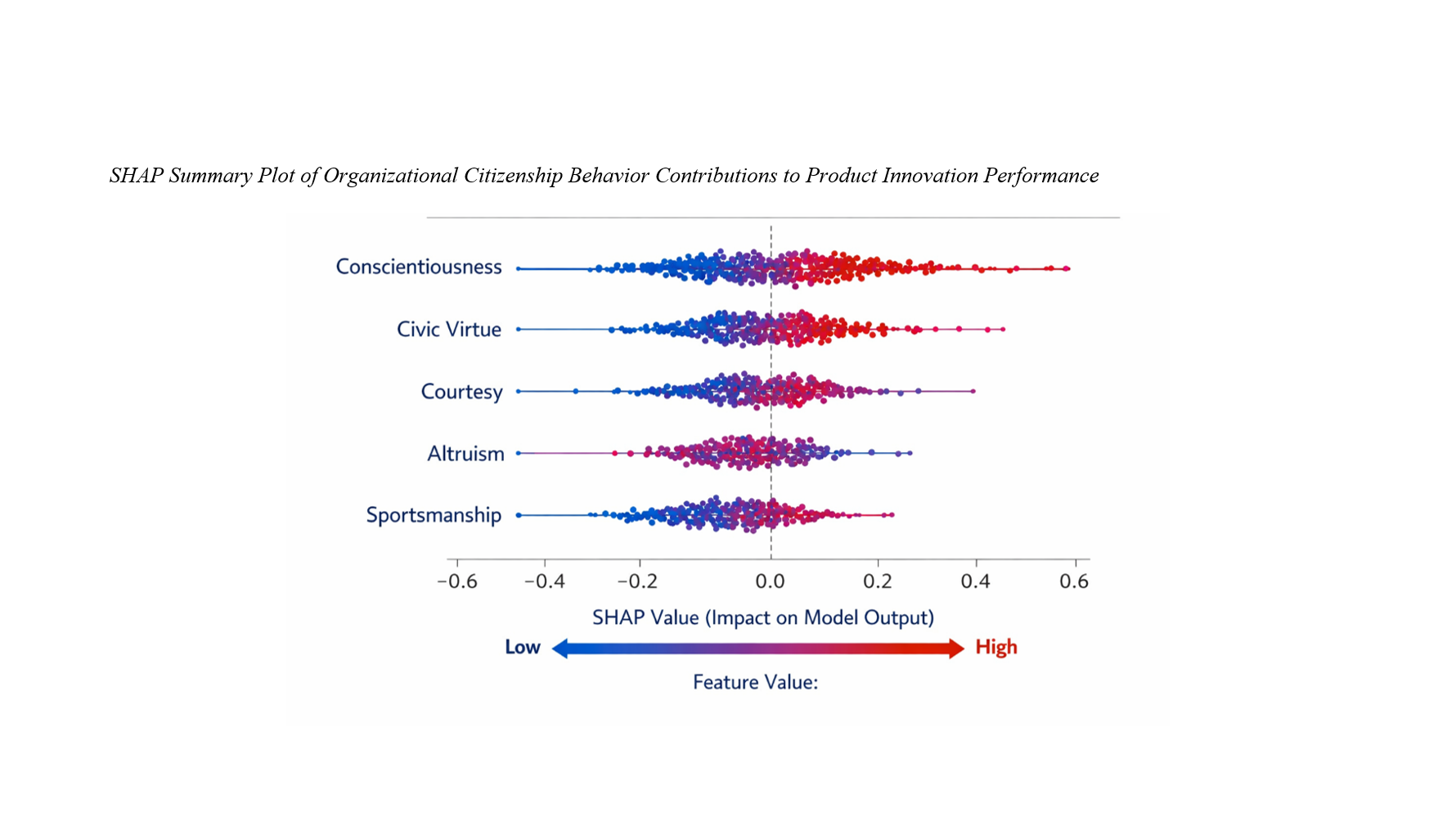
Methods and Materials: This study employed a quantitative cross-sectional design with data collected from 412 employees working in medium and large organizations. Organizational citizenship behaviors were measured across five dimensions including conscientiousness, civic virtue, courtesy, altruism, and sportsmanship, while product innovation performance was assessed using multidimensional performance indicators. Data were analyzed using the XGBoost algorithm with hyperparameter optimization and five-fold cross-validation. Feature importance was examined using both gain-based metrics and SHAP (SHapley Additive exPlanations) values to ensure transparent and robust interpretation of predictor contributions. Model robustness was evaluated through comparison with Random Forest and Elastic Net models.
Findings: The XGBoost model demonstrated strong predictive performance, explaining 68.4% of the variance in product innovation performance. Feature importance analysis revealed that conscientiousness was the most influential predictor, followed by civic virtue, courtesy, altruism, and sportsmanship. Conscientiousness exhibited the highest SHAP contribution, indicating its dominant role in driving innovation outcomes. Comparative analysis showed that XGBoost significantly outperformed Random Forest and Elastic Net across all evaluation metrics, confirming its superior capacity to capture nonlinear behavioral effects on innovation performance.
Conclusion: The findings confirm that organizational citizenship behaviors constitute critical behavioral drivers of product innovation performance and that advanced machine learning models provide superior analytical precision for understanding their complex influence. The study offers strong empirical evidence supporting the strategic integration of citizenship behavior development into organizational innovation policies.
Downloads
References
Ayyaz, M., Tasmin, R., Saeed, B., Nguyen, M., & Hafeez, A. (2023). Motivating Tacit Knowledge Sharing: The Role of Perceived Value of Knowledge and Organizational Citizenship Behavior. International Journal of Professional Business Review, 8(11), e03892. https://doi.org/10.26668/businessreview/2023.v8i11.3892
Brătianu, C., Stănescu, D. F., & Mocanu, R. (2022). The Mediating Role of Customer Knowledge Management on the Innovative Work Behavior and Product Innovation Relationship. Kybernetes, 52(11), 5353-5384. https://doi.org/10.1108/k-09-2021-0818
Clyde, V., Ismail, T., Hanifah, I. A., & Bastian, E. (2025). The Mediating Role of Organizational Citizenship Behavior and Product Creativity Between Risk-Taking Tendency, Transformational Leadership and Performance. Asian Journal of Economics Business and Accounting, 25(10), 158-175. https://doi.org/10.9734/ajeba/2025/v25i102005
Elshaer, I. A., Azazz, A. M. S., & Fayyad, S. (2023). Green Management and Sustainable Performance of Small- And Medium-Sized Hospitality Businesses: Moderating the Role of an Employee’s Pro-Environmental Behaviour. International journal of environmental research and public health, 20(3), 2244. https://doi.org/10.3390/ijerph20032244
Froese, F. J., Malik, A., Kumar, S., & Sahoo, S. (2022). Asian Business and Management: Review and Future Directions. Asian Business & Management, 21(5), 657-689. https://doi.org/10.1057/s41291-022-00209-y
Huang, J., Hu, H., & Wang, Y. (2022). Fuzzy Front-End Vertical External Involvement, Corporate Social Responsibility and Firms’ New Product Development Performance in the VUCA Age: From an Organizational Learning Perspective. Sustainability, 15(1), 280. https://doi.org/10.3390/su15010280
Iqbal, J., Parray, Z. A., & Bharadwaj, S. (2025). Toxic Workplaces, Tarnished Outcomes: Understanding the Effects of Bullying on Job Outcomes. Evidence-Based HRM a Global Forum for Empirical Scholarship. https://doi.org/10.1108/ebhrm-02-2024-0058
Kyeong, K. (2025). Do Transformational Leadership and Innovative Climate Always Enhance Employees’ Innovative Behavior? Focusing on the Moderated Mediating Role of Innovative Climate on Change-Oriented Organizational Citizenship Behavior. Public Personnel Management. https://doi.org/10.1177/00910260251325269
Mahmood, S., Iqbal, A., El‐kenawy, E. S. M., Eid, M. M., Alhussan, A. A., & Khafaga, D. S. (2025). The Impact of Green Technology Innovation, Pro-Environmental Behavior and Eco-Design on Green New Product Success: Examine the Moderating Role of Green Corporate Image. Environmental Research Communications, 7(1), 015028. https://doi.org/10.1088/2515-7620/adaaca
Manning, L., Morris, D. R., & Birchmore, I. (2023). Organizational Unlearning: A Risky Food Safety Strategy? Comprehensive Reviews in Food Science and Food Safety, 22(3), 1633-1653. https://doi.org/10.1111/1541-4337.13124
Mehedinţu, A., & Șoavă, G. (2023). Approach to the Impact of Digital Technologies on Sustainability Reporting Through Structural Equation Modeling and Artificial Neural Networks. Electronics, 12(9), 2048. https://doi.org/10.3390/electronics12092048
Quayson, M., Bai, C., Sun, L., & Sarkis, J. (2023). Building Blockchain‐driven Dynamic Capabilities for Developing Circular Supply Chain: Rethinking the Role of Sensing, Seizing, and Reconfiguring. Business Strategy and the Environment, 32(7), 4821-4840. https://doi.org/10.1002/bse.3395
Salloum, C., Jarrar, H., Chaanine, N., Sayah, M. A., & Verdié, J.-F. (2023). Winning Hearts and Minds: The Charismatic Leader’s Role in SME Productivity. European Business Review, 36(4), 494-509. https://doi.org/10.1108/ebr-04-2023-0126
Sebrek, S. S., Semenova, V., & Kosztyán, Z. T. (2024). Advancing the Software Development Process Through the Development of Technology-Enabled Dynamic Capabilities in a Project-Based Firm: Insights From Action Design Research. Business Process Management Journal, 30(8), 313-342. https://doi.org/10.1108/bpmj-02-2024-0070
Sharma, A., & Sagar, M. (2023). Exploring New-Product Selling Challenges in the FMCG Sector: A Qualitative Method Approach. Qualitative Market Research an International Journal, 26(5), 494-533. https://doi.org/10.1108/qmr-12-2021-0153
Sharma, A., Shin, H., Santa-María, M. J., & Nicolau, J. L. (2021). Hotels' COVID-19 Innovation and Performance. Annals of Tourism Research, 88, 103180. https://doi.org/10.1016/j.annals.2021.103180
Si, H., Tian, Z., Guo, C., & Zhang, J. (2023). The Driving Effect of Digital Economy on Green Transformation of Manufacturing. Energy & Environment, 35(5), 2636-2656. https://doi.org/10.1177/0958305x231155494
Taghizadeh, S. K., Rahman, S. A., Nikbin, D., Radomska, M., & Far, S. M. (2023). Dynamic Capabilities of the SMEs for Sustainable Innovation Performance: Role of Environmental Turbulence. Journal of Organizational Effectiveness People and Performance, 11(4), 767-787. https://doi.org/10.1108/joepp-04-2023-0166
Tian, Y., & Hong, J. (2022). In the Context of Digital Finance, Can Knowledge Enable Manufacturing Companies to Be More Courageous and Move Towards Sustainable Innovation? Sustainability, 14(17), 10634. https://doi.org/10.3390/su141710634
Turcotte‐Légaré, N., Gaudet, M. C., & Doucet, O. (2022a). Comprendre Les Effets Du Leadership D’habilitation Sur Les comportements Positifs Et Négatifs De Performance: Étude Dans Le Secteur Manufacturier. Canadian Journal of Administrative Sciences / Revue Canadienne Des Sciences De L Administration, 40(2), 232-247. https://doi.org/10.1002/cjas.1696
Turcotte‐Légaré, N., Gaudet, M. C., & Doucet, O. (2022b). Understanding the Effects of Empowering Leadership on Positive and Negative Performance Behaviors: A manufacturing Sector Study. Canadian Journal of Administrative Sciences / Revue Canadienne Des Sciences De L Administration, 40(2), 218-231. https://doi.org/10.1002/cjas.1695
Wang, H., Khan, M. A. S., Anwar, F., Shahzad, F., Adu, D., & Murad, M. (2021). Green Innovation Practices and Its Impacts on Environmental and Organizational Performance. Frontiers in psychology, 11. https://doi.org/10.3389/fpsyg.2020.553625
Xu, Q., Li, X., & Guo, F. (2023). Digital Transformation and Environmental Performance: Evidence From Chinese Resource‐based Enterprises. Corporate Social Responsibility and Environmental Management, 30(4), 1816-1840. https://doi.org/10.1002/csr.2457
Yang, X., & Han, Q. (2024). Nonlinear Effects of Enterprise Digital Transformation on Environmental, Social and Governance (ESG) Performance: Evidence From China. Sustainability Accounting Management and Policy Journal, 15(2), 355-381. https://doi.org/10.1108/sampj-08-2023-0553
Yang, Y., Yang, Q., & Jiang, C. X. (2024). How Cultural Intelligence Facilitates Employee Creativity: The Roles of Intercultural Citizenship Behavior and Perceived Disharmony. International Journal of Cross Cultural Management, 24(3), 543-561. https://doi.org/10.1177/14705958241270766
Yusr, M. M., Mokhtar, S. S. M., Perumal, S., & Salimon, M. G. (2021). The Impact of Customer Knowledge Management, TQM and Marketing Capabilities on Product Innovation Performance of Malaysian SMEs: An Empirical Study. International Journal of Innovation Science, 14(2), 316-338. https://doi.org/10.1108/ijis-03-2021-0053
Zhang, D., Hou, X., & Guo, J. (2023). How Does Digital Transformation Improve New Product Development Performance From the Perspective of Resource Orchestration?—Analysis Based on Configuration. PLoS One, 18(11), e0291652. https://doi.org/10.1371/journal.pone.0291652
Zhang, Z., Liu, H., & Zhao, Y. (2024). How Enterprises Achieve Frugal Innovation: A Configurational Study Based on the Model of Organizational Symbiosis. Sustainability, 16(11), 4465. https://doi.org/10.3390/su16114465
Downloads
Additional Files
Publication Timeline
- Submitted
- Revised
- Accepted