
Threshold Effects of Gross Fixed Capital Formation in the Relationship Between Healthcare Infrastructure and Life Expectancy Index in Iran
DOI:
https://doi.org/10.61838/kman.ijimob.5072Keywords:
Health expenditures, Healthcare infrastructure, Gross fixed capital formation, Life expectancy index, Smooth Transition Autoregressive (STAR) modelAbstract
Objective: The present study aimed to investigate the threshold effects of gross fixed capital formation on the relationship between healthcare infrastructure and the life expectancy index in Iran.
Methods and Materials: This applied and descriptive–analytical study employed an ex post facto design using annual time-series data for Iran covering the period 1986–2023. The empirical analysis was conducted using EViews software. To examine nonlinear dynamics and potential regime-switching behavior, a first-order Logistic Smooth Transition Regression (LSTR1) model was estimated, with gross fixed capital formation serving as the transition variable. Prior to model estimation, Phillips–Perron unit root tests were applied to assess stationarity, and the Johansen–Juselius cointegration approach was used to test for long-run equilibrium relationships among the variables. The model incorporated healthcare infrastructure indicators, including hospital beds, physicians, nurses and midwives, public and private health sector investment, labor force participation, population growth, and literacy rate. Diagnostic tests were performed to assess autocorrelation, heteroskedasticity, parameter stability, and remaining nonlinearity.
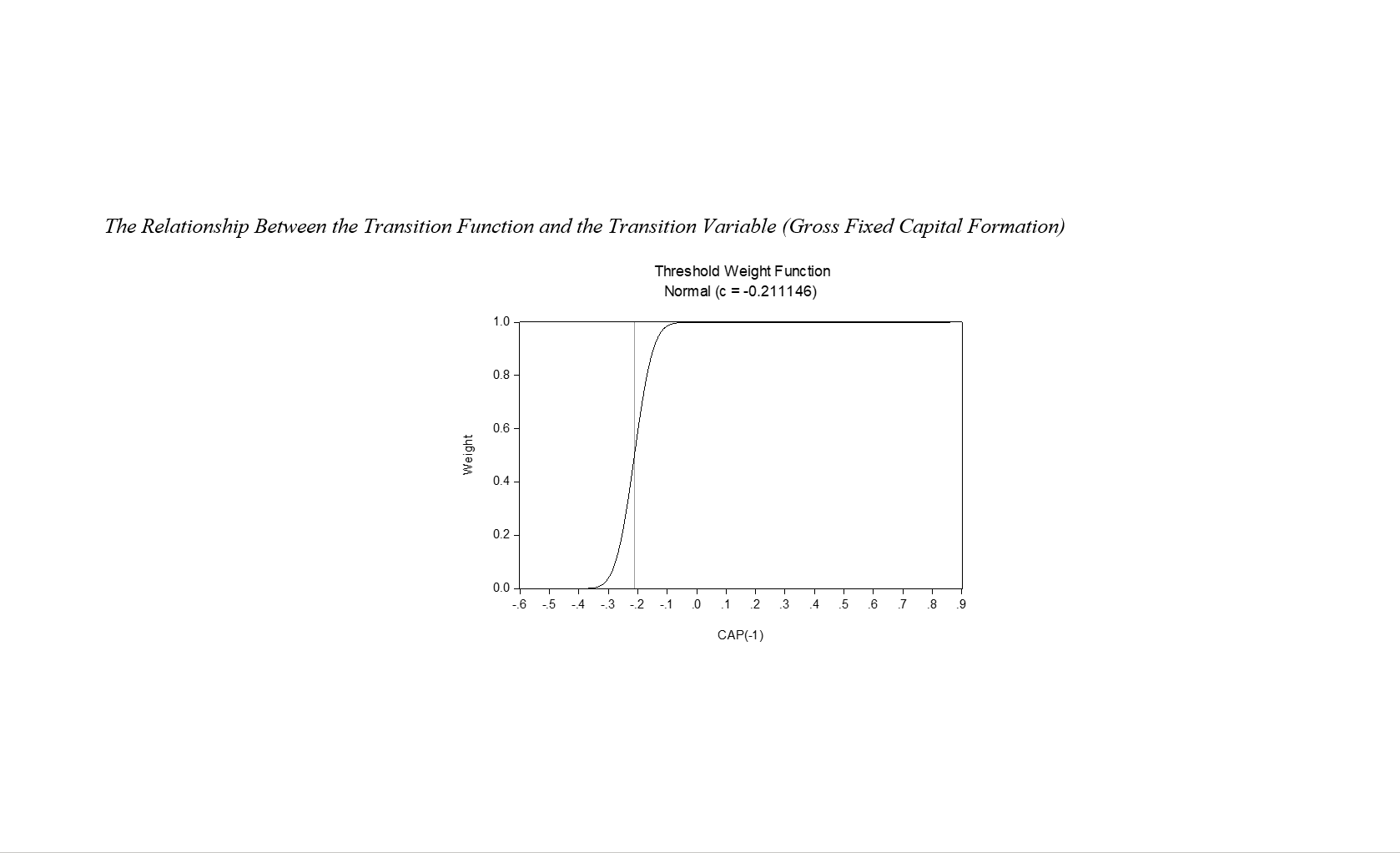
Findings: The results indicate that all variables are integrated of order one and cointegrated in the long run. The linearity test rejects the null hypothesis of linearity, confirming the appropriateness of the LSTR1 specification. Gross fixed capital formation exhibits a statistically significant threshold value of −0.211, dividing the model into two distinct regimes. In the nonlinear (high-capital) regime, the coefficients of gross fixed capital formation, hospital beds, physicians, nurses and midwives, and both public and private health sector investment are positive and statistically significant, with greater magnitudes compared to the low-capital regime. Diagnostic tests confirm the absence of autocorrelation and heteroskedasticity, and parameter constancy tests support regime-dependent coefficient variation. The adjusted R² of 0.88 indicates strong explanatory power.
Conclusion: The findings demonstrate that the effectiveness of healthcare infrastructure in improving life expectancy in Iran is conditional upon the level of gross fixed capital formation. When capital accumulation surpasses a critical threshold, the impact of healthcare infrastructure intensifies significantly, highlighting the importance of sustained macroeconomic investment in enhancing health outcomes.
Downloads
References
Bertoni, M., Cavapozzi, D., Pasini, G., & Pavese, C. (2025). The Causal Effect of Working From Home on Mental Health of 50+ Europeans. The Journal of the Economics of Ageing, 31, 100560. https://doi.org/10.1016/j.jeoa.2025.100560
Chireshe, J., & Ocran, M. K. (2020). Financial development and health care expenditure in Sub Saharan Africa Countries. Cogent Economics & Finance, 8, 1-22. https://doi.org/10.1080/23322039.2020.1771878
Eisavi, M., & Moayedfard, A. (2022). Budget Trends and Financing Methods of the Health Sector in Iran: an Operational Proposal. jha, 24(4), 71-83. https://doi.org/10.52547/jha.24.4.71
Fatemi Zardan, Y., & Fotros, M. H. (2021). Assessing the vulnerability of household health expenditures in each province to fluctuations in economic variables. Social Security Quarterly, 16(2), 59. https://qjo.ssor.ir/article_147453_59c58b5be1c9481472632f1fdddc4625.pdf
Fathollahi, E., & Jafari, M. (2024). Increasing life expectancy in Iran considering the role of financial development, health expenditures, and renewable energy consumption. Journal of the School of Public Health and Institute of Public Health Research, 22(1), 73-86. https://sjsph.tums.ac.ir/article-1-6307-en.html
Gulzar, R., & Ahmed, N. (2022). Nexuses between Economic Growth and Health Indicators: Evidence from Pakistan. Journal of Economic Sciences, 1(2), 137-151. https://doi.org/10.55603/jes.v1i2.a5
Hu, Q., & Wang, L. (2024). Economic growth effects of public health expenditure in OECD countries: An empirical study using the dynamic panel threshold model. Heliyon, 10(4). https://doi.org/10.1016/j.heliyon.2024.e25684
Ieng Lai, K., Fong, P., & Meng, L. (2025). Cross-sectional Study Reveals Moderate Professional Benefits Among Nurses in a Multicultural Healthcare System. INQUIRY: The Journal of Health Care, Organization, Provision, and Financing, 62, 1-10. https://doi.org/10.1177/00469580251316966
Jalili, A., Panahi, H., & Sojudi, S. (2019). Investigating the causal relationship between women's health and economic growth in D8 countries: A Konya panel causality approach. Quarterly Journal of Quantitative Economics (Formerly Economic Reviews), 16(4), 129-162. https://jqe.scu.ac.ir/article_14705_en.html
Mbau, R., Musiega, A., Nyawira, L., Tsofa, B., Mulwa, A., Molyneux, S., Maina, I., Jemutai, J., Normand, C., Hanson, K., & Barasa, E. (2023). Analysing the efficiency of health systems: a systematic review of the literature. Applied Health Economics and Health Policy, 21(2), 205-224. https://doi.org/10.1007/s40258-022-00785-2
Mosadeghrad, A. M., Heidari, M., & Esfahani, P. (2021). Strategies to strengthen Iran's primary healthcare system: A realist review. Journal of the School of Public Health and Institute of Public Health Research, 19(3), 237-258. https://doi.org/10.52547/payesh.20.2.237
Mousavi, M. H., Raghfar, H., & Fazel, Z. (2018). Measuring "equity" in the financing of household health expenditures in Iran's development plans. Hakim Health Systems Research Journal, 21(1), 1-12. https://hakim.tums.ac.ir/article-1-1853-en.html
Olorunyomi, T. D., Sanyaolu, T. O., Adeleke, A. G., & Okeke, I. C. (2024). Integrating FinOps in healthcare for optimized financial efficiency and enhanced care. International Journal of Frontiers in Science and Technology Research, 7(2), 20-28. https://doi.org/10.53294/ijfstr.2024.7.2.0053
Ozyilmaz, A., Bayraktar, Y., Isik, E., Toprak, M., Bilal, E. M., Besel, F., Aydin, S., Firat, O. M., & Collins, S. (2022). The Relationship between Health Expenditures and Economic Growth in EU Countries: Empirical Evidence Using Panel Fourier Toda-Yamamoto Causality Test and Regression Models. International journal of environmental research and public health, 19(22). https://doi.org/10.3390/ijerph192215091
Rezaei, H., Alizadeh, M., & Nademi, Y. (2018). Factors affecting per capita health expenditures: A comparison of spatial models in a selection of developing countries. 4(2), 1-26. https://ecoj.tabrizu.ac.ir/article_6470.html
Wang, K. M., & Nguyen Thi, T. B. (2021). Quantile panel-type analysis for income inequality and healthcare expenditure. Economic Research-Ekonomska Istraživanja, 35(1), 1-21. https://doi.org/10.1080/1331677X.2018.1546123
Wang, L. O., Wu, H., & Hao, Y. (2020). How does China's land finance affect its carbon emissions? Structural Change and Economic Dynamics, 54, 267-281. https://doi.org/10.1016/j.strueco.2020.05.006
Wu, C. F., Chang, T., Wang, C. M., Wu, T. P., & Lin, M. C. (2021). Measuring the Impact of Health on Economic Growth Using Pooling Data in Regions of Asia: Evidence from a Quantile-On-Quantile Analysis. Frontiers in Public Health, 9, 689610. https://doi.org/10.3389/fpubh.2021.689610
Ying, S., Leone, D., Cicchiello, A. F., Cicchiello, A. F., & Kazemikhasragh, A. (2022). Industrial dynamics and economic growth in health-care context. Evidence from selected OECD countries. Journal of Business & Industrial Marketing, 37(8), 1706-1716. https://doi.org/10.1108/JBIM-11-2020-0513
Zhang, J., Zhao, W., Cheng, B., Li, A., Wang, Y., Yang, N., & Tian, Y. (2022). The Impact of Digital Economy on the Economic Growth and the Development Strategies in the post-COVID-19 Era: Evidence from Countries Along the "Belt and Road". Frontiers in Public Health, 10, 856142. https://doi.org/10.3389/fpubh.2022.856142
Zhao, Z., Dong, S., Wang, J., & Jiang, Q. (2023). Estimating the efficiency of primary health care services and its determinants: evidence from provincial panel data in China. Frontiers in Public Health, 11, 1173197. https://doi.org/10.3389/fpubh.2023.1173197
Downloads
Additional Files
Publication Timeline
- Submitted
- Revised
- Accepted