Identification of the Fundamental Dimensions of Corporate Entrepreneurship and Corporate Governance: A Delphi Study in Entrepreneurial Companies
DOI:
https://doi.org/10.61838/kman.ijimob.5097Keywords:
Corporate Entrepreneurship, Corporate Governance, Delphi Method, Qualitative StudyAbstract
Objective: The present study aimed to identify and conceptualize the fundamental dimensions and components of corporate entrepreneurship and corporate governance within entrepreneurial companies through an exploratory qualitative approach.
Methods and Materials: This research employed a qualitative exploratory design using the classical Delphi method to develop a contextualized conceptual framework. The study population consisted of senior managers and academic experts with extensive experience in entrepreneurial firms, selected through purposive and snowball sampling techniques. Data collection was conducted in two iterative Delphi rounds involving 12 experts. In the first round, an initial list of factors derived from literature review and preliminary qualitative exploration was evaluated and expanded by panel members. In the second round, participants reassessed the refined factors after receiving structured feedback, including median scores and response ranges. Consensus among experts was assessed using Kendall’s coefficient of concordance (W), and statistical analyses were performed using SPSS Version 22. Qualitative content analysis with inductive coding was applied to organize concepts into subcategories, core dimensions, and an integrated conceptual model describing the interaction between corporate entrepreneurship and corporate governance.
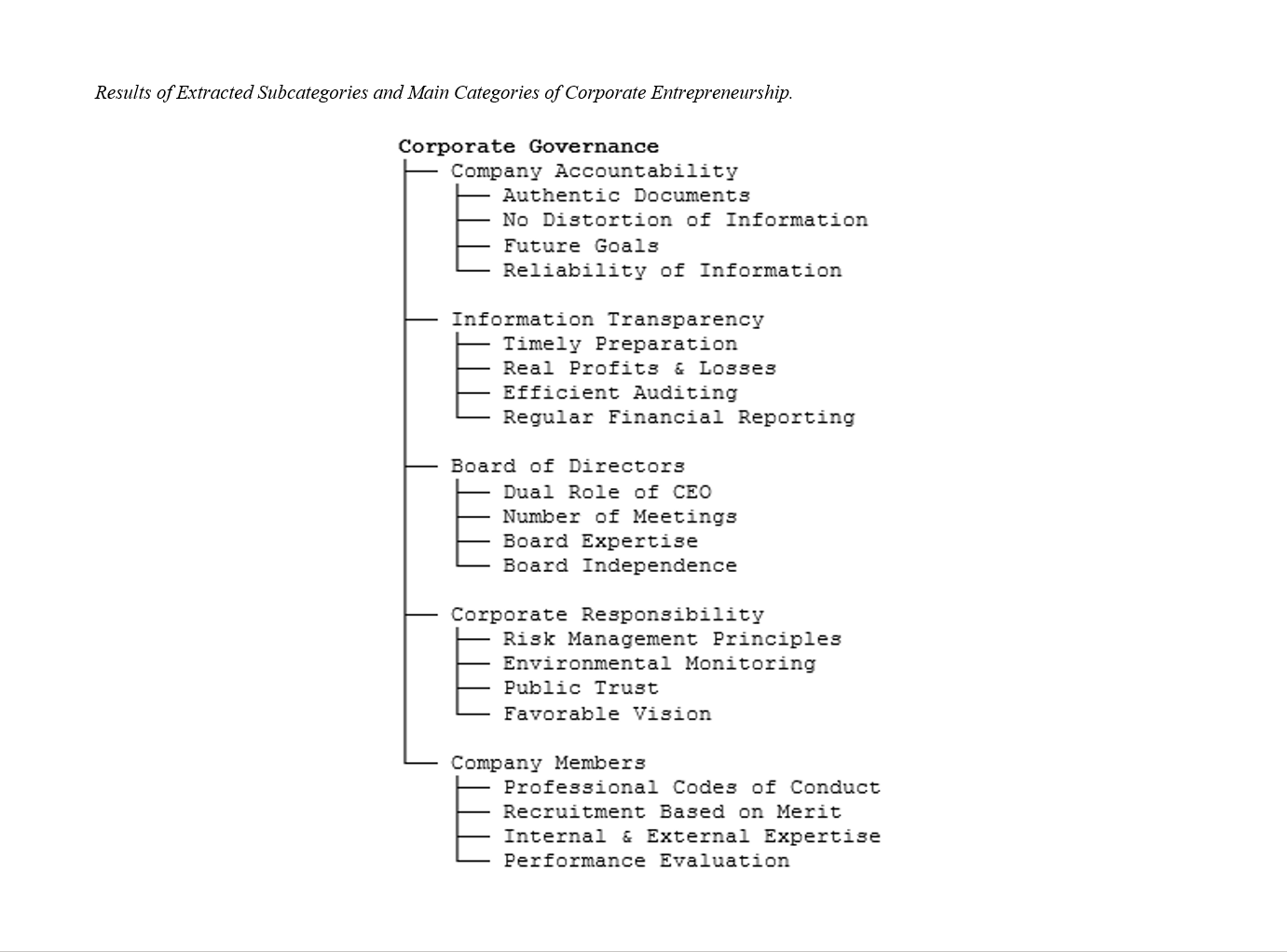
Findings: The findings indicated that corporate entrepreneurship is structured around five interrelated dimensions: human resource prerequisites, managerial competencies, external opportunities, internationalization infrastructure, and market orientation. Simultaneously, corporate governance was conceptualized through five principal dimensions: corporate accountability, information transparency and reliability, board effectiveness, corporate responsibility, and company member competencies. The statistically significant Kendall’s coefficient confirmed expert consensus regarding the identified dimensions. Results suggest that entrepreneurial effectiveness depends on supportive governance mechanisms, while governance performance is strengthened by entrepreneurial capabilities, demonstrating a mutually reinforcing relationship between the two constructs.
Conclusion: The study concludes that effective organizational performance in entrepreneurial companies emerges from the integrated alignment of corporate entrepreneurship and corporate governance systems. Governance structures provide accountability, transparency, and strategic control, whereas corporate entrepreneurship promotes innovation, adaptability, and competitive renewal. The proposed multidimensional framework offers a comprehensive roadmap for understanding organizational dynamics and supports the development of measurement tools, managerial strategies, and future empirical research aimed at enhancing sustainable competitiveness.
Downloads
References
Almarayeh, T., Aibar-Guzmán, B., & Aibar-Guzmán, C. (2019). Gender diversity, corporate governance and firm behavior: The challenge of emotional management. Journal of Business Research, 107, 20-31. https://www.sciencedirect.com/science/article/pii/S2444883418300494
Areneke, G., Khlif, W., Kimani, D., & Soobaroyen, T. (2022). Do corporate governance codes matter in Africa? In Research handbook on corporate board decision-making (pp. 273-295). Edward Elgar Publishing. https://doi.org/10.4337/9781800377189.00023
Bawuah, I. (2024). The moderator role of corporate governance on capital structure-performance nexus: Evidence from Sub-Saharan Africa. Cogent Business & Management, 11(1), 2298030. https://doi.org/10.1080/23311975.2023.2298030
Ben Ammar, S., Larbi, M., & Jarboui, A. (2024). Board gender diversity and corporate social responsibility: The moderating role of corporate governance. Journal of Global Responsibility, 15(1), 45-62. https://www.researchgate.net/publication/379539809_Board_gender_diversity_and_corporate_social_responsibility
Ben Haffedh, A., Boubaker, S., & Mefteh, S. (2023). Entrepreneurial finance and corporate governance: A review and research agenda. International Review of Financial Analysis, 85, 102456. https://doi.org/10.1016/j.irfa.2022.102456
Botateng, Y., Agyei, S. K., & Osei, K. A. (2022). Board characteristics and financial reporting quality: The moderating role of CEO duality. Journal of Accounting in Emerging Economies, 12(3), 458-482. https://www.researchgate.net/publication/281928362_Board_characteristics_and_financial_reporting_quality_Evidence_from_Jordan
Danso, A., Fosu, S., Owusu-Agyei, S., Ntim, C. G., & Adegbite, E. (2022). Capital structure revisited. Do crisis and competition matter in a Keiretsu corporate structure? International Journal of Finance & Economics, 26(4), 5073-5092. https://doi.org/10.1002/ijfe.2055
Ebrahimi, J., Azizi, M., & Poormahdi, K. (2022). A model of international corporate entrepreneurship for Iranian mobile operators. Journal of Intelligent Business Management Studies, 10(40), [page range]. https://ims.atu.ac.ir/article_14542.html
Ezzat, A. M. (2019). CEO duality and firm performance: The moderating role of board independence. Journal of Financial Reporting and Accounting, 17(1), 84-106. https://www.researchgate.net/publication/338479184_CEO_duality_and_firm_performance_the_moderating_roles_of_CEO_informal_power_and_board_involvements
Fonkoua, I. S., Vlačić, B., & Dabić, M. (2023). Corporate entrepreneurship in the public sector: A systematic literature review and research agenda. Journal of Innovation & Knowledge, 8(2), 100343. https://doi.org/10.1016/j.jik.2023.100343
García-Meca, E., & Sánchez-Ballesta, J. P. (2010). Ownership structure, strategic controls and corporate value. Managerial and Decision Economics, 31(6), 387-401. https://www.scirp.org/reference/referencespapers?referenceid=2198147
Gawke, J. C., Gorgievski, M. J., & Bakker, A. B. (2019). Measuring intrapreneurship at the individual level: Development and validation of the Intrapreneurial Behavior Scale. European Management Journal, 37(6), 806-817. https://doi.org/10.1016/j.emj.2019.03.001
Ghodrati, M., & Feizi, T. (2015). Investigating the relationship between corporate governance system and financial performance of companies listed on the Tehran Stock Exchange. Applied Research in Management and Accounting, 1(2), 85-102. https://www.researchgate.net/publication/351457265_Investigating_the_relationship_between_corporate_governance_and_financial_performance_of_the_banks_listed_in_Tehran_stock_exchange
Honoré, F., Munari, F., & de La Potterie, B. V. P. (2015). Corporate governance practices and companies' R&D intensity: Evidence from European countries. Research Policy, 44(2), 533-543. https://doi.org/10.1016/j.respol.2014.10.016
Kuratko, D. F., & Audretsch, D. B. (2021). The future of corporate entrepreneurship: A developmental ecosystem perspective. Journal of Business Venturing Insights, 15, e00236. https://doi.org/10.1016/j.jbvi.2021.e00236
Liu, X., Sheng, Y., & Wang, J. (2020). The influence of executive compensation incentives on R&D investment: The moderating effect of executive overconfidence. Technology Analysis & Strategic Management, 32(10), 1169-1181. https://doi.org/10.1080/09537325.2020.1748184
Morales, C., Holtschlag, C., Masuda, A. D., & Marquina, P. (2019). In which cultural contexts do individual values explain entrepreneurship? An integrative values framework using Schwartz's theories. International Small Business Journal, 37(3), 241-267. https://doi.org/10.1177/0266242618811890
Muhammad, H., Migliori, S., & Consorti, A. (2024). Corporate governance and R&D investment: Does firm size matter? Technology Analysis & Strategic Management, 36(3), 518-532. https://doi.org/10.1080/09537325.2022.2042508
Nason, R. S., McKelvie, A., & Lumpkin, G. T. (2015). The role of organizational size in the heterogeneous nature of corporate entrepreneurship. Small Business Economics, 45(2), 279-304. https://doi.org/10.1007/s11187-015-9632-6
Russi, L., & Cabula, R. (2015). Ownership concentration and R&D investments: The moderating effect of financial constraints. European Management Journal, 33(6), 451-461. https://www.researchgate.net/publication/373922924_Ownership_concentration_and_RD_investment_the_moderating_role_of_stock_options
Samadi Largani, M. (2025). Investigating the Impact of the Corporate Governance System on the Relationship Between Actors and the Role of Social Responsibilities in Companies Listed on the Tehran Stock Exchange. Knowledge of Accounting and Management Auditing, 14(56), 343-360.
Shane, S., & Venkataraman, S. (2000). The promise of entrepreneurship as a field of research. Academy of Management Review, 25(1), 217-226. https://doi.org/10.2307/259271
Tsabita, N. M., & Gunadi, A. (2025). Corporate governance failures leading to bankruptcy in state-owned enterprises (SOEs). Subsidiari, 10(2). https://acopen.umsida.ac.id/index.php/acopen/article/view/12991
Turava, M. (2025). Principles of Modern Corporate Governance and Their Impact on the Functioning of Georgian Corporate Entities. Academic Digest, 109-122. https://doi.org/10.55896/2298-0202/2024/109-122
Ulfah, A., & Denta, D. H. (2025). Corporate Governance Dan Struktur Kepemilikan Terhadap Green Banking Disclosure (Studi Pada Perbankan Di Indonesia Tahun 2021-2023). Balance Media Informasi Akuntansi Dan Keuangan, 17(1). https://doi.org/10.52300/blnc.v17i1.18960
Urbano, D., Aparicio, S., & Audretsch, D. B. (2019). Twenty-five years of research on institutions, entrepreneurship, and economic growth: What has been learned? Small Business Economics, 53(1), 21-49. https://doi.org/10.1007/s11187-018-0038-0
Wei, P., Mao, Y., Zhu, M., & Zhu, Q. (2025). Environment court, shareholder conflict and corporate governance: evidence from market reactions to bank loan announcements. Sustainability Accounting, Management and Policy Journal, 16(1), 79-106. https://doi.org/10.1108/SAMPJ-01-2023-0009
Welter, F., Baker, T., & Wirsching, K. (2019). Three waves and counting: The rising tide of contextualization in entrepreneurship research. Small Business Economics, 52(2), 319-330. https://doi.org/10.1007/s11187-018-0094-5
Yakubu, I. N., & Oumarou, S. (2023). Boardroom dynamics: The power of board composition and gender diversity in shaping capital structure. Cogent Business & Management, 10(2), 2236836. https://doi.org/10.1080/23311975.2023.2236836
Zahra, S. A. (2007). Contextualizing theory building in entrepreneurship research. Journal of Business Venturing, 22(3), 443-452. https://doi.org/10.1016/j.jbusvent.2006.04.007
Zona, F. (2016). Agency models in different stages of CEO tenure: The effects of stock options and board independence on R&D investment. Research Policy, 45(2), 560-575. https://doi.org/10.1016/j.respol.2015.10.012
Downloads
Additional Files
Publication Timeline
- Submitted
- Revised
- Accepted