Designing a Strategic Human Resource Management Model in the Era of Digital Transformation with Emphasis on Artificial Intelligence Applications: A Mixed-Methods Study
DOI:
https://doi.org/10.61838/kman.ijimob.5105Keywords:
Artificial Intelligence, Human Resource Management, Digital Transformation, Mixed-Methods Study, Algorithmic Ethics, Talent ManagementAbstract
Objective: The present study aimed to design and validate a strategic human resource management model aligned with digital transformation requirements by examining the role of artificial intelligence applications in enhancing organizational human capital management.
Methods and Materials: This research adopted a sequential exploratory mixed-methods design conducted in two phases. In the qualitative phase, a meta-synthesis based on the seven-step Sandelowski and Barroso method was performed to analyze 95 scholarly articles published between 2000 and 2025, complemented by semi-structured interviews with 28 experts including senior HR managers, digital transformation consultants, and university scholars selected through purposive sampling until theoretical saturation was achieved. Thematic analysis was used to identify key dimensions and components of strategic HR transformation. In the quantitative phase, a researcher-developed questionnaire consisting of 42 items derived from qualitative findings was distributed among 384 human resource managers and specialists from organizations operating in information technology, financial, manufacturing, and service sectors in 2025 using stratified random sampling. Reliability and validity of the instrument were confirmed through expert review and internal consistency measures. Data were analyzed using Partial Least Squares Structural Equation Modeling (PLS-SEM) in SmartPLS 4, complemented by Interpretive Structural Modeling (ISM) and MICMAC analysis to determine hierarchical relationships among model components.
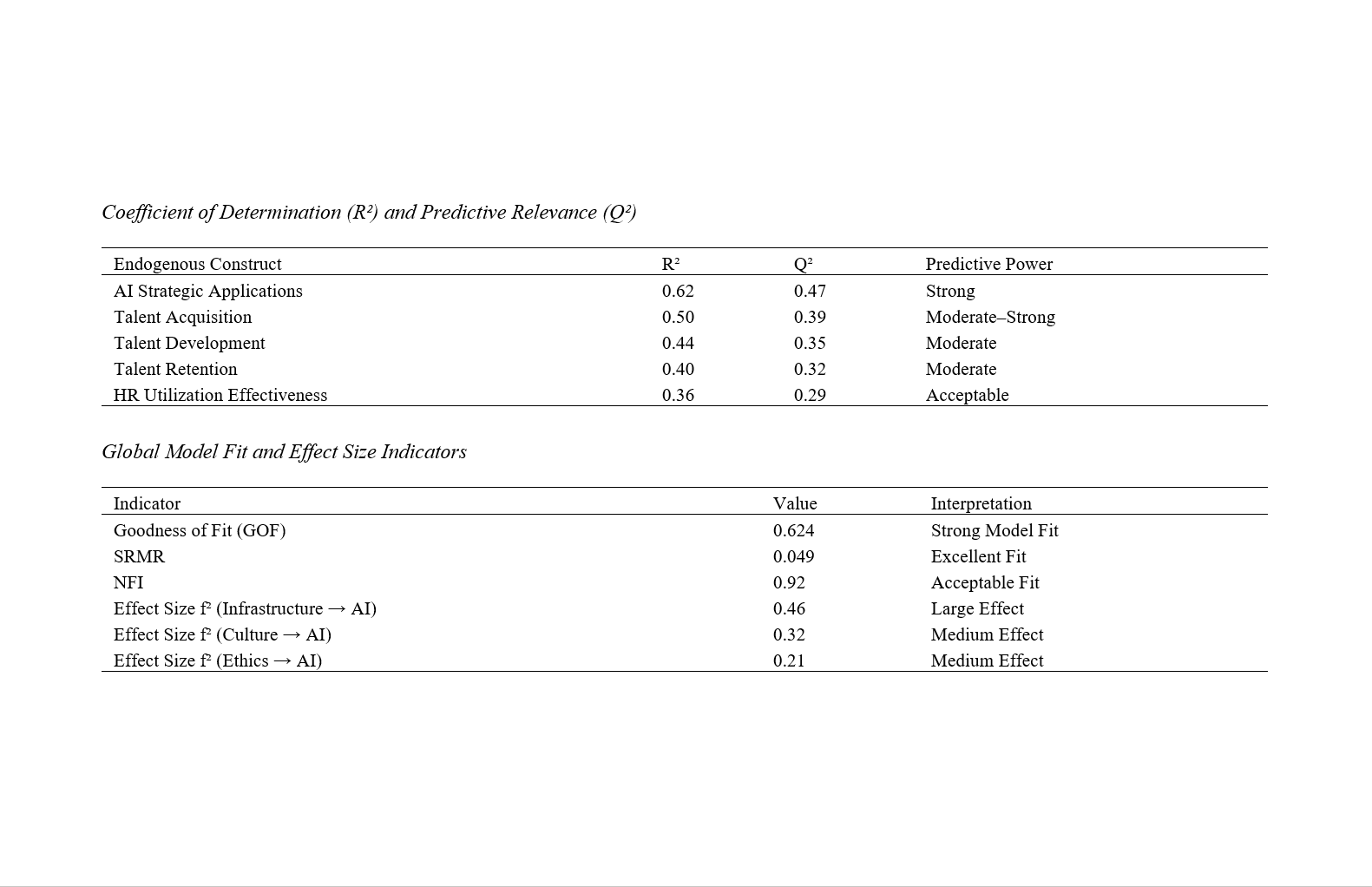
Findings: Structural model results demonstrated that transformation infrastructure significantly predicted strategic AI applications (β = .68, p < .001), while digital organizational culture exerted a strong positive effect (β = .54, p < .001). Ethical challenges showed a significant negative influence on AI implementation (β = −.35, p < .001). Artificial intelligence applications significantly enhanced talent acquisition (β = .71), talent development (β = .66), talent retention (β = .63), and HR utilization effectiveness (β = .60). The model explained 62% of the variance in AI applications and achieved strong overall goodness of fit (GOF = 0.624), indicating robust explanatory and predictive power.
Conclusion: The findings confirm that artificial intelligence serves as a strategic enabler of human resource transformation when supported by technological infrastructure, digital organizational culture, and ethical governance mechanisms. The proposed model provides an integrated framework that balances algorithmic efficiency with human-centered management and demonstrates that successful digital HR transformation requires coordinated investment in technology, organizational learning, and responsible AI practices to achieve sustainable competitive advantage.
Downloads
References
Abtahi, S. H., & Abedi Jafari, H. (2023). Advanced Human Resource Management: Modern Approaches and Theories. Tehran University Press. https://shm.shahroodut.ac.ir/article_1398_be61ad0decb46afafeb69a3fd1513d16.pdf
Bidel, T., Goli, F., Tanha, Z., & Moshtagh, H. (2025). Application of Artificial Intelligence in Human Resource Performance Management. https://ensani.ir/fa/article/download/632131
Biravand, F., Sayadi, A., & Alipour, N. (2025). Ethical Challenges and Opportunities of Artificial Intelligence in Human Capital Development. 1st National Conference on Human Capital Education and Development,
Boudreau, J. W., & Cascio, W. F. (2024). Investing in People: The Financial Impact of Human Resource Initiatives. Society for Human Resource Management. https://ptgmedia.pearsoncmg.com/images/9780137070923/samplepages/9780137070923.pdf
Budhwar, P., Chowdhury, S., Wood, G., Aguinis, H., Bamber, G. J., Beltran, J. R., & Varma, A. (2024). Human resource management in the age of generative artificial intelligence: Perspectives and research directions. Human Resource Management Journal, 34(1), 1-21. https://dspace.library.uu.nl/bitstream/handle/1874/434235/Human_Res_Mgmt_Journal_-_2023_-_Budhwar_-_Human_resource_management_in_the_age_of_generative_artificial_intelligence_.pdf?sequence=1
Chowdhury, S., Dey, P., Joel-Edgar, S., Bhattacharya, S., Rodriguez-Espindola, O., Abadie, A., & Truong, L. (2023). Unlocking the value of artificial intelligence in human resource management through AI capability framework. Human Resource Management Review, 33(1), 100899-100899. https://doi.org/10.1016/j.hrmr.2022.100899
Davenport, T. H. (2023). The AI Advantage: How to Put the Artificial Intelligence Revolution to Work. MIT Press. https://www.amazon.com/Advantage-Artificial-Intelligence-Revolution-Management/dp/0262039176
Marr, B. (2022). Data-Driven HR: How to Use Analytics and Metrics to Drive Performance. Kogan Page Publishers. https://www.amazon.com/Data-Driven-HR-Analytics-Metrics-Performance/dp/074948246X
Memar, M. (2025). Ethics in Artificial Intelligence (AI Ethics) and Data Privacy in Human Resources (HR Data Privacy).
Mirkhani, K. (2025). Digital Transformation in Human Resources: The Key Role of Artificial Intelligence and Gartner Solutions.
Moghadam, A., Zarei, A., & Sadr Jahanian, M. (2025). Applications and Challenges of Artificial Intelligence in Human Resource Management Systems. 2nd International Conference on Management, Industrial Engineering, and Economics,
Sharifi, A. R., Pashayi Samar, M., & Talashan, M. (2025). The Role of Artificial Intelligence in Transforming Human Resource Management. 1st International Conference on Management and Technology Engineering,
Tak, M. (2025). Artificial Intelligence in Human Resources: Strategic Transformation in Talent Acquisition and Management.
Tambe, P., Cappelli, P., & Yakubovich, V. (2019). Artificial intelligence in human resources management: Challenges and a path forward. California Management Review, 61(4), 15-42. https://doi.org/10.1177/0008125619867910
Vrontis, D., Christofi, M., Pereira, V., Tarba, S., Makrides, A., & Trichina, E. (2022). Artificial intelligence, robotics, advanced technologies and human resource management: a systematic review. The International Journal of Human Resource Management, 33(6), 1237-1266. https://doi.org/10.1080/09585192.2020.1871398
Downloads
Additional Files
Publication Timeline
- Submitted
- Revised
- Accepted