Explainable AI Models of Organizational Creativity: Influences of Inclusive Leadership and Team Psychological Safety
DOI:
https://doi.org/10.61838/kman.ijimob.5270Keywords:
Organizational Creativity, Inclusive Leadership, Team Psychological SafetyAbstract
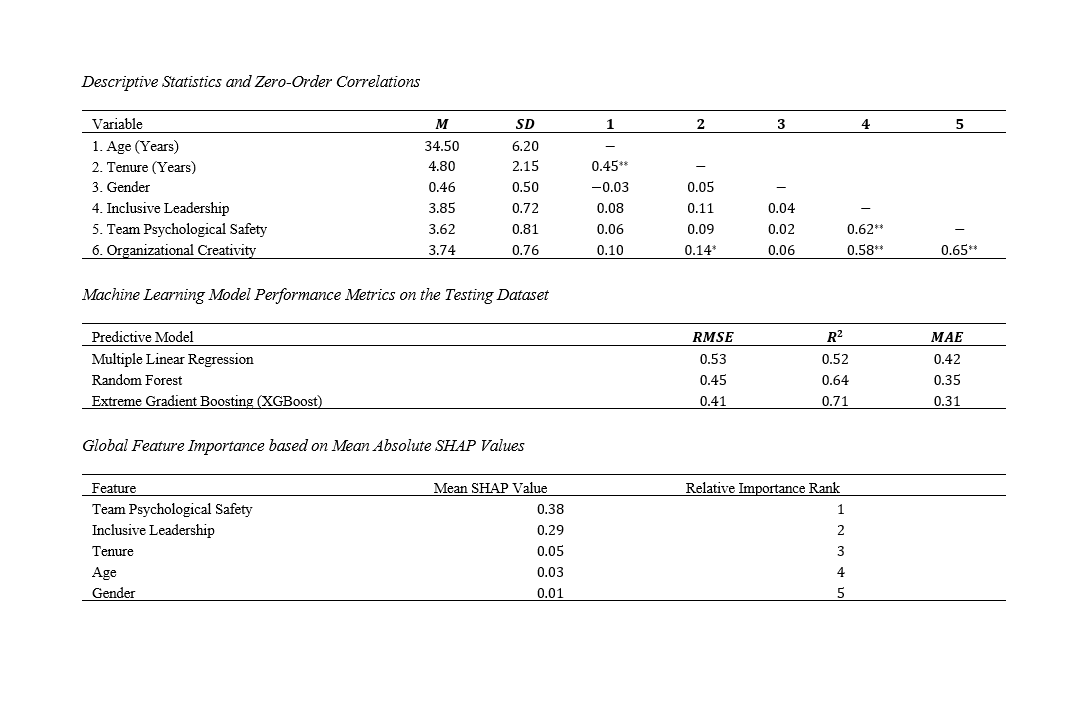
Objective: The primary objective of this study was to utilize an explainable artificial intelligence (XAI) machine learning framework to predict organizational creativity and mathematically elucidate the complex, non-linear interactions between inclusive leadership and team psychological safety.
Methods and Materials: A quantitative, cross-sectional predictive design was employed, utilizing a multi-stage stratified random sample of employees nested within work teams across the IT, finance, and advanced manufacturing sectors in Indonesia. Data were collected via structured digital questionnaires measuring inclusive leadership (Cronbach’s ), team psychological safety (Cronbach’s ), and organizational creativity (Cronbach’s ) using -point Likert scales. Data analysis moved beyond traditional linear models by employing the Extreme Gradient Boosting (XGBoost) algorithm for prediction, coupled with SHapley Additive exPlanations (SHAP) to quantify global and local feature importance and map non-linear synergistic effects.
Findings: The XGBoost model demonstrated robust predictive accuracy ( , ), significantly outperforming traditional multiple linear regression ( ). SHAP analysis identified team psychological safety as the paramount global predictor of creativity (Mean ), followed by inclusive leadership (Mean ). Crucially, SHAP dependence plots revealed a distinct non-linear threshold: inclusive leadership only yielded a positive, synergistic impact on organizational creativity when team psychological safety scores exceeded approximately on a -point scale, with veteran employees showing the highest sensitivity to these dynamics.
Conclusion: Cultivating a baseline threshold of team psychological safety is a mandatory structural prerequisite that must be mathematically satisfied before inclusive leadership behaviors can effectively catalyze organizational creativity.
Downloads
References
Adel-Babalan, Z., Moeini-Kia, M., Sahebdel, S., & Foroughi, F. (2021). The role of school culture and organizational creativity in the job engagement of primary school teachers in District 2 of Ardabil city. Journal of New Research Approaches in Management and Accounting, 5(16), 137-121. https://majournal.ir/index.php/ma/article/view/751
Agars, M. D., Kaufman, J. C., Deane, A., & Smith, B. (2012). Fostering individual creativity through organizational context: A review of recent research and recommendations for organizational leaders. In Handbook of organizational creativity (pp. 271-291). https://doi.org/10.1016/B978-0-12-374714-3.00012-4
Alavi, S. H., Farzan, F., & Dousti, M. (2017). Predicting Organizational Creativity Based on Job Affiliation and Information Technology Skills in Adra Sport and Youth Employees of Mazandaran Province. Journal of Sport Management and Motor Behavior, 13(25), 19-25. https://msb.journals.umz.ac.ir/article_1873.html
Barimani, A., & Alizadeh Paji, V. (2020). The Relationship between Organizational Creativity and Happiness with Organizational Performance of the Road and Transportation Staff. Journal of Innovation and Creativity in Human Science, 9(3), 1-24. http://journal.bpj.ir/article_668203_5d638bc49bd6abccae4f96205526036c.pdf
Boso, N., Donbesuur, F., Bendega, T., Annan, J., & Adeola, O. (2017). Does Organizational Creativity Always Drive Market Performance? Psychology and Marketing, 34(11), 1004-1015. https://doi.org/10.1002/mar.21039
Cheng, C., & Yang, M. (2019). Creative process engagement and new product performance: The role of new product development speed and leadership encouragement of creativity. Journal of Business Research, 99, 215-225. https://doi.org/10.1016/j.jbusres.2019.02.067
Haji Agha, P., Elmbeigi, A., Pishbin, S. A., & Jalilian, S. (2018). A Model for Developing Individual and Organizational Creativity Based on the Role of Social Network Connections and Organizational Commitment Among Agricultural Extension Experts in Isfahan Province. Innovation and Creativity in the Humanities. https://www.sid.ir/paper/223386/en
Hilmiyanti, N. D., & Kusumastuti, R. (2021). The Influence of Organizational Learning Capability and Organizational Creativity on Organizational Innovation (Study at PT XYZ). Hasanuddin Economics and Business Review, 4(3), 13. https://doi.org/10.26487/hebr.v4i3.2542
Huang, P., & Yao, C. (2017). Effect of Learning Organization on Organizational Communication and Organizational Creativity in High-Tech Industry. Eurasia Journal of Mathematics, science and technology education, 13. https://doi.org/10.12973/ejmste/78702
Li, N., Yan, Y., Yang, Y., & Gu, A. (2022). Artificial Intelligence Capability and Organizational Creativity: The Role of Knowledge Sharing and Organizational Cohesion. Frontiers in psychology. https://doi.org/10.3389/fpsyg.2022.845277
Liu, J., & Huang, J.-H. (2024). The Influence of College Students' Perception of Green Inclusive Leadership on Green Creativity: the Mediating Role of Green Intrinsic Motivation. Journal of Ecohumanism, 3(8). https://doi.org/10.62754/joe.v3i8.5406
Māhī Jāghra, A., Rashīdī, M. M., Zabīḥī, M. R., & Taqṣīmī, J. (2018). Designing and Evaluating the Intellectual Capital Model of Mashhad University of Medical Sciences with an Emphasis on the Role of Organizational Creativity. Journal of North Khorasan University of Medical Sciences, 10(4), 100-108. https://doi.org/10.52547/nkums.10.4.100
Mikalef, P., & Gupta, M. (2021). Artificial intelligence capability: Conceptualization, measurement calibration, and empirical study on its impact on organizational creativity and firm performance. Information & Management, 58(3), 103434. https://doi.org/10.1016/j.im.2021.103434
Modarresi, S. J., & Modarresi, A. (2015). Entrepreneurial management and its role in organizational creativity and innovation. Proceedings of the Second International Conference on Management and Humanities,
Motavalli, F., Yazkasti, A., & Sadeqiarani, Z. (2022). Drivers and Barriers of creativity in the organization: Meta-analysis of Iranian studies. Journal of Innovation and Creativity in Human Science, 11(3), 189-222. http://journal.bpj.ir/article_689970_ef81e708b47a97038e5d46c9fb04936a.pdf
Motavalli Jafarabadi, F., Yazdkhasty, A., & Sadeqi-Arani, Z. (2021). Organizational Factors Affecting Organizational Creativity: A Meta-Analysis Study in Some Iranian Organizations. Industrial and Organizational Psychology Studies, 8(1), 49-74. https://doi.org/10.22055/jiops.2021.38772.1248
Ölçer, F., & Çoşkun, Ö. (2022). The Mediating Role of Organizational Silence in the Relationship Between Organizational Justice and Organizational Creativity. Society and Business Review, 19(1), 23-46. https://doi.org/10.1108/sbr-09-2021-0172
Patwary, A. K., Alwi, M. K., Rehman, S. U., Rabiul, M. K., Babatunde, A. Y., & Alam, M. M. D. (2024). Knowledge management practices on innovation performance in the hotel industry: mediated by organizational learning and organizational creativity. Global Knowledge, Memory and Communication, 73(4/5), 662-681. https://doi.org/10.1108/GKMC-05-2022-0104
Pınarbaşı, F., Çakır, F. S., Gültekin, D. G., Yazıcı, M., & Adıgüzel, Z. (2023). Examination of the Effects of Value Creation, Intellectual Property And organizational Creativity On artificial Intelligence Focused Enterprises. Business Process Management Journal, 30(1), 317-337. https://doi.org/10.1108/bpmj-07-2023-0551
Randel, A. E., Galvin, B. M., Shore, L. M., Ehrhart, K. H., Chung, B. G., Dean, M. A., & Kedharnath, U. (2018). Inclusive leadership: Realizing positive outcomes through belongingness and being valued for uniqueness. Human Resource Management Review, 28(2), 190-203. https://doi.org/10.1016/j.hrmr.2017.07.002
Reiter‑Palmon, R., Ben, W., & De Vreede, T. (2017). Team creativity and innovation: The effect of group composition, social processes and cognition. In M. D. Mumford & S. Hemlin (Eds.), Handbook of Organizational Creativity (pp. 295-320). Academic Press. https://www.researchgate.net/publication/256455193_Team_creativity_and_innovation_The_effect_of_team_composition_social_processes_and_cognition
Sadeghi, M., & Razavi, M. R. (2020). Organizational silence, organizational commitment and creativity: The case of directors of Islamic Azad University of Khorasan Razavi. European Review of Applied Psychology, 70(5), 100557. https://doi.org/10.1016/j.erap.2020.100557
Shabani , M. (2017). Effectiveness of training based on creative problem solving (CPS) on creative thinking among the Employees of Kosar Credit Institute. Journal of Innovation and Creativity in Human Science, 6(24), 149-170. https://www.magiran.com/paper/1707507
Shakoori, N., Shirazi, A., Rahimnia, F., & Kashefpour, A. (2020). Designing a diversity-based talent management model (Grounded theory approach. Quarterly of Talent Development(1), 0-0. http://rimag.ir/fa/Article/31632
Shokrkon, H., Shamsi, M., & Montakhab Yegane, M. (2015). The Effect of Transformational Leadership on Organizational Creativity with Mediating role of Organizational Trust and Moderating Role of Organization-Based Self-Esteem. Industrial and Organizational Psychology Studies, 2(1), 37-56. https://doi.org/10.22055/jiops.2016.12445
Smith, N. B. (2019). Investigating the Relationship between Organizational Creativity and the Level of Use of New Information Technologies Among US Employees. The Conference on Mental Health,
Soleimani, T., & Afrouz, R. (2023). Level of Learning Organization, Barriers to Its Creation, and Its Role in Job Innovation and Organizational Creativity: Employees of Ardabil University of Medical Sciences. Bimonthly Scientific-Research Journal of New Approaches in Educational Administration, 14(1), 44-60. https://jedu.marvdasht.iau.ir/article_5913.html?lang=en
Sosa, R. (2018). Innovation Teams and Organizational Creativity: Reasoning with Computational Simulations. The Journal of Design, Economics, and Innovation, 4(2), 157-170. https://doi.org/10.1016/j.sheji.2018.03.004
Thielmann, B., Ifferth, M., & Böckelmann, I. (2025). The Role of Personal Traits in Shaping Resilience and Safety Culture in Emergency Medical Services. Gruppe Interaktion Organisation Zeitschrift Für Angewandte Organisationspsychologie (Gio). https://doi.org/10.1007/s11612-025-00821-4
Ts, S., & Sasikumar, M. (2025). Preventing Silent Resignation Through Leadership and Psychological Safety. https://papers.ssrn.com/sol3/papers.cfm?abstract_id=5285618
V, D. K. (2025). Managerial Influence on Employee Psychological Safety in High-Performance Teams. Lex Localis - Journal of Local Self-Government, 23(S6), 5413-5425. https://doi.org/10.52152/hqt0pq76
Yıldız, T., Akan, B. B., Sığrı, Ü., & Dabić, M. (2025). Impact of knowledge-sharing culture on organizational creativity: integrating explicit and tacit knowledge sharing as mediators. Journal of Knowledge Management, 29(4), 1248-1277. https://doi.org/10.1108/JKM-05-2024-0633
Yılmaz, E. (2010). The analysis of organizational creativity in schools regarding principals’ ethical leadership characteristics. Procedia - Social and Behavioral Sciences, 2(2), 3949-3953. https://doi.org/10.1016/j.sbspro.2010.03.622
Yue, Z. (2022). Forming the Antecedent Variable System Framework of Organizational Creativity From Five Perspectives. 1585-1596. https://doi.org/10.2991/978-2-494069-31-2_187
Zarei, M. (2024). The Impact of High-Performance Work Systems on Promoting Organizational Creativity and Innovation Mediated by Knowledge Sharing (Case Study: A Military Organization). Journal of Marine Science Education, 11(4), 13-29.
Downloads
Additional Files
Publication Timeline
- Submitted
- Revised
- Accepted