Clustering Innovation Behaviors Using Machine Learning: Roles of Future Time Perspective and Proactive Motivation
DOI:
https://doi.org/10.61838/kman.ijimob.5283Keywords:
Innovation Behaviors, Machine Learning, K-means Clustering, Future Time Perspective, Proactive Motivation, Organizational BehaviorAbstract
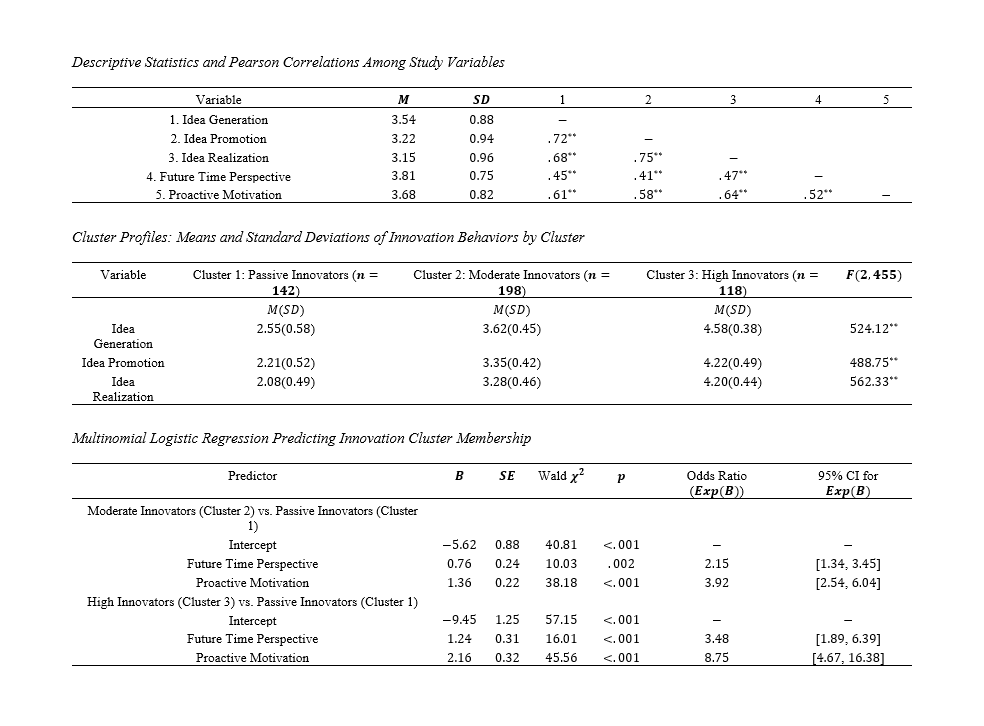
Objective: This study aimed to identify distinct profiles of employee innovation behaviors using unsupervised machine learning and to evaluate the predictive roles of future time perspective and proactive motivation in determining membership within these empirically derived behavioral clusters.
Methods and Materials: A quantitative, cross-sectional design was utilized to collect data from a purposive sample of professionals employed in various knowledge-intensive sectors across Spain. Participants completed validated self-report questionnaires assessing three core dimensions of innovation behavior (idea generation, idea promotion, and idea realization), alongside measures of future time perspective and proactive motivation. The analytical framework employed a K-means clustering algorithm to partition the multidimensional innovation scores into distinct profiles, followed by multinomial logistic regression models to evaluate the predictive capacity of the psychological variables in determining cluster categorization.
Findings: The K-means clustering analysis ( ) successfully identified three distinct behavioral profiles: “Passive Innovators” ( , ), “Moderate Innovators” ( , ), and “High Innovators” ( , ). The multinomial logistic regression model demonstrated robust predictive power (Nagelkerke ). A one-unit increase in future time perspective significantly increased the odds of an individual belonging to the High Innovators cluster rather than the Passive Innovators cluster ( , ). Furthermore, proactive motivation emerged as an exceptionally strong differentiator; a one-unit increase in proactive motivation drastically elevated the likelihood of being classified as a High Innovator compared to the passive reference group ( , ).
Conclusion: Fostering a future-oriented mindset and cultivating intrinsic proactive motivation are critical psychological catalysts for transforming passive employees into highly engaged innovators capable of driving ideas from initial conception to full realization.
Downloads
References
Alrifae, A. A. M. (2025). The Impact of Digital Human Resource Management on Employee Innovation Behavior: The Mediating Role of Organizational Learning in the ICT Sector in the Middle East. Problems and Perspectives in Management, 23(4), 100-111. https://doi.org/10.21511/ppm.23(4).2025.08
Bagheri, A., & Akbari, M. (2018). The impact of entrepreneurial leadership on nurses' innovation behavior. Journal of Nursing Scholarship, 50(1), 28-35. https://doi.org/10.1111/jnu.12354
Chen, X., & Ma, L. (2025). Research on the Relationship Between Shared Leadership and Employee's Deviant Innovation Behavior. Academic Journal of Management and Social Sciences, 12(3), 65-68. https://doi.org/10.54097/rvr47m60
Du, S., & Wang, J. (2022). The Employee Relationship Analysis on Innovation Behavior of New Ventures Under the Organizational Psychology and Culture. Frontiers in psychology, 13. https://doi.org/10.3389/fpsyg.2022.804316
Han, Z., Lu, J., Chen, Y., Gu, Y.-Y., & Zheng, Z. (2024). A Game Study on the Impact of Employees’ Deviant Innovation Behaviors on Firms’ Organizational Innovation Performance. Frontiers in Physics, 12. https://doi.org/10.3389/fphy.2024.1364550
Hernawati, M. (2024). The Influence of Cultural Intelligence on Sustainable Innovation Behavior Mediated by Knowledge Sharing and Moderate by Organization Culture. Journal of Social Research, 3(2). https://doi.org/10.55324/josr.v3i2.1925
Isa, E. S. A. I., & Muafi, M. (2022). Human Capital, Organizational Learning and Their Effects on Innovation Behavior and Performance of Banking Employees. International Journal of Finance & Banking Studies, 11(1), 1-18. https://doi.org/10.20525/ijfbs.v11i1.1533
Li, X., Huang, Y., Li, J., Liu, X., He, J., & Dai, J. (2022). The mechanism of influencing green technology innovation behavior: evidence from Chinese construction enterprises. Buildings, 12(2). https://doi.org/10.3390/buildings12020237
Liu, C., & Niu, T. (2020). Like-Minded Cooperators—The Research on the Relationship Between the CEO Transformational Leadership and the Innovation Behavior of Designer. Journal of Service Science and Management, 13(03), 567-593. https://doi.org/10.4236/jssm.2020.133037
Markus, S., Taegoo Terry, K., Soyon, P., & Gyehee, L. (2018). Motivate to innovate: How authentic and transformational leaders influence employees' psychological capital and service innovation behavior. International Journal of Contemporary Hospitality Management, 30(2), 776-796. https://doi.org/10.1108/IJCHM-05-2016-0282
Mei-rong, Z., Cao, J., & Wang, M. (2022). How Does Goal Orientation Affect Employees’ Innovation Behavior: Data From China. Frontiers in psychology, 13. https://doi.org/10.3389/fpsyg.2022.890062
Mertiningsih, S., Legiman, L., & Haris, S. (2024). The Role of Organizational Competence and Commitment on Employee Performance with Innovation Behavior as an Intervening Variable: Study at the Pemalang Regency Fisheries Service. Proceeding of the International Conference on Business and Economics,
Rasheed, M. I., Hameed, Z., Kaur, P., & Dhir, A. (2024). Too sleepy to be innovative? Ethical leadership and employee service innovation behavior: a dual-path model moderated by sleep quality. Human Relations, 77(6), 739-767. https://doi.org/10.1177/00187267231163040
Shaalan, L. A. A. B., Elsaid, A. M., & Aboul-Ela, G. M. B. E. (2022). Knowledge management processes and strategic human resources management: Creating competitive advantage through employee innovation behavior. The Business & Management Review, 13(2), 237-245. https://doi.org/10.24052/BMR/V13NU02/ART-21
Wang, H., Yang, C., Meng, M., & Zeng, Y. (2022). Research on the Initiative Scientific Research and Innovation Behavior of Postgraduates: Based on the Theory of Planned Behavior. Frontiers in psychology, 13. https://doi.org/10.3389/fpsyg.2022.839981
Xie, G., & Fang, S. (2020). Research on the Mechanism of the Effect of Employment Model on Employees’ Innovation Behavior: Proposal of Conceptual Model. Open Journal of Business and Management, 08(04), 1375-1403. https://doi.org/10.4236/ojbm.2020.84088
Xing, Y., & Li, Y. (2022). How Does Workplace Ostracism Affect Employee Innovation Behavior: An Analysis of Chain Mediating Effect. Frontiers in psychology. https://doi.org/10.3389/fpsyg.2022.920914
Xu, B., Gao, X., Cai, W., & Jiang, L. (2022). How Environmental Leadership Boosts Employees’ Green Innovation Behavior? A Moderated Mediation Model. Frontiers in psychology, 12. https://doi.org/10.3389/fpsyg.2021.689671
Yang, L., & Liu, H. (2022). The Impact of Ethical Leadership on Employees’ Green Innovation Behavior: A Mediating-Moderating Model. Frontiers in psychology, 13. https://doi.org/10.3389/fpsyg.2022.951861
Yang, S., & Wu, H. (2021). The Performance Impact of New Ventures in Working Environment and Innovation Behavior From the Perspective of Personality Psychology. Frontiers in psychology, 12. https://doi.org/10.3389/fpsyg.2021.734014
Yin, M., Jiang, S., & Niu, X. (2024). Can AI really help? The double-edged sword effect of AI assistant on employees' innovation behavior. Computers in human Behavior, 150, 107987. https://doi.org/10.1016/j.chb.2023.107987
You, S. W., & Park, J. H. (2024). The Impact of the High Commitment HRM System on Employees' Innovation Behavior: The Mediating Role of Acceptance of Organizational Change and the Moderating Role of HRM System Strength. The Academic Society of Global Business Administration, 21(1), 56-85. https://doi.org/10.38115/asgba.2024.21.1.56
Yu, X. M. X. (2021). Intrinsic Motivation, Knowledge Sharing and Innovation Behavior of Knowledge-Based Employees in the Industrial New Generation. Converter, 75-87. https://doi.org/10.17762/converter.38
Zhang, H., Li, X., & Li, Y. (2023). The Impact of Authentic Leadership on Employee Innovation Behavior and Work Engagement in Specialized, Fined, Peculiar and Innovative SMEs. Open Journal of Business and Management, 11(01), 238-259. https://doi.org/10.4236/ojbm.2023.111014
Zhu, Y., & Tsai, K.-C. (2024). A Study on the Impact of Perceived Leadership Member Exchange on Innovation Behavior by University Lectures. Environment and Social Psychology, 9(9). https://doi.org/10.59429/esp.v9i9.3044
Downloads
Additional Files
Publication Timeline
- Submitted
- Revised
- Accepted