Validation of the Indigenous Good Governance Model with a Social Justice Approach in the Plan and Budget Organization of the Country
Keywords:
Good governance, Iran’s administrative system, social justice, Plan and Budget Organization of the CountryAbstract
Objective: The present study aimed to validate an indigenous good governance model with a social justice approach in the Plan and Budget Organization of the Country using Structural Equation Modeling (SEM).
Methods and Materials: This study was applied in terms of objective and exploratory–explanatory in terms of nature and was conducted using a correlational design with a path analysis approach. The statistical population consisted of managers, senior experts, and decision-makers working in the Plan and Budget Organization of the Country who were selected through stratified random sampling. Data were collected using a researcher-developed questionnaire designed based on the dimensions of good governance and social justice. Content validity was confirmed by expert evaluation, while construct validity was examined through Confirmatory Factor Analysis (CFA). Reliability was assessed using Cronbach’s alpha coefficient and Composite Reliability (CR). Data analysis was conducted using Structural Equation Modeling (SEM) and Partial Least Squares (PLS) techniques to evaluate the measurement and structural models and to test the causal relationships among the research variables.
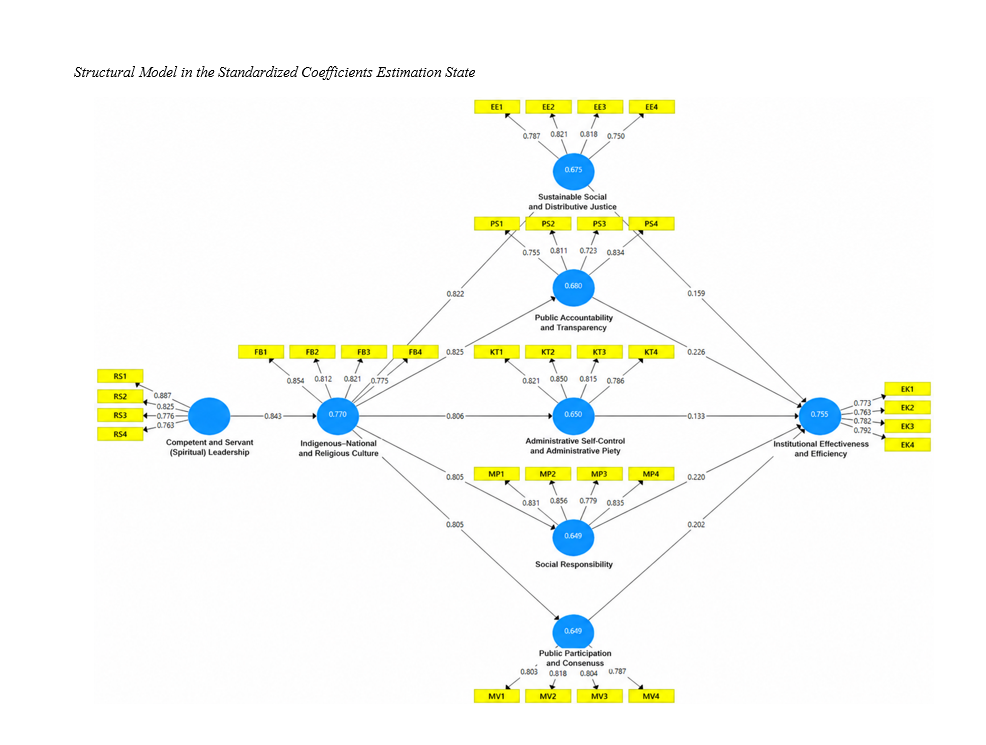
Findings: The findings indicated that all constructs demonstrated acceptable reliability and validity, as Cronbach’s alpha and Composite Reliability values exceeded 0.70 and the Average Variance Extracted (AVE) values were greater than 0.50. The overall Goodness of Fit (GOF) index of 0.663 confirmed the strong fit of the proposed model. Structural path analysis showed that competent and servant leadership had a significant positive effect on indigenous–national and religious culture (β = 0.843, p < 0.001), while indigenous culture significantly influenced sustainable social and distributive justice (β = 0.822, p < 0.001). Furthermore, social justice significantly affected institutional effectiveness and efficiency (β = 0.159, p < 0.001). The findings also confirmed the significant roles of accountability and transparency, administrative self-control, social responsibility, and public participation in strengthening governance effectiveness and justice-oriented institutional performance.
Conclusion: The results demonstrated that good governance in Iran’s administrative system is a multidimensional and value-oriented phenomenon closely associated with social justice and institutional legitimacy.
Downloads
References
Ajaj, R., Buniya, M. K., Wuni, I. Y., & Yousif, O. S. (2025). A Structural Equation Model of the Critical Success Factors for Sustainable Smart Cities: A Case Study of Abu Dhabi. Journal of Urban Management, 14(3), 843-855. https://doi.org/10.1016/j.jum.2025.02.008
Al-Mamary, Y. H., Alshallaqi, M., & Abubakar, A. A. (2025). A Comprehensive Conceptual Model of Digital Transformation in Public Services: Exploring Key Factors and Their Impact on Government Success. Future Business Journal, 11, 193. https://doi.org/10.1186/s43093-025-00621-8
Andrews, M., Pritchett, L., & Woolcock, M. (2020). Building State Capability: Evidence, Analysis, Action. Oxford University Press.
Ayeneh Nama, S. (2022). Investigating the relationship between the quality of urban services and civic culture: A case study of citizens aged 20 to 64 in Gilan-e Gharb County Payame Noor University of West Azerbaijan Province, Boukan Center].
Azimi, M., & Afshari, M. (2025). The place of citizenship education in urban development plans: A case study of development plans for the Herandi neighborhood of Tehran. Urban Studies Quarterly, 14(55), 77-90.
Booth, D. (2020). Politically Smart, Locally Led Development (ODI Working Paper, Issue.
Bruce, J., North, C., & FitzPatrick, J. (2019). Preservice teachers' views of global citizenship and implications for global citizenship education. Globalisation, Societies and Education, 1-16. https://doi.org/10.1080/14767724.2018.1558049
Caballero, F. D. (2023). Information and communication technology through global [digital] citizenship education.
Forati, H. (2025). Presenting a Model of Good Governance in Iran with a Focus on Employed Women and Gender Justice. Public Organizations Management, 13(4), 165-180. https://doi.org/10.30473/ipom.2025.72814.5070
Gholami, H. (2022). The role of municipal environmental advertising in the civic culture of the people of Isfahan Daneshpazhoohan Institute of Higher Education].
Grindle, M. S. (2017). Good Governance, R.I.P.: A Critique and an Alternative. Governance, 30(1), 17-22. https://doi.org/10.1111/gove.12223
Hien, N. T. T., Hai, P. H., Bui, T. T. T., & Tuan, D. A. (2025). Structural Equation Modeling of Factors Affecting Accountability-Based Accounting in Public Sector Entities. Emerging Science Journal, 9(4), 2162-2178. https://doi.org/10.28991/ESJ-2025-09-04-023
Hosseinpour, S., Vaezi, R., & Pourezzat, A. A. (2023). Administrative Reform and Governance Challenges in Iran's Public Sector. Journal of Public Administration Research, 15(2), 45-68.
Houser, N. O. (2023). The value of a personal philosophy of citizenship education. The Social Studies, 114(2), 59-66. https://doi.org/10.1080/00377996.2022.2084011
Joris, M., Simons, M., & Agirdag, O. (2022). Citizenship-as-competence, what else? Why European citizenship education policy threatens to fall short of its aims. European Educational Research Journal, 21(3), 484-503. https://doi.org/10.1177/1474904121989470
Kaufmann, D., Kraay, A., & Mastruzzi, M. (2022). The Worldwide Governance Indicators: Methodology and Analytical Issues (World Bank Policy Research Working Paper, Issue.
Kester, K. (2023). Global citizenship education and peace education: Toward a postcritical praxis. Educational Philosophy and Theory, 55(1), 45-56. https://doi.org/10.1080/00131857.2022.2040483
Khair, Q. (2013). Factors contributing to quality of training and effecting employee job satisfaction. The Business & Management Review, 3(4), 61-74.
Khatmi, S., Zamani, S. G., & Salehi, H. (2026). Good Governance in International Instruments: A Legal Approach to State Transparency and Accountability. Legal Studies in Digital Age, 1-10. https://jlsda.com/index.php/lsda/article/view/292
Oecd. (2021). Principles on Good Governance and Public Integrity. https://doi.org/10.1787/5c6dcdaf-en
Osborne, S. P. (2018). From Public Service-Dominant Logic to Public Service Logic: Are Public Service Organizations Capable of Co-Production and Value Co-Creation? Public Management Review, 20(2), 225-231. https://doi.org/10.1080/14719037.2017.1350461
Rawls, J. (1999). A Theory of Justice (Revised edition ed.). Harvard University Press.
Rothstein, B. (2018). Just Institutions Matter: The Moral and Political Logic of the Universal Welfare State. Cambridge University Press.
Rothstein, B., & Teorell, J. (2019). Getting to Sweden, Part II: Breaking with Corruption in the Nineteenth Century. Scandinavian Political Studies, 42(3-4), 238-254. https://doi.org/10.1111/1467-9477.12143
Salehi, M., & Karimi, H. (2020). Bureaucratic Inefficiency and Governance Deficits in Iran's Administrative System. International Journal of Public Administration, 43(10), 865-878. https://doi.org/10.1080/01900692.2019.1658772
Schiller, H. I. (2022). The privatization and transnationalization of culture. In Cultural Politics in Contemporary America (pp. 317-332). Routledge. https://doi.org/10.4324/9781003326427-27
Sincer, I., Severiens, S., & Volman, M. (2019). Teaching diversity in citizenship education: Context-related teacher understandings and practices. Teaching and Teacher Education, 78, 183-192. https://doi.org/10.1016/j.tate.2018.11.015
Sukma, N., & Yamnill, S. (2025). A New Public Management Model for Open Data Collaboration in Sustainable Digital Insurance Ecosystems. Frontiers in Political Science, 7, 1598403. https://doi.org/10.3389/fpos.2025.1598403
Tarahani, M. (2023). The educational status of citizenship rights in textbooks Shahid Chamran University of Ahvaz, Faculty of Economics and Social Sciences].
Toleikiene, R., Butkus, M., Bartuseviciene, I., & Jukneviciene, V. (2025). Assessing Digital Governance Maturity in the Context of Municipal Resilience: The Triadic Model, Its Dimensions and Interrelations. Administrative Sciences, 15(11), 435. https://doi.org/10.3390/admsci15110435
Tuhuteru, L., Ausat, A. M. A., Pratiwi, E. Y. R., & Suherlan, S. (2023). The role of civic education in promoting diversity and tolerance in schools. Edumaspul: Jurnal Pendidikan, 7(1), 275-280.

Downloads
Additional Files
Published
Submitted
Revised
Accepted
Issue
Section
How to Cite