XGBoost-Based Prediction of Innovative Work Behavior Using Organizational Climate and Leadership Variables
DOI:
https://doi.org/10.61838/kman.ijimob.5416Keywords:
Innovative Work Behavior, XGBoost, Machine Learning, Organizational Climate, Transformational Leadership, Leadership Variables, Innovation ClimateAbstract
Objective: The present study aimed to develop and evaluate an XGBoost-based machine learning model for predicting innovative work behavior using organizational climate and leadership variables among employees working in Indonesian organizations.
Methods and Materials: This study employed a cross-sectional predictive research design involving 1,248 employees from multiple Indonesian organizations representing manufacturing, information technology, telecommunications, financial services, and public administration sectors. Data were collected using standardized measures of innovative work behavior, organizational climate, and leadership. Demographic and occupational variables were also included as supplementary predictors. Data preprocessing procedures included missing-value treatment, standardization, and quality screening. The dataset was divided into training (80%) and testing (20%) subsets. Extreme Gradient Boosting (XGBoost) was utilized to develop the predictive model, while hyperparameter optimization was performed using five-fold cross-validation and grid-search procedures. Model performance was evaluated using the coefficient of determination (R²), root mean square error (RMSE), mean absolute error (MAE), and mean absolute percentage error (MAPE). SHapley Additive exPlanations (SHAP) analysis was applied to identify and interpret the relative importance of predictor variables.
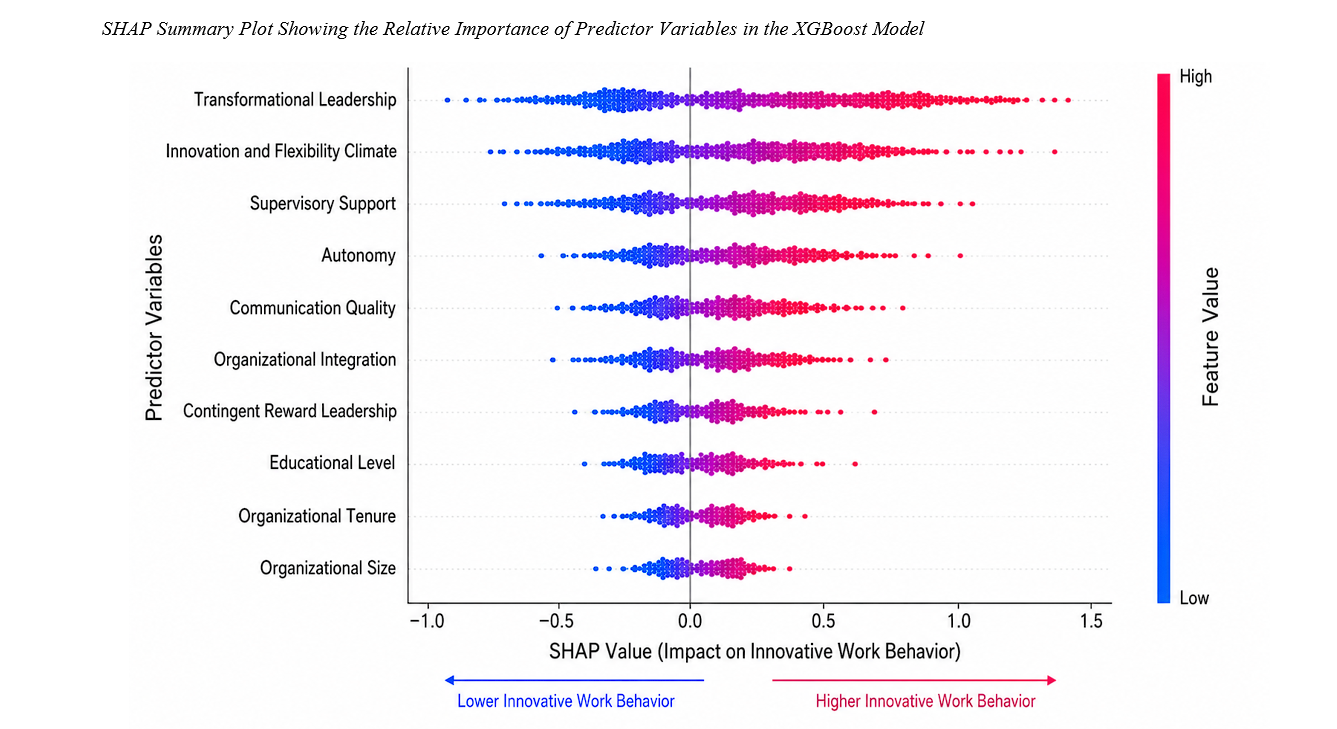
Findings: Inferential analyses revealed significant positive correlations between innovative work behavior and organizational climate (r = .71, p < .01), transformational leadership (r = .68, p < .01), transactional leadership (r = .41, p < .01), and organizational tenure (r = .19, p < .01). The XGBoost model demonstrated strong predictive performance, explaining 88.7% of the variance in innovative work behavior in the training dataset and 84.2% in the testing dataset (R² = .842). The model achieved low prediction errors, with testing RMSE = 0.287, MAE = 0.223, and MAPE = 7.46%, indicating excellent predictive accuracy and generalizability. SHAP analysis identified transformational leadership as the most influential predictor, followed by innovation and flexibility climate, supervisory support, autonomy, communication quality, organizational integration, contingent reward leadership, educational level, organizational tenure, and organizational size. The results demonstrated that leadership and organizational climate variables accounted for the majority of predictive power within the model.
Conclusion: The findings demonstrate that innovative work behavior can be predicted with high accuracy using organizational climate and leadership variables. Transformational leadership and innovation-supportive organizational climates emerged as the most influential determinants of employee innovation. The study highlights the value of explainable machine learning techniques for organizational research and provides evidence that leadership development and innovation-oriented workplace environments represent critical levers for enhancing innovative work behavior.
Downloads
References
Ağaoğlu, F. O., Baş, M., Tarsuslu, S., & Ekinci, L. O. (2025). Serial Mediating Role of Transformational Leadership and Perception of Artificial Intelligence Use in the Effect of Employee Happiness on Innovative Work Behaviour in Nurses. BMC Nursing, 24(1). https://doi.org/10.1186/s12912-025-02776-9
Akıncı, G., Alpkan, L., Yıldız, B., & Karaçay, G. (2022). The Link Between Ambidextrous Leadership and Innovative Work Behavior in a Military Organization: The Moderating Role of Climate for Innovation. Sustainability, 14(22), 15315. https://doi.org/10.3390/su142215315
Arham, A. F., Abdul, S. A., & Ahmad, H. M. (2024). Towards Malaysia MADANI: Do Leadership Styles Influence Innovative Work Behavior? a Conceptual Framework for the Malaysian Public Sector. Information Management and Business Review, 16(3S(I)a), 707-718. https://doi.org/10.22610/imbr.v16i3s(i)a.4233
Aristana, I. N., Wibawa, I. W. S., & Wisnawa, I. M. B. (2024). Psychological Empowerment Exploration on Innovative Work Behavior: The Role of Transformational Leadership as Mediator. Jurnal Manajemen Bisnis, 15(1), 77-98. https://doi.org/10.18196/mb.v15i1.20274
Baig, L. D., Azeem, M. F., & Paracha, A. (2022). Cultivating Innovative Work Behavior of Nurses Through Diversity Climate: The Mediating Role of Job Crafting. Sage Open Nursing, 8. https://doi.org/10.1177/23779608221095432
Bhatnagar, A., & Aggarwal, G. (2022). Impact of Inclusive Leadership on Variables Affecting Employee Performance: A Review of Empirical Papers. International Journal of Research in Human Resource Management, 4(1), 13-24. https://doi.org/10.33545/26633213.2022.v4.i1a.83
Contreras, F., Espinosa, J. C., & Dornberger, U. (2022). Innovational Leadership: A New Construct and Validation of a Scale to Measure It. Estudios Gerenciales, 151-160. https://doi.org/10.18046/j.estger.2022.163.4763
Ebrahim, Z. B., Ismail, I., & Kassim, E. S. (2023). A Conceptual Review of the Determinants of Employee Innovative Work Behavior. Information Management and Business Review, 15(4(SI)I), 239-257. https://doi.org/10.22610/imbr.v15i4(si)i.3598
Elsayed, E., Gaber, M. A., & Mohamed, W. (2022). Innovative Work Behavior and Its Relation to Knowledge Sharing Among Nurses at Zagazig University Hospitals. Zagazig Nursing Journal, 18(2), 273-290. https://doi.org/10.21608/znj.2022.296448
Ezeaku, O. T. C., Ebeh, R. E., & Sydney-Agbor, N. (2024). Abusive Supervision and Employee Participation in Decision Making as Moderators of Subordinate Silence and Innovative Work Behaviour Among Civil Servants in Southeast Nigeria. https://doi.org/10.21203/rs.3.rs-4442491/v1
Handoko, Y., & Anjaningrum, W. D. (2024). The Smart Effort to Build Up an Innovative Organizational Culture in a Skincare Company. Jurnal Siasat Bisnis, 37-55. https://doi.org/10.20885/jsb.vol28.iss1.art3
Helmy, I., Azizah, S. N., Purnomo, J., & Fitriani, N. (2023). The Effect of Transformational Leadership on Innovative Work Behavior in SMEs: Test of a Mediating Model. Journal of International Conference Proceedings, 6(1), 153-164. https://doi.org/10.32535/jicp.v6i1.2245
Husen, S. H. S. (2024). The Role of Leadership in Promoting Innovation Within Organizations in Public Sector. Journal of Global Social Sciences, 5(20), 20-42. https://doi.org/10.58934/jgss.v5i20.296
Indrayanti, I., & Ulfia, N. (2022). Authentic Leadership and Innovative Work Behavior Through Organizational Culture: A Study in Indonesian State-Owned Enterprises. F1000research, 11, 1243. https://doi.org/10.12688/f1000research.126559.1
Junbish, R. K., Nayel, A. N., & Zadran, H. G. (2023). The Impact of Transformational Leadership on Innovative Work Behavior: Mediating Role of Intrinsic Motivation. Kardan Journal of Economics and Manangement Sciences. https://doi.org/10.31841/kjems.2023.135
Li, W., Gill, S. A., Wang, Y., Safdar, M. A., & Sheikh, M. R. (2022). Proactive Personality and Innovative Work Behavior: Through the Juxtapose of Schumpeter's Theory of Innovation and Broaden-and-Build Theory. Frontiers in psychology, 13. https://doi.org/10.3389/fpsyg.2022.927458
Listyanti, I. N., & Hendarman, A. F. (2023). Knowledge Sharing Behavior, Team Climate, and Organizational Learning Culture as Predictors of Innovative Work Behavior. International Journal of Management Entrepreneurship Social Sciences and Humanities, 7(1), 34-49. https://doi.org/10.31098/ijmesh.v7i1.1564
Logacheva, E. Y., & Plakhotnik, M. S. (2021). The Impact of Humor Climate on Innovative Work Behavior: Evidence From the Banking Industry in Russia. Industrial and Commercial Training, 53(3), 237-249. https://doi.org/10.1108/ict-10-2020-0107
Marwan, M., & Alhadar, F. M. (2024). Effects of HR Management Practices on Employee Innovative Work Behavior With Two Mediation. Jurnal Manajemen, 28(2), 247-271. https://doi.org/10.24912/jm.v28i2.1796
Modliba, R., Fischer, S. B., Treffers, T., & Welpe, I. M. (2024). Translating Leader–member Exchange to Innovative Work Behaviour: The Role of Creative Self‐efficacy and Team Support for Innovation. Creativity and Innovation Management, 33(4), 671-684. https://doi.org/10.1111/caim.12613
Muhammad Jahanzeb Khan Saima, A. (2021). Organizational and Individual’s Factors as a Predictors of Innovative Work Behaviour Among Software Engineers. Pakistan Journal of Educational Research, 4(4). https://doi.org/10.52337/pjer.v4i4.371
Musenze, I. A., Mayende, T. S., Wanyana, M., & Kasango, J. (2024). Servant Leadership and Innovative Work Behavior: The Role of Innovation Climate Using Evidence From the Ugandan Local Government Sector. Journal of Management Development, 43(6), 896-919. https://doi.org/10.1108/jmd-10-2023-0316
Özdaşlı, K., Ceyhan, S., & Yildirim, D. (2023). The Effect of Organi̇zational Culture on Innovative Work Behavior: The Mediator Role of Trust in Managers. Mehmet Akif Ersoy Üniversitesi İktisadi Ve İdari Bilimler Fakültesi Dergisi, 10(2), 1479-1500. https://doi.org/10.30798/makuiibf.1249986
Phairat, P., Kim‐Lim, T., Ting, H., Soonsan, N., & Tanticharatwarodom, P. (2026). Driving Idea Exploration to Implementation: The Role of Transformational Leadership in Fostering Innovative Work Behavior. Global Business and Organizational Excellence, 45(5), 545-559. https://doi.org/10.1002/joe.70034
Soukupová, N., & Stříteská, M. (2024). The Significance of Responsible Leadership for Innovative Work Behaviour: A Conceptual Framework. European Conference on Management Leadership and Governance, 20(1), 554-561. https://doi.org/10.34190/ecmlg.20.1.2940
Srirahayu, D. P., Ekowati, D., & Sridadi, A. R. (2023). Innovative Work Behavior in Public Organizations: A Systematic Literature Review. Heliyon, 9(2), e13557. https://doi.org/10.1016/j.heliyon.2023.e13557
Usmanova, K., Wang, D., Sumarliah, E., Khan, S. Z., Khan, S. U., & Younas, A. (2021). Spiritual Leadership as a Pathway Toward Innovative Work Behavior via Knowledge Sharing Self-Efficacy: Moderating Role of Innovation Climate. VINE Journal of Information and Knowledge Management Systems, 53(6), 1250-1270. https://doi.org/10.1108/vjikms-04-2021-0054
Veloso, A., Roque, H., Ferreira, A. T., & Gomes, J. F. (2021). Psychometric Characteristics of an Adapted Measure of Innovative Behavior at Work. Review of Business Management, 141-152. https://doi.org/10.7819/rbgn.v23i1.4093
Vu, G. T. H., Nguyen, D. T., & Le, T. P. (2025). Transformational Leadership and Innovative Work Behaviors: The Mediating Effects of Psychological Empowerment and Work Engagement. Sage Open, 15(2). https://doi.org/10.1177/21582440251335464
Wijaya, N. H. S. (2024). Extending the Transformational Leadership-Innovative Work Behavior Relationship: Integrating Climate for Innovation and Dissimilarities in Dyad Relational Demography. Journal of Leadership & Organizational Studies, 32(1), 34-48. https://doi.org/10.1177/15480518241301237
Xu, Z., & Suntrayuth, S. (2022). Innovative Work Behavior in High-Tech Enterprises: Chain Intermediary Effect of Psychological Safety and Knowledge Sharing. Frontiers in psychology, 13. https://doi.org/10.3389/fpsyg.2022.1017121
Xu, Z., Yang, F., Yuan, Y., & Dan, J. (2023). Perceived Innovation-Oriented Human Resource System and Innovative Work Behavior: The Chain Mediating Role of Innovative Culture and Intrinsic Motivation. Journal of managerial psychology, 38(6), 434-448. https://doi.org/10.1108/jmp-10-2021-0538
Downloads
Additional Files
Publication Timeline
- Submitted
- Revised
- Accepted