Designing an Appropriate Model of Managers’ Decision-Making Styles by Considering Managers’ Spiritual Intelligence and Employees’ Organizational Citizenship Behavior
DOI:
https://doi.org/10.61838/Keywords:
Decision-Making Styles, Spiritual Intelligence, Organizational Citizenship Behavior, ManagersAbstract
Objective: The present study aimed to design and test an appropriate model of managers’ decision-making styles based on managers’ spiritual intelligence and employees’ organizational citizenship behavior among managers and employees of Islamic Azad University in Sistan and Baluchestan Province.
Methods and Materials: This study was conducted using an applied, descriptive-correlational design with a structural equation modeling approach. The statistical population included all managers and employees of Islamic Azad University in Sistan and Baluchestan Province during the 2020–2021 academic year. Sampling was performed using a stratified sampling method. Based on Cochran’s formula, 146 employees were selected from among 300 employees and 57 managers were selected from among 70 managers, resulting in a total sample of 203 participants. Data were collected using the General Decision-Making Style Questionnaire, the Spiritual Intelligence Self-Report Inventory, and the Organizational Citizenship Behavior Questionnaire. The reliability and validity of the instruments were confirmed through Cronbach’s alpha coefficients, composite reliability, and confirmatory factor analysis. Data analysis was conducted using descriptive statistics, Pearson correlation analysis, and structural equation modeling through SPSS and AMOS software.
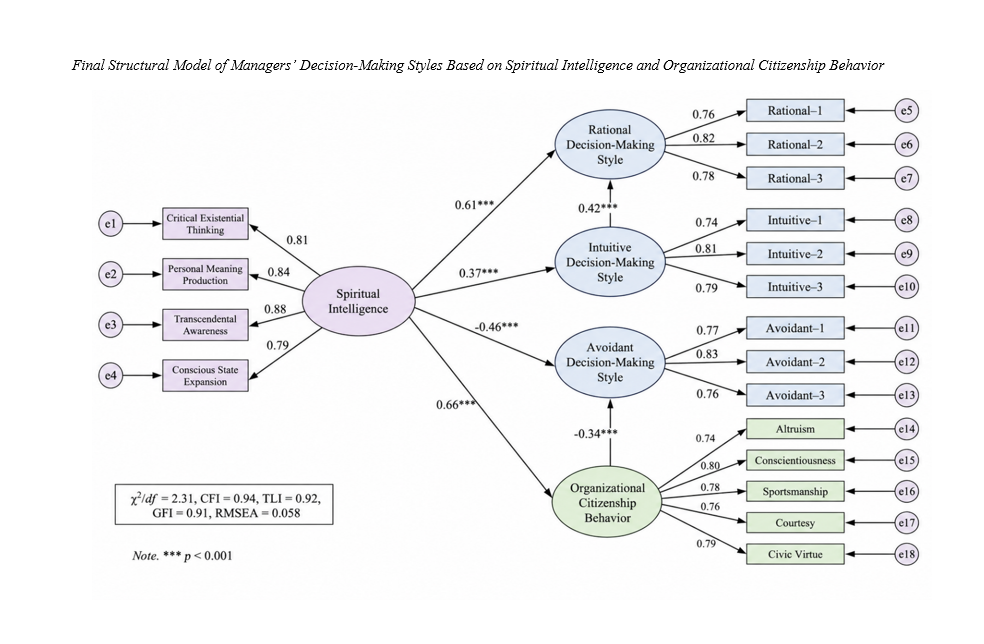
Findings: The results demonstrated that spiritual intelligence had a significant positive effect on rational decision-making style (β = 0.61, p = 0.001) and intuitive decision-making style (β = 0.37, p = 0.001), while it had a significant negative effect on avoidant decision-making style (β = -0.46, p = 0.001). Organizational citizenship behavior also positively influenced rational decision-making style (β = 0.42, p = 0.001) and negatively affected avoidant decision-making style (β = -0.34, p = 0.001). Furthermore, spiritual intelligence significantly predicted organizational citizenship behavior (β = 0.66, p = 0.001).
Conclusion: The findings of the present study indicated that spiritual intelligence and organizational citizenship behavior play substantial roles in shaping managers’ decision-making styles within higher education institutions.
Downloads
References
Abdallah, S. A., & Mostafa, S. (2021). Effects of Toxic Leadership on Intensive Care Units Staff Nurses’ Emotional Intelligence and Their Organizational Citizenship Behaviors. Tanta Scientific Nursing Journal, 22(3), 211-240. https://doi.org/10.21608/tsnj.2021.196635
Ahmed, Z. S., & Asim, M. (2023). Dart Emotional Spiritual Quotient (DESQ) Impact on Employee Performance and Role of Training Module (TM-DESQ): A Public Enterprise Perspective for Islamic Republic of Pakistan. Journal of Entrepreneurship Management and Innovation, 5(4), 580-600. https://doi.org/10.52633/jemi.v5i4.336
Alfiana, N. I., Haryono, S., & Nuryakin, N. (2022). Antecedents and Consequences of Organizational Citizenship Behavior in the Covid-19 Pandemic Era. Journal of Business Management Review, 3(7), 419-436. https://doi.org/10.47153/jbmr37.4082022
Ali, H. M., Shohib, M., & Ibrahim, M. B. (2021). Validating a Model of OCBIP Practices in Indonesian Islamic Higher Education Institutions: A Structural Equation Modeling Approach. IIUM Journal of Educational Studies, 9(2), 64-88. https://doi.org/10.31436/ijes.v9i2.317
Eisenberg, A., Davidova, J., Ignatjeva, S., & Michaelsson, A. R. (2021). Assessing the Interrelations Between Organizational Learning Culture and Organizational Citizenship Behavior in the Public Sector. Tiltai, 80(2), 85-98. https://doi.org/10.15181/tbb.v79i2.1779
Flórez-Jiménez, M. P., & Lleó-de-Nalda, A. (2023). PURPOSE TRENDS REPORT. A Selection of What Has Been Published About Purpose in December 2022. https://doi.org/10.15581/025.2022.0012
Göker, S. D. (2021). A Closer Look at Organizational Culture in Action. https://doi.org/10.5772/intechopen.77624
Hakim, A. F. L., & Pristika, A. Y. (2020). The Influence of Organizational Citizenship Behavior, Continuance Commitment, Emotional Intelligence, and Spirituality on Performance. https://doi.org/10.2991/aebmr.k.200127.016
Hasan, D. C., Sudiarditha, I. K. R., Wibowo, Hakim, L., & Susita, D. (2024). Analysis of Determinants Factors Affecting Organizational Citizenship Behaviour in Post-Merger Sharia Banks. Revista De Gestão Social E Ambiental, 18(9), e06592. https://doi.org/10.24857/rgsa.v18n9-079
Hurriyati, R., Ana, A., Ismail, A., Sulastri, S., & Lisnawati, L. (2023). Increasing Lecturer Performance Through Organizational Citizenship. 1551-1557. https://doi.org/10.2991/978-94-6463-234-7_163
Ida Ayu Putu Widani, S., Mahayasa, I. G. A., Yasa, I. K. D., & Pratama, I. G. A. A. E. B. (2021). Improving Employee Performance Through Spiritual Intelligence and Organizational Citizenship Behavior. Timor Leste Journal of Business and Management, 3, 26-33. https://doi.org/10.51703/bm.v3i2.52
Ifani, N. N., & Kartiwi, A. P. (2024). Leadership in Indonesian Islamic Schools: How Leader Spiritual and Motivational Styles Affect Organizational Citizenship Behavior and Employees' Religiosity. Nidhomul Haq Jurnal Manajemen Pendidikan Islam, 9(1), 67-78. https://doi.org/10.31538/ndh.v9i1.4559
Jena, L. K. (2021). Does Workplace Spirituality Lead to Raising Employee Performance? The Role of Citizenship Behavior and Emotional Intelligence. International Journal of Organizational Analysis, 30(6), 1309-1334. https://doi.org/10.1108/ijoa-06-2020-2279
Karaca, M. (2020). The Influence of Transformational Leadership in Organizations: The Mediating Role of Meaningful Work. Journal of Economy Culture and Society, 0(61), 153-172. https://doi.org/10.26650/jecs2019-0028
Kurşunmaden, F. İ., & Bedük, A. (2023). A Bibliometric Analysis of the Studies in 2019 and 2020 on Positive Organizational Behavior. Journal of Business & Finance in Emerging Markets, 6(1), 13-22. https://doi.org/10.32770/jbfem.vol613-22
Lestari, I. D., Hardhienata, S., & Sunaryo, W. (2024). Enhancing Teacher Organizational Citizenship Behavior in Junior High School of Depok City. Pijed, 3(2), 27-34. https://doi.org/10.59175/pijed.v3i2.290
Masrum, M., Akob, M., & Jumady, E. (2025). The Role of Organizational Commitment in Mediating the Effect of Knowledge Sharing and Competence on Organizational Citizenship Behavior. Golden Ratio of Human Resource Management, 5(1), 251-265. https://doi.org/10.52970/grhrm.v5i1.865
Murdiono, J., & Suparno, S. (2023). Spiritual Leadership and Organizational Citizenship Behavior as Factors Influencing Employee Performance:A Literature Review. International Journal of Scientific Multidisciplinary Research, 1(10), 1337-1350. https://doi.org/10.55927/ijsmr.v1i10.6953
Muttaqiean, F., Cahyaningati, R., & Meilan, R. (2023). Implementation of Management Strategies to Improve Employee Performance at Rural Banks in East Java. Wiga Jurnal Penelitian Ilmu Ekonomi, 13(2), 257-271. https://doi.org/10.30741/wiga.v13i2.1105
Navis, M. W., Widiastuti, N. P. E., & Sumardjo, M. (2020). Factors Affecting Organizational Citizenship Behavior on the Environment of Community Organizations in Indonesia. Jurnal Aplikasi Manajemen, 18(3), 449-460. https://doi.org/10.21776/ub.jam.2020.018.03.05
Noermijati, N., Firdaus, E. Z., Sulastri, S., & Farhiya, D. (2024). Can Employee Turnover Intention Be Minimized Through Job Satisfaction, Organizational Citizenship Behavior and Organizational Commitment? Jurnal Aplikasi Manajemen, 22(1). https://doi.org/10.21776/ub.jam.2024.022.01.18
Oktarisa, F., Zulaifah, E., & Budiharto, S. (2024). Quranic Work Ethic Aspects Than Can Increase Organizational Citizenship Behavior: An Intervention on Syari’ah Hotel Employees. https://doi.org/10.4108/eai.4-11-2023.2344830
Omoankhanlen, J. A., & Issa, T. E. (2021). Impression Management and Organizational Citizenship Behaviour of Hotels in Rivers State, Nigeria. European Journal of Business Management and Research, 6(6), 278-285. https://doi.org/10.24018/ejbmr.2021.6.6.878
Putra, J. P., & Khan, R. B. F. (2023). The Impact of Organizational Citizenship Behavior Based Spiritual Leadership on Job Satisfaction. Jurnal Ilmiah Manajemen Ekonomi & Akuntansi (Mea), 7(3), 1176-1191. https://doi.org/10.31955/mea.v7i3.3526
Qasemi, H. R., & Shahkarami, F. (2024). Structural Empowerment, Job Involvement, and Performance: The Mediating Role of Psychological Empowerment. Journal of Accounting Business and Finance Research, 19(1), 1-9. https://doi.org/10.55217/102.v19i1.788
Radiany, A., & Radiany, A. A. (2021). Mediation Effects Organizational Citizenship Behavior Between Emotional and Spiritual Intelligence on Lecturer Performance at the College Economics. Ilomata International Journal of Management, 2(2), 72-81. https://doi.org/10.52728/ijjm.v2i2.218
Riadi, F., Riani, D., Sunarsi, D., & Munna, A. S. (2025). Islamic work ethics-based organizational citizenship behavior to improve the job satisfaction and organizational commitment of higher education lecturers in Indonesia. International Journal of Educational Administration, Management, and Leadership, 1(1), 17-28.
Rosyid, B., Agustina, T. S., & Sridadi, A. R. (2024). Organizational Commitment and Workplace Spirituality as Moderation of Organization Citizenship Behavior (OCB) and Spiritual on Employee Performance on SDG. JLSDGR, 4(2), e01805. https://doi.org/10.47172/2965-730x.sdgsreview.v4.n02.pe01805
Santa, R., Moros, A., Morante, D., Rodríguez, D., & Scavarda, A. (2023). The Impact of Emotional Intelligence on Operational Effectiveness: The Mediating Role of Organizational Citizenship Behavior and Leadership. PLoS One, 18(8), e0284752. https://doi.org/10.1371/journal.pone.0284752
Sharifnia, A. M., Fernandez, R., Green, H., & Alananzeh, I. (2022). Spiritual Intelligence and Professional Nursing Practice: A Systematic Review and Meta-Analysis. International Journal of Nursing Studies Advances, 4, 100096. https://doi.org/10.1016/j.ijnsa.2022.100096
Sulphey, M. M., & Jasim, K. M. (2025). Perceived Anomie, Organizational Silence, Compulsory Organization Citizenship Behavior, and Workplace Alienation as Antecedents of Knowledge Hiding. Knowledge and Process Management. https://doi.org/10.1002/kpm.70001
Sutaata, M. P. B., Karimah, A., & Hasanati, N. (2024). Exploring Factors Influencing OCB in Early Adulthood: A Systematic Review. International Journal of Research Publication and Reviews, 5(5), 13039-13044. https://doi.org/10.55248/gengpi.5.0524.1455
Tuyen Buia, Q., Anh Doa, V. P., Ly Tranb, L., & Nguyen, P. M. (2025). Examining the Relationship between Corporate Social Responsibility, Organizational Citizenship Behavior and Job Satisfaction: Evidence from Vietnamese Manufacturing Firms in the Digital Age. Procedia Computer Science, 253, 717-726. https://doi.org/10.1016/j.procs.2025.01.133
Vasconcelos, A. F. (2023). Corporate Social Responsibility, Corporate Citizenship, and Spiritism Doctrine: Examining the Common Linkages. Revista Pensamento Contemporâneo Em Administração, 17(2), 35-62. https://doi.org/10.12712/rpca.v17i2.59121
Wea, D., Fakhruddin, F., Sukestiyarno, Y. L., & Prihatin, T. (2020). Antecedent and Consequent of Altruistic Professional Behavior of Catholic Religious Education (CRE) Teachers in South Papua. https://doi.org/10.4108/eai.29-6-2019.2290134
Wu, S.-M. (2024). Emotional Intelligence and Workplace Spirituality in Predicting Career Success of High-Tech Leaders. Behavioral Sciences, 14(11), 1009. https://doi.org/10.3390/bs14111009
Zacharias, T. (2022). Spiritual Intelligence and Emotional Intelligence on Employee Performance: Analysis of Organizational Citizenship Behavior as a Mediating Variable. Jurnal Konseling dan Pendidikan, 10(2), 199. https://doi.org/10.29210/180700
Downloads
Additional Files
Publication Timeline
- Submitted
- Revised
- Accepted